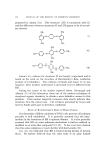
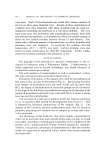
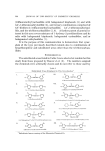
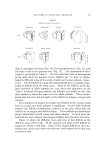
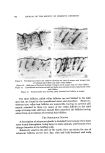
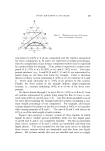
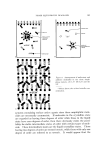
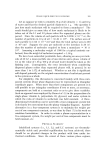
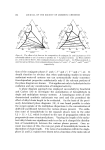
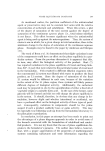
192 JOURNAL OF THE SOCIETY OF COSMETIC CHEMISTS agent used, the nonaqueous additive is solubilized within, or possibly upon, the micelies. It is profitable from a mechanistic point of view to consider the micelles as a pseudophase dispersed in a continuous aqueous phase, the latter containing unaggregated surfactant molecules at a con- centration equal to the critical micelle concentration. When a third com- ponent is added to an aqueous solution of the surface active agent, it is distributed between the micelles and the continuous aqueous phase. The phase boundary of the L1 region simply reflects the point at which both the micelles and the continuous aqueous phase become saturated with additive. It is generally held that, at this•point, the concentration of additive in the aqueous phase equals the water solubility of the addi- tive in the absence of surfactant. The remainder is therefore solubi- lized within the micelies. This situation is depicted in Fig. 4A which shows a spherical, Hartley-type, micelle. It seems highly probable that, at relatively high surfactant concentrations, the L1 micelle be- comes asymmetric. However, the principle of distribution illustrated in Fig. 4A remains unchanged. The specific location of the additive will depend on its polar-nonpolar balance in relation to that of the sur- factant (3). Predominantly nonpolar additives will be located in the center of the micelle more polar species will be positioned toward the periphery of tF•e micelie. Molecules that are essentially polar are thought to be adsorbed onto the surface of the micelle. While less effort has been directed to studying the isotropic "oily" L2 phase region, evidence exists for the presence of micelles above a cer- tain surfactant concentration. The micelles in this phase are "reversed" when compared to those in an L1 phase and so provide an environment for the solubilization of normally lipid-insoluble materials such as water and other polar molecules. As in the L1 phase region, the phase bound- ary denotes the saturation limit of both the micellar pseudophase and the continuous phase with respect to additive. The situation is depicted in Fig. 4B. The third single phase of interest is the anisotropic liquid crystalline phase, LC. Here the surfactant molecules are highly oriented and this results in such phases possessing optical properties associated with crys- talline materials. However, the degree of restriction is less than in the crystalline state, and so LC phases also possess flow properties com- parable to those of viscous liquids. Thus, LC phases exhibit birefrin- gence under polarized light yet flow under an applied stress. The prop- erty of liquid crystallinity is possessed only by molecules with a high degree of asymmetry consequently, such phases invariably appear in

PHASE E•}UILIBRIUM DIAGRAMS 193 MICELLE WITH •ater • • • SURFACTANT A • ••i • SURFACTANT O "oe•i• "' ¸ WATE. % i water' • A Figure 4. Arrangement of surfactant -• • additive molecules in the three single(C)and phase regions, (A) LI*, (B) L2*, and LC * When above the critical micelle con- t centration. systems containing surface active agents since these amphiphilie mole- cules are necessarily asymmetric. If molecules in the crystalline state are regarded as having three degrees of order while those in the liquid state have zero degrees of order, then there obviously exists the possi- bility for stable intermediate states of order with certain types of mole- cule. These intermediate states are the liquid crystalline states. Those having two degrees of order are termed srnectic, while those with only one degree of order are referred to as nematic. It would appear that the
Purchased for the exclusive use of nofirst nolast (unknown)
From: SCC Media Library & Resource Center (library.scconline.org)