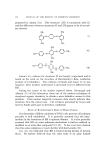
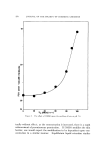
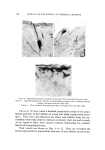
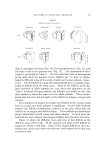
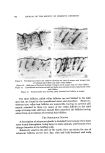
BANDROWSKI'S BASE 143 within the fiber. His conclusions were based on the fact that he was able to extract BB from the fiber with hot pyridine without appreciably altering the depth of color of the fiber. He also isolated a material which he claimed to be "an azine combined with the protein of the fur" after decomposition of the fiber. Unfortunately, Cox's work was con- ducted with copper-mordanted rabbit fur. Any influence by copper on the reactions between hydrogen peroxide and PPD has not been es- tablished. * On the other hand, Austin (10) presented cogent arguments for the fact that BB itsdf is responsible for the color of dyed hair. He showed that: (a) BB is known to form under conditions of oxidative hair dye- ing (b) hair can be dyed with an aqueous suspension of reduced BB at 100 øC and (c) hair can be dyed from a pyridine solution of BB. Austin also suggested that white hair, dyed rapidly by PPD and hydrogen peroxide, yields resistant reddish-brown dyes upon prolonged treatment with dilute hydrogen peroxide. From these findings he concluded that BB is the main colorant and that it can be further oxidized to an azine type of dye. This latter step, however, is due to over-oxidation and is undesirable. In a recent paper, Tucker (20) used the formation of BB as a measure of the amount of dye formation from PPD. He indicated that BB is the first stable product formed during the oxidation of PPD and implied that BB is at least a precursor of the dyes formed in hair. The study reported here was undertaken to shed some light on the question of whether BB is present in or on hair which has been dyed with PPD and hydrogen peroxide EXPERIMENTAL Bandrowski's Base--This substance was synthesized by the method of Ritter and Schmitz (7). Five grams of PPD (recrystallized from ben- zene) was dissolved in 375 ml of water, and 1.5 ml of 28% NH•OH was added (pH 9.5). To this solution was added 62.5 ml of 3% H202, and the resulting mixture was maintained for 24 hours at room temperature. About 1 g of fairly pure BB was removed by filtration. The solution yielded an equal quantity of less pure BB 24 hours later. The results of a synthesis under identical conditions and with the same quantities of * The synthesis of BB in the presence of Cu ++ by the technique described in the experi- mental section was attempted here. The reaction proceeded rapidly and yielded a variety of color bodies and considerable quantities of very impure BB.

144 JOURNAL OF THE SOCIETY OF COSMETIC CHEMISTS raw materials but in the presence of an added 10 g of resorcinol are described later. For purification, BB was dissolved quickly in hot pyridine and then precipitated by the slow addition of water (4). The determination of the molecular weight was considered necessary because no definitive evidence could be found in prior literature which would confirm the generally accepted formation of BB from three moles of PPD. The molecular weight was determined in boiling pyridine. The following analytical data were obtained: Melting point 236 øC Elemental analysis for C•sH•sN6 Calculated C 67.9% H 5.7% N 26.4% Found C 67.3% H 5.7% N 27.5% Molecular weight* Calculated 318 Found 339 Dyeing of Hair--White, natural hair obtained from S. Kalinsky & Sont was extracted overnight in a Soxhlet extractor, first with chloro- form and then with methanol. Bundles of hair, weighing from 0.3- 0.5 g, were dyed with a 0.5% solution of PPD (adjusted to pH 9.5 with ammonia) which was mixed with an equal volume of 6% H202 just before use. The hair was saturated with the mixture, drained for a few seconds, and allowed to react on a watch glass for 30 minutes. The swatches of hair were then rinsed with tap water, shampooed five times with a deter- gent shampoo, rinsed well with distilled water, and finally dried at ambi- ent temperature. Removal of Dye from Hair--After dyeing, the swatches of hair were then treated by one of the following methods: 1. Freshly dyed hair swatches were soaked in about 50 ml each of methanol, ethanol, or pyridine for 1-7 days at 45 øC. 2. Freshly dyed hair swatches were extracted in a Soxhlet extractor with about 200 ml of the above solvents and with dimethyl formamide and dimethyl sulfoxide. 3. Freshly dyed or extracted hair swatches were decomposed with about 100-125 ml of 0.1N NaOH. Detection of Bandrowski's Base--Evidence for the presence of BB was sought by thin-layer chromatography. The above extracts were chroma- * Determined by Schwarzkopf Microanalytical Laboratory, 56-19 37th Avenue, Woodside, N.Y. 11377. • 110 West 17th Street, New York, N.Y.
Purchased for the exclusive use of nofirst nolast (unknown)
From: SCC Media Library & Resource Center (library.scconline.org)