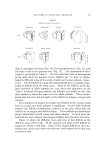
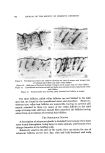
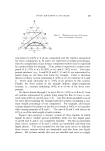
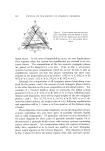
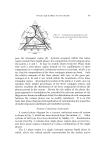
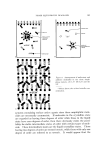
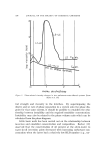
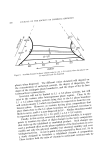
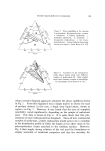
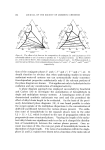
194 JOURNAL OF THE SOCIETY OF COSMETIC CHEMISTS liquid crystalline phases observed in systems containing surfactants are all smectic. Figure 4C illustrates the molecular arrangement within a smectic LC phase. In any one bimolecular unit (or leaflet), the "crys- talline" state exists in the depth (normal to the plane of the paper) and the breadth of each unit. The structure as a whole is "liquid" in the third plane (height) between the individual leaflets and so flow can occur between adjacent layers. The situation has been well-compared to the spreading of a pack of playing cards on a flat surface. The additive will be distributed between the surfactant molecules forming the bimolecular leaflet and the intervening water layers in a manner analogous to that in the L1 phase system. The structure of the fourth single-phase region, solid (S), requires no comment other than that the crystalline state exists in all three dimen- sions (i.e., there are three degrees of order). From a consideration of Fig. $ it is apparent that a variety of multi- phase regions are possible. These arise from combinations of the four single-phase regions discussed above. Strictly speaking, the phase dia- gram shows the phase equilibria and tie lines when the two or more con- jugate phases have been separated. Under these conditions the inter- facial area between the phases is at a minimum. When the interface is increased by dispersing one phase within the other, it is reasonable to suppose that adsorption of more surfactant molecules from the bulk to the interface will occur. As a result, some of the surfactant molecules in the bulk previously aggregated to form micelles will undergo "demicel- lization" and reform monomers which will be adsorbed at the interface. This will lead to a re-equilibration of all components within and between the various phases. This is supported by thermodynamic evidence, for the free energy change per methylene group on adsorption at the oil- water interface is -0.85 kcal mole-•(4). This process is obviously fa- vored over that for micellization where free energy changes per methy- lene group of the order of - 0.65 kcal mole -• have been observed for nine surfactants of different types (5). For example, consider a system in the L1 -3- L2 phase region which produces an oil-in-water emulsion on dispersion. The dispersed L2 phase will be stabilized by adsorption of surfactant at the oil-water (more correctly, L1 + L2) interface. When the formation of a relatively condensed monolayer is assumed, the number of surfactant molecules adsorbed will be a function of the degree of dispersion or mean particle size. Whether or not the resultant change in the composition and amount of the L1 and L2 phases is signif- icant will depend on the magnitude of the above. The following hypo- thetical example should serve to illustrate this point.

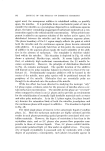
PHASE EQUILIBRIUM DIAGRAMS 195 Let us suppose we wish to emulsify 5{) g of oil (density = 1) and 50 g of water and that the desired particle diameter is 1 /•. The question is just how much surfactant will be required to form a monolayer ? The result should give us some idea of how much surfactant is likely to be taken out of the L1 and L2 phases when the separated phases are dis- persed. Since the volume of each particle will be 0.5236 X 10 -•2 cc, the number of particles in 50 g of oil = 95.49 X 10 •2. The surface area of each particle is 3.142 X 10 -s cm 2 and thus the total surface area is 300 X 104 cm 2. Suppose the area per molecule at the interface is 30 A 2, then the number of molecules required to form a monolayer = 10 X 102ø. Assuming a molecular weight of 1000 for a typical nonionic sur- factant, then the weight of surfactant required = 1.66 g. We have been somewhat pessimistic here, allowing an area per mole- cule of 30 A 2, a mean particle size of one micron and a phase volume of 0.5 so the value of 1.66 g/100 g of oil and water should be taken as the limiting case. Consequently, the error introduced when considering dispersed phases rather than separated phases will, in general, be no more than 1 to 1.5% of surfactant. Whether or not this is significant will depend primarily on the original concentration of surfactant present in the system as a whole. For simplicity, this discussion is concerned mainly with three-com- ponent systems whose phase diagrams may be represented on triangular coordinate paper. When more than three components are present it is still possible to use triangular coordinates if two or more, as necessary, components are held at a constant ratio so as to give three variables. Such an approach was employed by Boon et al. (6) in the preparation of a single-phase vitamin A, polysorbate 80, glycerol, and water system in which the ratio of vitamin to surfactant was held constant. A three- dimensional tetrahedron can be used with a four-component system but is obviously less convenient than the planar triangular diagram. Another alternative in a four-component system is to maintain the weight per cent of one component constant, as was done by Burt (7) in his work on emulsion formulation. In order to retain a planar representation in a five-component system, the weight per cent of two components must be held constant, etc. PHYSICAL STABILITY Solubilized systems (i.e., L1, L2, and LC systems) are thermody- namically stable and, provided equilibration has been achieved, there should be no physical changes in the product with time under iso- thermal conditions. Since the extent of these various phase regions,
Purchased for the exclusive use of nofirst nolast (unknown)
From: SCC Media Library & Resource Center (library.scconline.org)