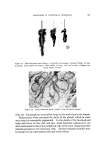
BALDNESS IN NONHUMAN PRIMATES 185 Hence, a sharp distinction between veilus and terminal hair follicles cannot be made on the basis of length alone. Also, the vellus follicles that develop from terminal ones during the process of baldness may still have wisps of arrectores pilorum muscles attached to them. Although the aging process in man causes a progressive degeneration of the follicles as well as of the bodily organs in general, baldness in young men (as in the stump-tailed macaques) can be attributed only to the transformation described here. Now that we have an experimental animal model for the study of alopecia, we may look forward to some progress in our understanding of this interesting biological phenomenon. (Received May 19, 1967) REFERENCES (1) Hamilton, J. B., Age, sex, and genetic factors in the regulation of hair growth in man: a comparison of Caucasian and Japanese populations, The Biology of ]]air Growth (Montagna, W., and Ellis, R., eds.), Academic Press, New York and London, 1958, pp. 400-432. (2) Kligman, A.M., Pathologic dynamics of human hair loss. I. Telogen effluvium, Arch. Dermatol., 83, 175-198 (1961). (3) Uno, H., Allegra, F., Adachi, K., and Montagna, W., Studies of common baldness of the stump-tailed macaque. I. Distribution of the hair follicles. J. Invest. Dermatol., (In press). (4) Montagna, W., Machida, H., and Perkins, E., The skin of primates. XXVIII. The stump-tailed macaque (Macaca speciosa), Am. J. Phys. Anthrop., 24, 71-86 (1966). (5) Montagna, W., Giacometti, L., and Machida, H., Histology and cytochemistry of human skin. XXXI. Aging changes in the cholinesterase-containing nerves of the scalp, J. Geron., 20, 401-404 (1965). (6) Noback, C. R., Morphology and phylogeny of hair, Ann. N.Y. Acad. Sci., 53,476-492 (1951). (7) Danforth, C. H., Physiology of human hair, Physiol. Rev., 19, 94-111 (1939). (8) Montagna, W., and Ellis, R. A., eds., The Biology of Hair Growth, Academic Press, Inc., New York, 1958. (9) Ellis, R. A., Aging of the human male scalp, The Biology of Hair Growth, (Montagna W., and Ellis, R., eds), Academic Press, New York, 1958, pp 469-485. (10) Giaeometti, L., The anatomy of the human scalp, Advances in the Biology of Skin, VI. .4ging (Montagna, W., ed.), Pergamon Press, Oxford, England, 1965, pp. 97-120.

J. Soc. Cosmetic Chemists, 19, 187-9(19 (Mar. 4, 1968) Phase Equilibrium Diagrams: An Approach to the Formulation of Solubilized and Emulsified Systems JAMES SWARBRICK, B.Pharm. (London), Ph.D., A.R.I.C., M.P.S.* Presented May •2, 1967, New York City Synopsis--Phase equilibrium diagrams offer a convenient method for expressing the phase equilibria of ternary systems of the type common to solubilized and emulsified systems. The underlying principles of these diagrams are presented, together with a discussion of their application in the rational formulation of solubilized and emulsified products. Particular emphasis is placed on the relationship between distribution of the components of the system within and between the phases present and the physical stability, chemical stability, and biological activity of the final product. INTRODUCTION The successful formulation of solubilized and emulsified systems occupies the attention of workers in the cosmetic, pharmaceutical, and veterinary fields. Frequently, the investigator may become puzzled by the apparent complexity of the changes in the several properties of both types of system as the basic three components for either system, namely surfactant, water, and oil, are varied with respect to one another. It is the purpose of this paper to rationalize certain of these changes in terms of the phase equilibria likely to exist in these ternary, and more complex systems. By acquiring an understanding of the relationships between the physical, chemical, and biological properties of such systems and the existing phase equilibria, the formulator will then be able to employ a * School of Pharmacy, The University of Connecticut, Storrs, Conn. 06268. 187
Purchased for the exclusive use of nofirst nolast (unknown)
From: SCC Media Library & Resource Center (library.scconline.org)