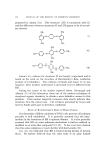
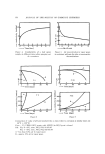
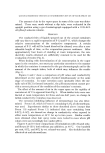
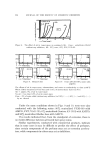
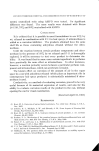
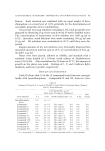
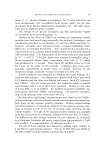
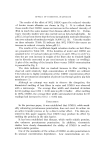
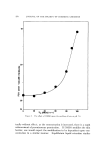
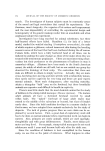
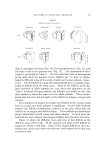
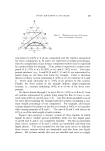
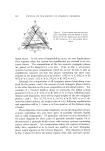
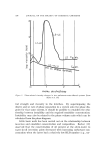
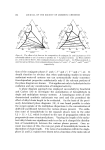
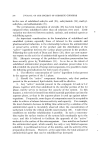
204 JOURNAL OF THE SOCIETY OF COSMETIC CHEMISTS x• ½ 40 I*L2*LC ½ 80 60 40 20 80 60 40 20 water a " water b Figure 9. The effect of tie lines on the composition of conjugate L1 and L2 phases as oil is continually added to an L1 system to produce L1 -3- L2 phase systems. (a) When systems d, e, f lie on the tie line bc, then conjugate phases are always b and c. (b) When systems d, e, andf cut across tie lines, then conjugate phases change to b' and c •, b • and c •, and b • and c respectively. tion of the conjugate phases b' and c', b •' and c", b'" and c"', etc. It should therefore be obvious that when undertaking studies in ternary surfactant-water-oil systems one can systematically study concentra- tion-dependent properties satisfactorily only if the relevant portions of the phase diagram are known. This applies not only to hydrolysis but to oxidation and any consideration of biological activity. A phase diagram approach was employed successfully by Swarbrick and Carless (20) to investigate the autoxidation of benzaldehyde in single and multiphase ternary systems. A homologous series of well- characterized synthetic surfactants was used and this permitted the effect of alkyl chain length to be evaluated. On the basis of the previ- ously determined phase diagrams (19), it was found possible to relate the oxygen uptake of the multiphase dispersions to the concentration of aldehyde partitioned between the various phases present. The oxida- tion rates of benzaldehyde in the separate phases were in the order L2 L1 LC, which is related to the ease of propagation within the progressively more structured phases. Varying the length of the surfac- tant alkyl chain was significant only in so far as it changed the distribu- tion of benzaldehyde between the various phases present. Once ac- count was taken of this, the rate per gram of benzaldehyde became in- dependent of chain length. The rates of autoxidation within the single- phase L1 and LC regions were shown to be a function of the mole ratio of

PHASE EQUILIBRIUM DIAGRAMS 2O5 oxidant to surfactant within the micelie, the site of reaction. Later work (21, 22) supported these findings. When the oxidant is highly water-soluble (e.g., ascorbic acid), the addi- tion of surfactant to produce an L1 phase system might not be expected to exert any profound effect on the concentration of oxidant in the con- tinous aqueous phase. This is because of the relatively low partition coefficient in favor of the micellar pseudophase. However, in the ascor- bic acid-water-polysorbate 20 system, Nixon and Chawla (23) observed an increase in the rate of ascorbic acid oxidation over that in water alone, once sufficient surfactant was present to form micelies of the L1 type. This implies some distribution of the ascorbic acid into the micelles where the relatively high local concentration would facilitate reaction. As the surfactant concentration was increased further, a reduction in rate was observed which .correlated with increased viscosity. The authors appear to be in error in claiming the increased viscosity as being due to the formation of L2-type micelles since the surfactant used is strongly hydrophilic. Furthermore, no lipophilic additives were used. It would seem more reasonable to suppose that the viscosity increases were due to either an increased number of spherical micelles or a pro- gressive change in shape to the laminar type of L1 micelle which is thought to occur at high surfactant concentrations in these (L1) phases. BIOLOGICAL ACTIVITY The term "biological activity" is used here to include preservative and antibacterial activity in addition to the more commonly used definition concerning the production of a pharmacological response in animals. With regard to the latter, changes in biological activity of material in solubilized and emulsified systems most frequently result from changes in absorption. An example is the progressively higher blood levels of vitamin A which follow the oral administration of an oil solution, an emulsion, and a solubilized system containing the vitamin (24). In view of this relationship between the type of system (L2, L1 -+- L2, L1) and the biological activity or availability, one should be able to obtain a correlation between blood levels and phase equilibria of the ternary surfactant-water-vitamin system. Naturally, one would have to take account of dilution and electrolyte effects in the in vivo situation. While the absorption of vitamin A is promoted by solubilization, there are reports of other, normally well-absorbed, drugs exhibiting a de- creased absorption when solubilized. Such findings have been reported
Purchased for the exclusive use of nofirst nolast (unknown)
From: SCC Media Library & Resource Center (library.scconline.org)