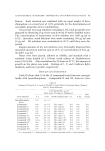
BANDROWSKI'S BASE 147 been solvent-extracted or with hair that was not shampooed after dyeing in no case were significant quantities of BB found. Attempts to Modify the Formation of Bandrowski's Base --It may be recalled that BB is generally isolated without difficulty whenever PPD is treated with alkaline H2Os. In contrast, little or no BB is found on hair after dyeing. The possibility remains that the protein interferes with the formation of BB. For this reason, preparation of BB was carried out in the presence of glycine at pH 8.7. Under these conditions, the initial yield of crude BB was 3.5 g, i.e., larger than the quantity isolated when the oxidation was conducted in the absence of glycine. The yield dropped slightly when the pH was raised to 9.5 or when 2.5 g of cystinc was substituted for the glycine. It was also determined that gelatin* did not influence the formation of BB. These experiments suggest that the presence of free amino acids or of a soluble protein does not interfere with formation of BB. One would reason, therefore, that the insoluble protein, hair, has no significant effect on the formation of BB. However further study of this problem would appear desirable since the model protein (gelatin)--in contrast to hair---contains almost no aromatic amino acids. In assessing the significance of these experiments for conventional hair dyeing practice, it must be remembered that in dyeing PPD is not used alone but, instead, is oxidized in the presence of "modifiers." In order to determine whether BB is formed during the oxidation of PPD in the presence of a typical modifier, this reaction was carried out in the presence of an excess of resorcinol. After completion of the reaction, there was no precipitate, and the solution yielded only a faint test for BB in the absence of resorcinol, this reaction should have yielded ap- proximately 0.7-1.0 g of BB (removable by simple filtration). This finding not only confirms that BB is not formed during standard hair dyeing but also yields some insight into the mechanism of the reactions taking place during hair dyeing. Apparently, PPD is oxidized to a reac- tive intermediate (quinone diimine ?) which in the presence of a modifier reacts preferentially with the modifier to form the hair dye but not with PPD to yield BB. CONCLUSIONS AND SUMMARY On the basis of the work described here, BB is not formed to any ap- preciable extent when hair is dyed by the hydrogen peroxide oxidation of PPD. The formation of BB by this oxidation is a slow process. Ac- cording to Tucker (20) only about 3r•o of PPD is converted to BB after * Pharmagel B, Kind and Knox Gelatin Co., Camden, N.J.

148 JOURNAL OF THE SOCIETY OF COSMETIC CHEMISTS 30 minutes in the presence of alkaline hydrogen peroxide. This is the average period required for in vivo hair dyeing and the period of hair treatment adopted for this study. It is not surprising, therefore, that little or no BB was found in hair dyed by the technique described above. Cox (16) showed conclusively that BB is not the coloring species when Cu-mordanted fur is dyed for 24 hours in an alkaline oxidizing dye bath containing PPD. Thus, even if the time is long enough for large amounts of BB to form, this substance does not act as a dye. The authors suggest that BB cannot account for the color of hair dyed with PPD alone or in the presence of a reactive modifier, such as resorcinol. In all likelihood, BB is the end product of an undesirable side reaction during hair dyeing. (Received June 20, 1967) (1 (2) (3) (4) (5) (6) (7) (8) (9) (11) (12) (lB) (14) (15) (19) (20) REFERENCES Bandrowski, E., /•ber die Oxydation des Paraphenylendiamins und des Paramidophen- ols, Monatsh. Chem., 10,123-8 (1889). Idem., • ber die Oxydation des Paraphenylendiamins, Chem. Ber., 27,480-6 (1894). Erdmann, E., Oxydationsprodukte des p-Phenylendiamins, Ibid., 37, 2906-13 (1904). Heiduschka, A., and Goldstein, E., iYber das Oxydationsprodukt des Paraphenylen- diamins (Ursols)durch Wasserstoffsuperoxyd, Arch. Pharm., 25,584-625 (1916). Willstatter, R., and Mayer, E., f•ber Chinondiimid, Chem. Ber., 37, 1499-1507 (1904). Green, A. G., Quinonoid addition as the mechanism of dyestuff formation, J. Chem. Soc., 103,925-33 (1913). Ritter, J. J., and Schmitz, G. H., The constitution of Bandrowski's Base, J. Am. Chem. Soc., 51, 1587-9 (1929). Lauer, W. M., and Sunde, C. J., The structure and mechanism of formation of the Bandrowski Base, J. Org. Chem., 3,261-4 (1938). Sunde, C. J., and Lauer, W. M., Structure of the Bandrowski Base. II. N,N'-bis (2,5-diaminophenyl)-p-quinonediimine, Ibid., 17, 609-12 (1952). Austin, W. E., Fur dyes and their oxidation products, J. Soc. Dyers Colourists, 72, 574-6 (1956). Greenough, R. C., and Altman, M., manuscript in preparation. Forster, R. B., and Soyka, C., Fur dyes: Their oxidation and identification on the fiber, J. Soc. Dyers Colourists, 47, 99-109 (1931). Cox, H. E., The chemical examination of furs in relation to dermatitis. II, Analyst, 58, 738-48 (1933). Idem., Hair dyes. iL The functions and reactions of phenols, Ibid., 65, 393-8 (1940). Cox, H. E., and Lewin, J. U., The chemical examination of furs in relation to dermatitis. V. Ibid., 60,350-5 (1934). Cox, H. E., The chemical examination of furs in relation to dermatitis. IV, Ibid., 59 3-11 (1934). Ginzel, A., Die Chemic der Pelzfarbstoffe, Melliand Textilber., 29,384-5 (1948). Sidi, E., and Zviak, C., Probldmes Capillaires, Gauthier-Villars, Paris, 1966. Markland, W. R., Hair Preparations, in Kirk-Othmer, Encyclopedia of Chemical Tech- nology, 10, 795, Enterscience, Nexv York, N.Y., 1966. Tucker, H.H., Hair coloring with oxidation dye intermediates, •. Soc. Cosmetic Chem- ists, 18, 609-28, (1967).
Purchased for the exclusive use of nofirst nolast (unknown)
From: SCC Media Library & Resource Center (library.scconline.org)