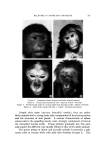
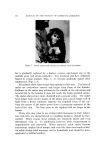
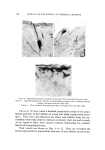
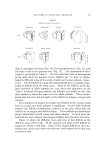
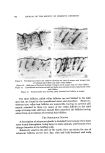
J. Soc. Cosmetic Chemists, 19, 173-185 (Mar. 4, 1968) Baldness in Nonhuman Primates* WILLIAM MONTAGNA, Ph.D., and HIDEO UNO, M.D.t Presented May 2, 1967, New York City Synopsis--Long believed to be a disorder peculiar to the scalp of man, alopecia occurs in some of the other pritnates. Even discounting the oddities of hair growth patterns in the head of some marmosets, sakis and sakiwinkis from South America, all adult species of uacaris are completely bald. A close look at the head of these animals shows that the bald scalp is covered with short hairs of small diameter. An identical situation occurs in the stump-tailed macaque (Macaca speciosa) the scalp of young stump-tails is covered with hair down to the eyebrows. Beginning in adolescence, the forehead becomes gradually "naked" and adult animals have a high, apparently glabrous forehead. Actually, the number of very small hairs on these bald areas is the same as in the haired comparable areas of young animals. The population of hair follicles, then, is not reduced in nu•nbers but the follicles are much smaller and produce very small hairs. With the diminution in size of the hair follicles, there is a substantial increase in the size of the accompanying sebaceous glands. Such a pattern of development of alopecia is identical with what takes place in some young adult men. Additional evidences of baldness occur in the orangutan, which, like the stump-tailed macaque, attains a naked forehead as it matures. Inspections of many chimpanzees of all ages also reveal varying degrees of alopecia in a triangle of forehead just above the brows this appears in adolescent animals and becomes prominent only in some adult animals. These observations point out that human alopecia has some phylogenetic significance and is not to be considered a disorder or disease. INTRODUCTION Despite the heroic methods used by some dermatologists in their study of alopecia in human subjects, many factors still limit their re- * Publication No. 257 from the Oregon Regional Primate Research Center supported in part by Grant FR 00163 of the National Institutes of Health and by funds from Grant AM 08445, Biology of the Skin of Man and Other Primates. Also supported in part by funds from Carter-Wallace, Inc., Cranbury, N.J. t Oregon Regional Primate Research Center, 505 N. W. 185th Ave., Beaverton, Ore. 97005 173

174 JOURNAL OF THE SOCIETY OF COSMETIC CHEMISTS search. The investigator of human subjects must be constantly aware of the moral and legal restrictions that curtail his experiments. Fur- thermore, man's longevity, the vagaries of his nature and temperament and the near-impossibility of controlling the experimental design and heterogeneity of his genetic makeup render him an unsuitable and often unpleasant subject for experiment. Investigators have long searched for animal substitutes, but these half-hearted efforts have failed. Hamilton (1), for lack of a better model, studied the wattled starling (Creatophora carunculata), the male of which acquires a glabrous, colored tumescent skin during the breeding season in areas of the head that had been leathered during the off season. Female birds, which have a fully feathered head at all times, can be induced to undergo the same changes as those of the males when they are treated with testosterone propionate. These are most interesting obser- vations but their pertinence to the phenomenon of baldness in man is somewhat oblique. Allusions have been made to the South American uacari, the adults of which are all bald, but no one outside our group has observed the histology of their scalp. The contention that these ani- mals are difficult to obtain is simply not true. Actually, the• are num- erous, but being slow-moving and slow-witted, with a melancholy nature, they rarely survive captivity for very long and hence are poor experi- mental animals. Most male chimpanzees, after reaching maturity, attain a triangular "bald" area on the forehead, but these formidable animals are expensive and difficult to handle in captivity. There is now little doubt that the most desirable animal for the study of baldness is the stump-tailed macaque (J/Iacaca speciosa). The mature adult animals all have a furrowed forehead covered by small vellus hairs. The "naked" forehead of large adult males may extend to the middle of the calvarium or beyond, but that of females rarely does. Since this bald condition develops in a manner similar to that in man, we have adopted these animals exclusively for the study of alopecia. The lack of greater progress than we now claim can be ex- plained by several factors. First, a great deal of exploratory work still has to be done on normal animals before experimental work can begin in earnest. Also, primates are costly animals, which are used sparingly, thoughtfully and with great deliberateness. Finally, most simian pri- mates are long-lived. For example, stump-tailed macaques do not reach adolescence until 5 years and become bald only after the sixth year. Since the condition of baldness is best exemplified in the human scalp, we use this as the point of reference. What happens in other
Purchased for the exclusive use of nofirst nolast (unknown)
From: SCC Media Library & Resource Center (library.scconline.org)