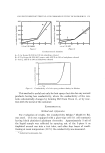
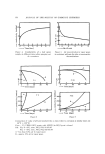
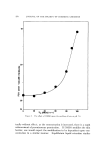
EFFECT OF DIMETHYL SULFOXIDE 171 (which corresponds to swelling) on hair keratin demonstrated this same type of DMSO concentration dependence. Thus, it has been possible to demonstrate that DMSO is capable of causing an expansion or unfolding of the protein chains in bovine serum albumin, beta lactoglobulin, and hair keratin. In addition, gross quali- tative observations suggest a similar action on skin. Although these substances may indeed be different from the complex substrate repre- senting the skin barrier (14, 15), there is every reason to suspect qualita- tive similarities in the action of DMSO upon keratin fibers and proteins in the skin. Whether the swelling action of DMSO is caused mainly by changes in environmental dielectric constant or binding phenomena or some combination of the two remains to be resolved. ACKNOWLEDGMENTS The authors wish to thank Edwin P. Aaron for his expert assistance with the viscosity studies and Miss Martha Elizabeth Yourshaw for her assistance with the other studies. Thanks are also due to Mrs. Barbara Galloway for her help in preparing these manuscripts. (Received June 13, 1967) (lO) REFERENCES (1) Elfbaum, S. G., and Laden, K., Mechanism of action of dimethyl sulfoxide, J. Soc. Cosmetic Chemists, 19• 119 (1958). (2) Rosenbaum, E. E., et al., Dimethyl sulfoxide in musculoskeletal disorders, .L Am. Med. Assoc., 192,109 (1965). (3) Kligman, A.M., Topical pharmacology and toxicology of dimethyl sulfoxide--Part 1, Ibid., 193,796 (1965). (4) Russell, T. J., and Winkehnann, R. K., Thermal shrinkage of human dermis (effect of dimethylsulfoxide), Arch. Dermatol., 94, 782 (1966). (5) Bradbury, J. H., and Chapman, G. V., The chemical composition of wool. I. The separation and microscopic characterization of components produced by ultrasonic disintegration, Australian .L Biol. Sci. 17,960 (1964). (6) Fritsch, W. C., and Stoughton, R. B., The effect of temperature and humidity on the penetration of C TM acetylsalicydic acid in excised human skin, .L Invest. Dermatol., 41, 307 (1963). (7) Vinson, L. J., et al., The nature of the epidermal barrier and some factors influencing skin permeability, Toxicol. Appl. Pharmacol., 7, 7 (1965). (8) Van Holde, K. E., and Sun, S. F., Bovine serum albumin in water-dioxane mixtures, J. Am. Chem. Soc., 84, 66 (1962). (9) Schachman, H. K., Ultracentrifugation, diffusion, and viscometry, in Methods in Enzymology Iv, Colowick, S. P., and Kaplan, N. O., Academic Press, N.Y., 1957, pp. 32-103. Cannon, M. R., et al., Viscosity measurement--the kinetic energy correction and a new viscometer, Anal. Chem., 32,355 (1960).

172 JOURNAL OF THE SOCIETY OF COSMETIC CHEMISTS (11) Valko, E. I., and Barnett, G., A study of the swelling of hair in mixed aqueous solvents (I), J. Soc. Cosmetic Chemists, 3,108 (1952). (12) Townend, R., et al., The molecular weight of beta-lactoglobulin, J. Am. Chem. Soc., 79, 3613 (1957). (13) Herskovits, T. T., et al., Molecular interactions in beta-lactoglobulin. IX. Optical rotatory dispersion of the genetic variants in different states of association, J. Am. Chem. Soc., 86, 4445 (1964). (14) Crounse, R. G., Keratin and the barrier, Arch. Environ. Health, 11,522 (1965). (15) Crounse, R. G., The association of lipids with keratinous proteins of human callus, J. Invest. Dermatol., 46,550 (1966).
Purchased for the exclusive use of nofirst nolast (unknown)
From: SCC Media Library & Resource Center (library.scconline.org)