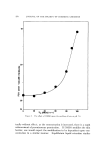
206 JOURNAL OF THE SOCIETY OF COSMETIC CHEMISTS in the case of solubilized salicylic acid (25), salicylamide (26), methyl- salicylate, and sulfanilamide (27). The percutaneous absorption of steroids (28) has been found to be enhanced when solubilized rather than oil solutions were used. Little variation was observed between anionic, cationic, and nonionic agents as solubilizing agents. An important consideration in the formulation of solubilized and emulsified systems, especially those of interest to the cosmetic and pharmaceutical industries, is the relationship between the antimicrobial or preservative activity of the product and the distribution of the "active" ingredient between the various phases present in the product. Following the early work of Bean and Berry (29), there are now numer- ous reports on the activity of antimicrobial agents in solubilized systems (30). Adequate coverage of the problem of emulsion preservation has been recently given by. Wedderburn (31). In so far as the intent of solubilized antimicrobial preparations and emulsion preservation is to kill or inhibit the growth of foreign microorganisms, it is possible to make the following generalizations for both types of system: 1. The effective concentration of "active" ingredient is that present in the aqueous portion of the L1 phase. 2. Should the "active" component dissociate, only that portion present in the un-ionized, lipid-soluble, form will be effective. 3. Any "active" material present in the conjugate L2 and/or LC phases, together with that solubilized in the micellar portion of the L1 phase, merely serves to increase the capacity of the system. In this manner, a reservoir is formed from which material partitions out into the aqueous phase, as that in the aqueous phase is used up against micro- organisms. Frequently, some degree of compromise must be accepted in order to achieve a balance between activity and capacity. For example, the most dramatic decrease in killing time achieved by a solution of the antimicrobial agent is invariably observed when the concentration of surfactant is below the critical micelle concentration (29). Under these conditions no micellar solubilization is possible. In such a concentra- tion region the surface tension of the system falls continually up to the c.m.c. and this is believed to facilitate the approach of the "active" molecule to the surface of the microorganism. Once micelles are formed the antimicrobial agent, which usually has only a very limited aqueous solubility, is partitioned in favor of the micelies, and the activity of the preparation decreases. However, at the same time, the total amount of antimicrobial agent that can be solubilized has increased.

PHASE EQUILIBRIUM DIAGRAMS 2O7 As mentioned earlier, the partition coefficient of the antimicrobial agent or preservative may not be constant but varies with the relative concentration of surfactant and solubilizate. When this occurs, a plot of the degree of saturation of the total system against the degree of saturation of the continuous aqueous phase (i.e., total minus miceliar) is not linear. This effect becomes significant when the antimicrobial agent is being used up against the microorganisms. Thus, the system of choice is one in which, for a given change in total saturation, there is the minimum change in the degree of saturation of the continuous aqueous phase. Examples may be found in the paper by Anderson and Morgan (17). The work of Boon et al. (6) demonstrated that slight variations in one of the components could have an effect on the phase equilibria in a par- ticular system. From the previous discussion it is apparent that this, in turn, may affect the biological activity of the product. Burt (7) has reported variations in the phase equilibria of Cresol and Soap Solu- tion, B.P. (Lysol) that were related to the particular isomer of eresol used in the formulation. This resulted in different dilution sequences when the concentrated L2 system was diluted with water to produce the finaI product, an L1 system. Since the degree of saturation of the final L1 system would be different in each ease, because of the variation in the extent of the L1 phase region, these systems will likely possess different degrees of biological activity. Additionally, the surfaetant used may be prepared in situ by the saponification of either a fixed oil of vegetable origin or a suitable fatty acid. In the ease of the former, some glycerin will be formed and this too will change the phase equilibria in in the system. It should, therefore, be obvious that any change in for- mulation, however slight and whether intentional or accidental, can have a profound effect on the biological activity of these types of prod- uct. Consequently, variations in components should be the prime suspect if such a product suddenly loses or gains activity. This may be especially true following scale-up from the formulation laboratory to the pilot plant or production. In conclusion, in this paper an attempt has been made to point out the advantages of a phase diagram approach in order to avoid some of the hazards associated with the formulation of solubilized and emulsi- fied products. It is not my thesis that the use of phase equilibrium dia- grams is the formulator's panacea. The author does believe, however, that, with a proper appreciation of the properties of multicomponent systems containing surfactants and some information regarding the
Purchased for the exclusive use of nofirst nolast (unknown)
From: SCC Media Library & Resource Center (library.scconline.org)