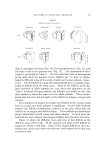
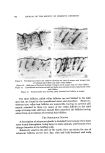
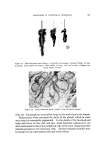
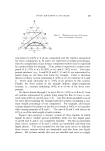
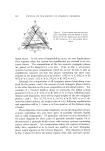
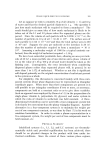
188 JOURNAL OF THE SOCIETY OF COSMETIC CHEMISTS more fundamental approach to the successful development to the de- sired solubilized or emulsified product. Obviously, because of the various uses to which each discipline puts its products, the specific com- ponents will vary somewhat. Nevertheless, the basic principles upon which this approach rests are common to all solubilized and emulsified systems of the type described in this paper. Solubilization may be defined as the phenomenon whereby substances that are otherwise insoluble in a given medium are brought into solution by incorporating them into, or upon, aggregates of colloidal dimensions, termed micelies. Substances that aggregate to form micelles in solution are necessarily amphiphilic in nature, that is, the molecule possesses two distinct regions having opposing solution tendencies. For a molecule to be amphiphilic it must also possess a certain degree of structural asym- metry. Molecules in which this property is well developed are com- monly referred to as surface active agents or surfactants. The phe- nomenon of micellar solubilization therefore has as a prerequisite the presence of amphiphilic molecules aggregated to form micelies. An emulsion is usually defined as a two-liquid phase dispersion of an oil and water, stabilized by the presence of an emulsifying agent. This discussion is limited to those emulsions in which the emulsifying agent is a surface active agent adsorbed as a monolayer at the interface between the aqueous and oil phases. As will become apparent later, this defini- tion of an emulsion in systems containing surfactant, oil, and water should be extended to include other systems produced by various com- binations of other phases. ]•HASE DIAGRAMS Before discussing specific systems, it is necessary to appreciate and understand some of the more relevant properties of triangular diagrams used to describe phase equilibria in ternary component systems. In order to represent ternary component systems in this manner, it is neces- sary to work under isothermal conditions and treat the system as con- densed, i.e., ignore the vapor phase. General Properties Triangular phase diagrams are based on the fact that, in an equi- lateral triangle (Fig. 1), the sum of the distances from a point rn drawn parallel to the three sides is always the same and equal to the length of any one side of the triangle. Consequently, if each side is used to repre-

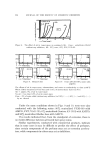
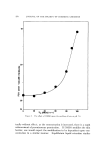
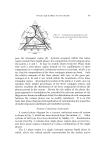
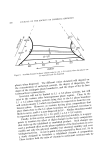
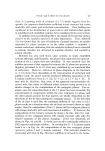
PHASE EQUILIBRIUM DIAGRAMS 189 Figure 1. Illustration of some of the prop- erties of triangular diagrams sent from 0 to 100% w/w of one component and the relative amounts of the three components A, B, and C are expressed as weight percentages, then the composition of any ternary component system can be expressed by a point within the triangle. Thus, point rn represents a system com- posed of A (70% w/w), B (20% w/w), and C (10% w/w). Two-com- ponent mixtures (e.g., A and B B and C C and A) are represented by points lying on the lines that form the triangle. Point n therefore denotes a binary system containing A (30% w/w) in a mixture of A and C. There must obviously be C (70% w/w) present in this system. Finally, the three points of the triangle indicate single-component systems, i.e., systems containing 100% w/w of one of the three com- ponents. If a line is drawn through C to meet AB at o (40% w/w B in A), then all systems represented by points lying along the line Co have a con- stant ratio of B to A (in this case, 2: 3). Any line drawn parallel to one of the three lines bounding the triangle indicates systems containing a con- stant weight percentage of one component. For example, all ternary systems depicted by points on the line po contain A (60% w/w) together with varying amounts of B and C. The sum of B and C will always be 40% w/w of the total weight of such systems. Figure 1 also portrays a ternary system of three liquids, in which liquids B and C exhibit partial miscibility while the two liquid pairs A and B and A and C are completely miscible. The line qu represents those binary systems of B and C which are immiscible and form two liquid phases. The area bounded by the line qrstu serves to indicate those ternary systems which are immiscible and also form two liquid phases. All systems outside this area are miscible and exist as a single
Purchased for the exclusive use of nofirst nolast (unknown)
From: SCC Media Library & Resource Center (library.scconline.org)