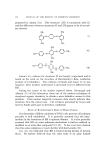
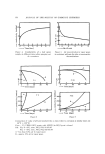
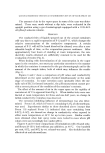
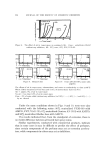
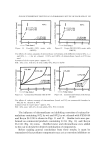
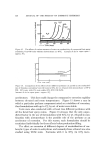
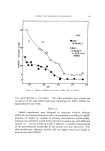
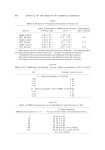
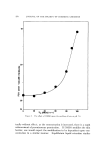
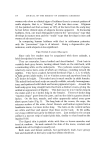
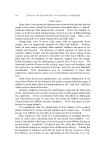
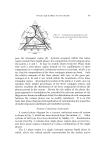
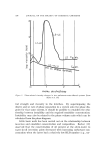
EFFECT OF DIMETHYL SULFOXIDE 169 The results of the effect of 30% DMSO upon the reduced viscosity of bovine serum albumin are shown in Fig. 1. It is evident from these results that DMSO causes an increase in the reduced viscosity of BSA in much the same manner that dioxane affects BSA (8). Prelim- inary viscosity studies were also carried out on beta-lactoglobulin. At pH 3.5, it has been shown that the beta-lactoglobulin molecule dissociates into two subunits of molecular weight 15,000 (12, 13). Viscosity studies on these subunits (Table II) indicate that 30% DMSO also causes an increase in reduced viscosity below pH 3.5. The results of the equilibrium liquid retention studies on hair fibers are presented in Table III. If the densities of water and DMSO are assumed to be 1.0 (actual values are 0.997 g/co and 1.099 g/co at 25 øC), then the per cent increase in weight of the fibers due to retained liquid can be directly converted to per cent increase in volume (or swelling). A plot of the swelling of the keratin fibers versus DMSO concentration is presented in Fig. 2. The data indicates that no marked increase in fiber swelling is observed until relatively high concentrations of DMSO are utilized. This behavior is highly reminiscent of the DMSO concentration effect upon the percutaneous absorption of pierate ion through guinea pig skin membranes (1). Although no attempt was made to observe the elongation, the diametrical swelling of hair fibers in water and DMSO was observed with a microscope. The average fiber width and standard deviation for 60 readings was 0.099 + 0.005 mm in pH 7.0 buffer. After swelling in 100% DMSO, the average fiber width and standard deviation for 60 readings had increased to 0.115 + 0.003 mm. DISCUSSION In the previous paper, it was established that DMSO, while mark- edly enhancing percutaneous penetration, does not exert its action via. an active transfer process or by a direct carrier effect. The data pre- sented in this paper suggests that DMSO may produce its effect by swelling the proteins in the skin barrier. It has been established that dioxane, which swells soluble proteins, also enhances percutaneous penetration. In addition, viscometric studies have clearly demonstrated the ability of DMSO to swell or unfold soluble proteins. One of the anomalies of the action of DMSO on skin penetration is its unusual concentration dependence. Low concentrations are vir-

170 JOURNAL OF THE SOCIETY OF COSMETIC CHEMISTS Z 5O 3O 25 0 2• 4• • 8•) 11•0 øto DMSO (vtv) Figure 2. The effect of DMSO upon the swelling of hair at pH 7.0. tually without effect as the concentration is increased, there is a rapid enhancement of percutaneous penetration. If DMSO modifies the skin barrier, one would expect the modification to be dependent upon con- centration in a similar manner. Equilibrium liquid retention studies
Purchased for the exclusive use of nofirst nolast (unknown)
From: SCC Media Library & Resource Center (library.scconline.org)