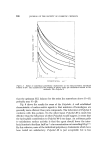
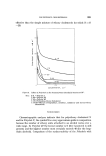
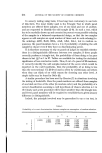
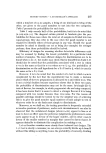
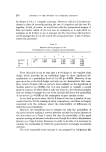
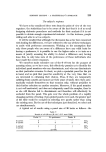
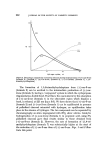
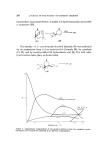
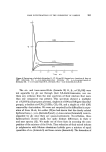
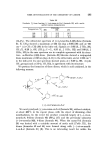
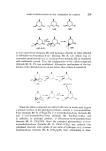
POLYETHOXY CHOLESTEROLS 209 effective than the simple mixture of ethoxy cholesterols for which N----17 --20. 2O 0'3 O' 6 Concentration, g L -t Figure 6. Effect of Polychols on the benzene/water interfacial tension •t 20 ø, Key: P5 =Polychol& P 20=Polychol 20 P 40=Polychol 40 C l$ ---- Pentadeca-ethoxy cholesterol C 17-20•-Mixture of heptadeca-, octadeca-, nonadeca- and eicosa-ethoxy cholesterols. CONCLUSION Chromatographic analyses indicate that for polyethoxy cholesterol N and for Polychol N, the symbol N is a very approximate guide to composition because the number of ethoxy units attached to an alcohol varies over a wide range. In Polychol 40 the lowest number is 0 (free lanosterol is still present) and the highest number most certainly exceeds 40 (for the long- chain alcohols). Comparison of the surface-activity of the Polychols with

210 JOURNAL OF THE SOCIETY OF COSMETIC CHEMISTS that of ethoxy cholesterol 17-20 strongly suggests that the inferior per- formance of the former arises from its heterogeneous composition and, in particular, from its wide range of N-values. Fractionation of Polychol into narroxv cuts is likely to give products having improved surface activity. Because Polychol contains many compounds which vary over a wide range of N-values, the activities of its most useful components are dimin- ished by dilution with less useful components. Several advantages may be foreseen if Polychol were to be fractionated. For example, the cuts will cover a range of fairly specific surface-activities, and at least one cut should exhibit a surface-activity superior to that of the parent Polychol the relatively homogeneous composition of the individual cuts will eliminate problems of incompatibility in blending caused by the extreme components of the original range. ACKNOWLEDGEMENTS We thank E. S. Lower, Esq., for gifts of Polychol and one of us (J.S.) thanks the International Wool Secretariat for financial assistance. (Received: 26th June 1970) REFERENCES (1) Brit. Pat: 643 422 (2) Harkins, W. D. and Brown, F. E. The determination of surface tension (Free surface energy), and the weight of failing drops: the surface tension of water and benzene by the capillary height method. f. Am. Chern. Soc., 41 49• (1919). (3) Gaddum, J. H. A simple method of measuring surface tension. Prov. Roy. Soc., London, Ser. B 109 114 (1931). (4) Purdy, S. J. and Truter, E. V. Quantitative analysis by thin-film chromatography Analyst, 87 802 (1962).
Purchased for the exclusive use of nofirst nolast (unknown)
From: SCC Media Library & Resource Center (library.scconline.org)