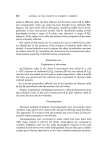
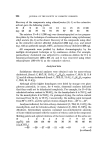
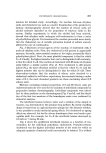
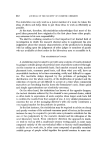
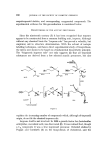
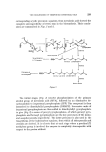
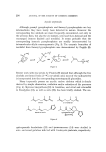
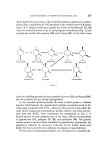
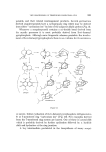
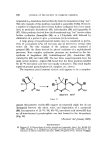
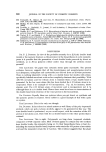
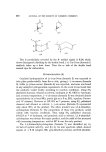
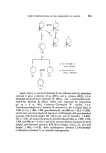
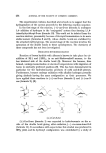
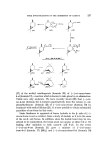
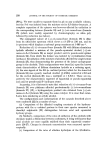
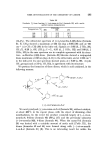
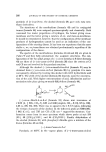
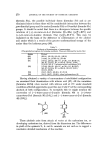
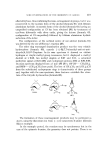
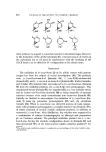
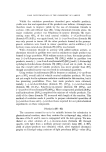
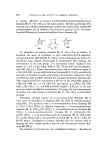
276 JOURNAL OF THE SOCIETY OF COSMETIC CHEMISTS ketones were present in yields of 3.5% and 1% in the oxidation product of (q-)-car-3-ene. We also isolated (+)-car-3-en-2-one (formula 68) (2%) whose very existence was doubted by some earlier workers (52). However, van Tamelen, McNary, and Lornitzo (56) claimed its intermediate formation in the syn- thesis of eucarvone (formula 69) from carvone hydrobromide (formula 71), but •ve were unable to repeat this work. There is little doubt that (+)-car- 3-en-2-one (formula 68) is unstable, but it can be kept for long periods in a neutral environment. However, even cold sodium acetate will convert it to cucarvone (formula 69). We attribute its stability, under the alkaline con- ditions of oxidation of (q-)-car-3-ene, to its absorption on the surface of the manganese dioxide formed in the oxidation. (+)-car-3-en-2-one (formula 68) showed m/e 150 (M+) in its mass spectrum, maxima at 227 and 254 nm in ethanol, and at 221 and 244 nm in hexane. Whilst these maxima are at longer wavelengths than forecast 0 HO 7 o (76) (77) (78) (79) by Woodward's rules (58), the nmr spectrum of the ketone (formula 68) with signals, z 8.91 and 8.78 (singlets, 6H gem-dimethyls), 8.52 (m, 2H, cyclopropyl protons), 8.3 (s, 3H, CH3C=C ), 7.46 (m, 2H, H5), and 3.75 (m, 1H, I-IC=C) leaves no doubt as to its identity. On hydrogenation it afforded (--)-cis-caran-2-one (formula 12). Other oxidation products were 8-hydroxy-m-cymene (formula 72) (3%), (--)-a-3,4-epoxycaran-5-one (formula 73)(2%), (+)-car-2-en-4-one (for- mula 74) (1.5%), (+)-nor-caran-3-one (formula 75)(2.5%), (+)a-3,4,- epoxycarane (formula 76) (18) (2%), (--)-car-3-ene-2, 5-dione (formula 77) (58) (5%), and (+)-a-3,4-epoxycaran-2-one (formula 78) (2%). Each oxidation product was identified by its spectrum and by comparison with an authentic specimen prepared by unambiguous methods.

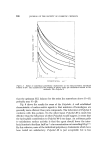
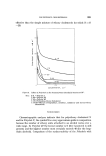
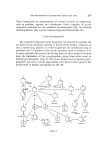
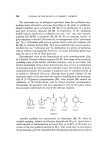
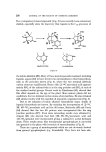
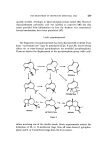
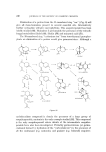
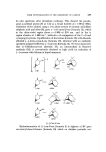
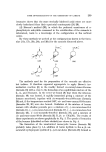
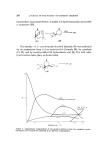
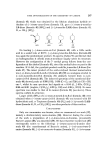
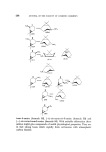
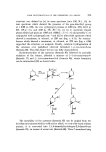
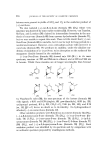
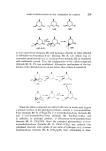
SOME INVESTIGATIONS OF THE CHEMISTRY OF CARENE 277 Whilst the oxidation procedures described gave valuable products, yields were low and separation of the products was tedious. Attempts were therefore made to improve yields by the use of chromium trioxide in acetone, •vith and without base (54). Using chromium trioxide alone, the major oxidation product was 8-hydroxy-m-cymene (formula 72) repre- senting some 45% of the total neutral volatiles. (--)-Car-3-ene-5-one (formula 67) (8.2%) was again found, but (+)-car-3-en-2-one (formula 68) was only present in traces. All the other products formed in the perman- ganate oxidation were found in minor quantities and in addition (+)-3 hydroxy-trans-caran-4-one (formula 79) (10%) was formed. When chromium trioxide in acetone with added sodium acetate, or chromium trioxide in pyridine were used as oxidants no single product was formed in large quantities. With sodium acetate as base, the major product was (+)-a-3,4-epoxycarane (formula 76) (24%) whilst in pyridine two products, namely (--)-car-3-en-5-one(formula 67)(25%)and 1, 1,4-trimethyl cyclohepta-2,4-dien-6-one (formula 70) (28%) stood out in yield. In any case the overall yield of volatile products was never greater than 20% though unoxidised carene was recovered in substantial quantities. Using tertiary butylchromate (59) in benzene as oxidant, (+)-car-3-ene gave a 35% overall yield of volatile neutral oxidation products. We have not yet sought for the optimum oxidation conditions for this reaction, but it has promising possibilities. Thus, four main products were obtained, namely, (--)-car-3-en-2,5-dione (formula 77), (11%), (+)-car-3-en-2-one (formula 68) (11.4%), 8-hydroxy-rn-cymene (formula 72) (27%), and (--)-car-3-en-5-one (formula 67) (4½%). Minor oxygenated products (0.8%) and hydrocarbons (3.8%) completed the mixture of volatile products. The yield of the dione (formula 77) increased with length of the reaction. This method of oxidation made it possible to prepare substantial quantities of (+)-car-3-en-2-one and (--)-car-3-en-5-one required for our photochemical experiments on these compounds. Photolysis (60---62) The caranones seemed to us to be suitable ketones for submission to photochemical reaction, since they contain the cyclopropyl ring, which in the case of the 2- and 5- ones is conjugated with the keto group. We irra- diated an ether solution of (--)-cis-caran-4-one (formula 18) through quartz, with light from a medium pressure mercury lamp (60). A 50% yield of photo-products was obtained, which, after repeated chromat½- graphy on Kieselgel using a mixture of light petroleum (95%)--ether (5%)
Purchased for the exclusive use of nofirst nolast (unknown)
From: SCC Media Library & Resource Center (library.scconline.org)