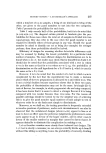
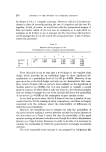
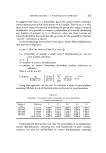
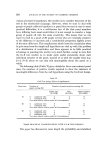
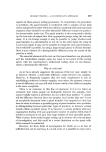
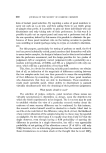
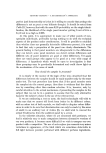
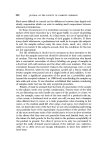
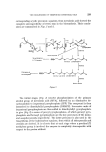
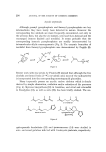
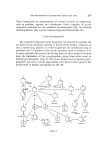
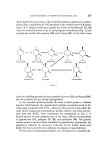
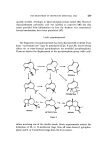
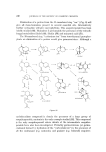
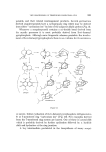
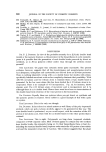
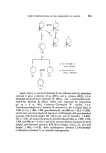
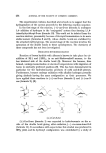
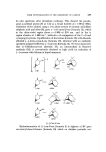
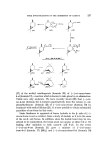
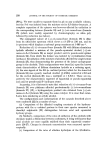
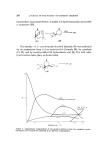
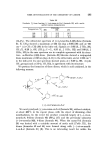
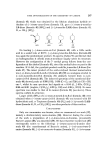
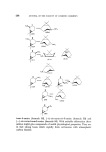
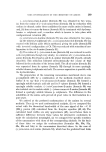
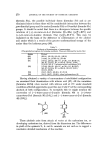
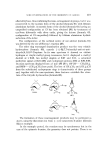
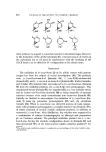
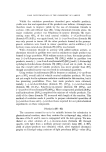
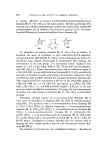
278 JOURNAL OF THE SOCIETY OF COSMETIC CHEMISTS as solvent, afforded (q-)-trans-l,l,3-trimethyl-5-vinylcyclopentan-2-one (formula 80 R, CH=CH2) as the main product. Heckert and Kropp (61), carrying out a similar photochemical reaction also isolated this substituted cyclopentanone, but in addition they isolated a mixture of cis- and trans- 2-methyl-2(3-methyl-2-oxocyclobutyl)but-3-ene (formula 81). 0 4 0 r • z o I (80) We identified our ketone (formula 80 R, CH=CH2) as follows. It absorbed one mole of hydrogen to give trans-5-ethyl-l,l,3-trimethyl- cyclopentan-2-one (formula 80 R, C 2H 5). It also exchanged one proton for deuterium using sodium deuterioxide in deuterioxide thus showing the environment of the keto group. The deuteriated ketone displayed nmr signals at • 4-5.1 (C_H=CH_2), 8.86 (s, 3H, CH33), 8.97 and 9.2 [singlets, each 3H, (CH 3)2C] ß Before deuteriation there was an additional signal at x 7-8.4 (1H, H3). As expected the ketone (formula 80 R, C2H 5) reacted with one mole of bromine in acetic acid giving a monobromo compound, which on refluxing with pyridine afforded the unsaturated ketone (formula 82). This compound showed a maximum at 227 nm in the ultraviolet, peaks at 1 706 and 1 639 cm-1 in the infra-red, and signals at • 2.92 (s, 1H, H4), 8.25 (s, 3H, CH 3C=C), and 8.96 and 9.09 [singlets, (CH 3)2 C] in its nmr spectrum which identified it conclusively. We assign the trans-arrangement of methyl and vinyl groups in (formula 80 R, CH=CH 2) on theoretical grounds. Photolysis, through quartz, of (q-)-cis-caran-5-one (formula 25) in ether gave an abundance of products (62), the yield of volatile products being 65%. The products were (--)-cis-m-menth-8-en-5-one (formula 83 R, CH3C=CH2)(37%), its dihydro compound (--)-cis-m-menthan-5-one Iformula 83 R, (CH3)2CH 1 (12%), (--)-m-menth-3-en-5-one (formula 84) (15%), (--)-cis-m-menthan-cis-5-ol [formula 85 R, (CH3)2CH R1, [t-OHI (15%), (--)-cis-m-menthan-trans-5-ol [formula 85 R, (CH 3) 2CH R1, a-OH• (1-2%) and cis-m-menth-8-en-cis-5-ol (85 R, CH3C=CH2 R1 I•-OH) (trace). Irradiation in hexane afforded only the ketones and in benzene the only volatile product was the a,[t- unsaturated ketone (for- mula 84) (32%). The identities of the ketones were established as follows:• Reaction of

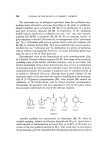
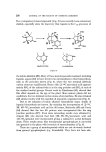
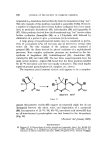
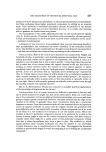
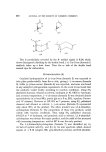
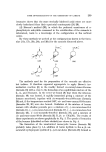
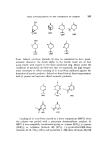
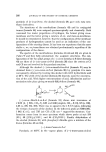
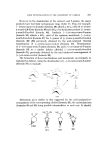
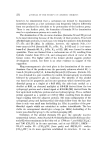
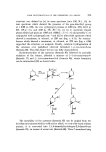
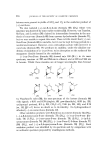
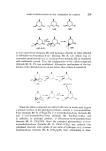
SOME INVESTIGATIONS OF THE CHEMISTRY OF CARENE 279 (SG$ Rl'Cl) • o (+)-cis-caran-5-one (formula 25) with hydrogen chloride in ether afforded (+)-8-chloro-cis-m-menthan-5-one (formula 86 R, C1) which was re- converted quantitatively to (+)-cis-caran-5-one (formula 25) on treatment with methanolic potash. Thus the configuration of the chloro-compound (formula 86 R, C1) was established. Alternative mechanisms of the for- mation of the chloroketone are shown below. One of these is concerted. •(+ "OH 0 C• 0 C C • (25) (SE• R• Ct ) OH • (25) When the chloro-compound was stirred with zinc in acetic acid, it gave a mixture of three of the photolysis products, namely (--)-cis-m-menthan- 5-one (formula 83 R, (CH3)2CH), (--)-m-menth-3-en-5-one (formula 84) and (--)-cis-m-menth-8-en-5-one (formula 83 R,CH3C•- CH2) and in addition, as principal product, (+)-8-acetoxy-cis-m-menthan-5-one (formula 86 R, CH3CO0 ). Since the principal photoproduct (--)-cis- m-menth-8-en-5-one (formula 83 R, CH3C=CH2) was reduced over palladised charcoal, with uptake of one mole of hydrogen, to (--)-cis-m- menthan-5-one [formula 83 R, (CH3)2CH] their relationship is clear.
Purchased for the exclusive use of nofirst nolast (unknown)
From: SCC Media Library & Resource Center (library.scconline.org)