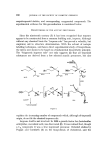
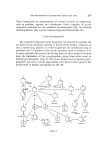
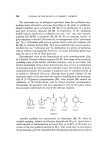
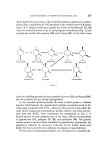
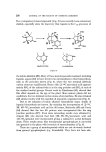
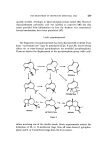
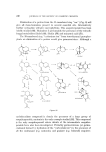
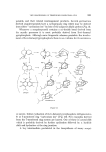
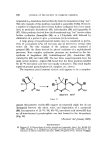
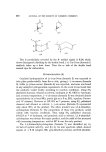
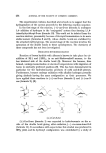
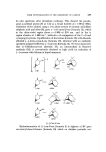
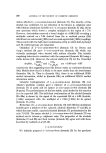
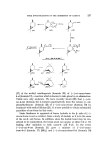
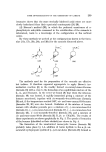
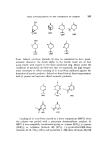
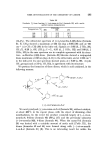
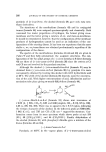
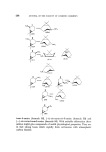
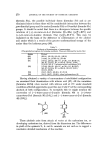
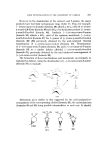
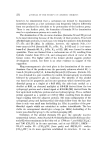
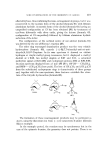
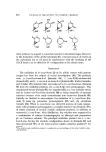
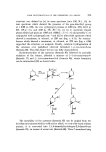
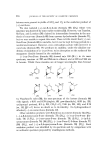
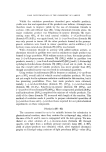
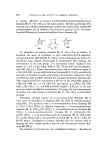
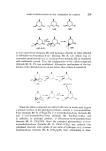
242 JOURNAL OF THE SOCIETY OF COSMETIC CHEMISTS terpenoids is ¾-bisabolene derived directly from the 6-membered ring "ion". The only example of this skeleton examined is paniculide B (54). However, a number of compounds derived from further cyclisation have been exam- ined, in particular trichothecin (55), helicobasidin (56) and lagopodine B (57). Other products derived from the 6-membered ring "ion" involve either further cyclisation (fumagillin (58), or a 1,2-hydride shift followed by elimination of a proton to give ¾-curcumene (or [I-curcumene). A large group of sesquiterpenoid skeleta may be considered as deriva- tives of ¾-curcumene (Fig. 11) but may also be derived by several other routes (3). The only example of the cadinene group examined is gossypol (59), the dimer derived by phenol oxidation of a naphthalenoid precursor. More complex cyclisation processes are involved in the bio- synthesis of longifolene (60), helminthosporal (61), dendrobine (62), coriamyrtin (63) and tutin (63). The last three sesquiterpenoids have the same carbon skeleton. Arigoni (63) found that the three positions labelled by [2-14C ]mevalonic acid were not equally radioactive. This result implies a pool of geranyl pyrophosphate (cf. camphor, etc. above). The important plant hormone abscisic acid appears to be a sesquiter- OH- O•OH abscJsic acid Figure 12 penoid. Biosynthetic results (65) support its terpenoid origin but do not distinguish between the direct route, and degradation of a carotenoid (66). Incorporation of [2-14C, 3R, 4R-3H 1] mevalonic acid shows (67) that an all-trans-farnesyl pyrophosphate was first formed in the biosynthesis (Jig. (Received: 3rd January 1970J REFERENCES (1) Clayton, R. B. Biosynthesis of steroIs, steroids and terpenoids. Quart. Rev. 19 168, 201 (1965). Nicholas, H. ]. Biogenesis of naturally occurring materials. {n Bernreid, P. The •{•õen•{• o• •atura• •• 2nd Edn. (1•67) (Pergamon Press, Oxford) Pridh•m,

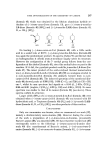
THE BIOGENESIS OF TERPENOID ESSENTIAL OILS 243 T. B. Terpenoids in plants (1967) (Academic Press) Rickards, J. H. and Hendrickson, J. B. The biosynthesis of steroids, terpenes and acetogenins (1964) (Benjamin) Teisseire, P. Recherches 17 77 (1969). (2) Ruzicka, L. Isoprene rule and the biogcnesis of terpenic compounds. Experientia 9 357 (1953) Perspektiven der Biogenese und der Chemie der Terpene. Pure Appl. Cbem. 6 493 (1963). (3) Parker, W., Roberts, J. S. and Ramage, R. Sesquiterpene biogenesis. Quart. Rev. 21 331 (1967). (4) Popj•k, G. and Cornforth, J. W. Substrate stereochemistry in squalene biosynthesis. Biochem. J. 101 553 (1966). (5) Ruzicka, L. History of the isoprene rule. Proc. Chem. Soc. 341 (1959). (6) Tavormina, P. A., Gibbs, lX[. H. and Huff, J. W. The utilization of [t-hydroxy-ll-methyl- $-valerolactone in cholesterol biosynthesis. J. ,4 m. Chem. Soc. 7814498 (1956) Tavormina, P. A. and Gibbs, M. H. The metabolism of [t, ¾-dihydroxy-ll-methyl valeric acid by liver homogenates. J. Am. Chem. Soc. 78 6210 (1956). (7) Hanson, K. R. Applications of the sequence rule. I. Naming the paired ligands g,g at a tetrahedral atom Xggij. II. Naming the two faces of a trigonal atom Yghi. J. Am. Che•n. Soc. 88 2731 (1966). (8) PopjJtk, G. The biosynthesis of derivatives of allylic alcohols from [2-• 4C] mevalonate in liver enzyme preparations and their relation to synthesis of squalene. Tetrahedron Letters 19 (1959 No. 19) see atso Goodman, D. S. and Popj•k, G. Studies on the bio- synthesis of cholesterol, XII. Synthesis of allyl pyrophosphate from mevalonate and their conversion into squalene with liver enzymes. J. Lipid Res. 1 286 (1960). (9) Francis, M. J. O. and O'Connell, M. The incorporation of mevalonic acid into rose petal monoterpenes. Phytochem. 8 1705 (1969) see also Pasechnichenko, V. A. and Guseva, A. R. E sential oil biosynthesis by isolated rose p•tals. Bioche•n. U.S.S.R. 32 1020 (1967) Gaseva, A. R. and Pasechnicht. nko, V. A. Essential oil alcohols biosynthesis from a Rosa da•nascena x R. Gallira hybrid. Biocbem. U.S.S.R. 31 988 (1966). (10) Waller, G. R., Frost, G. M., Burieson, D., Brannon, D. and Zalkow, L. H. Biosynthesis of monoterpenoids by Santolina cha•naecyparissus L. Phytochem. 7 213 (1968). (11) B:,rch, A. J., B•ulter, D., Fryer, R. I., Thomson, P. J. and Willis, J. L. The biosynthesis of citrondial and of cineole in Eucalyptus. Tetrahedron Letters 1 (1959) No. 3 Neethling, L. P., Reiber, H. G. and Chichester, C. O. Biosynthesis of citral in Eucalyptus stai•eriana. Proc. Nat. Conf. Nucl. Energy, Pretoria, 451 (1963). (12) Happ, G. M. and Meinwald, J. Biosynthesis of arthropod secretions. I. Monoterpene synthesis in an ant (Acanthomyops claviger). J. Am. Chem. Soc. 87 2507 (1965). (13) Waldner, E. E., Schlatter, Ch. an3 Schm[d, H. Zur Btosynthese des Dendrolasins, eines Inhaltsstoffes der Am•ise Lasius fuliginosus LATR. Helv. Chim. Acta, 52 15 (1969). (14) Oguni, I., Oshima, K.. Imaseki, H. and Uritani, I. Biochemical studies on the terpene metabolism in sweet potato root tissue with blackrot. Agri. Biol. Che•n. 33 50 (1969) and refs. therein. (15) Birch, A. J., Ko•6r, M., Sheppard, N. and Winter, J. Studies in relation to biosynthesis. Part XXIX. The terpenoid chain of mycelianamide. J. Che•n. Soc. 1502 (1962). (16) Schiitte, H. R. and Leh•_eldt, J. Bi. osynthese von Nuphar luteurn alkaloids. Arch. Pharm. 298 461 (1965). (17) Bat•ersby, A. R., Barnett, A. R., Knowles, G. D. and Parsons, P. G. Seco-cyclopentane glucosides from Menyanthes trifoliata: foliamenthin, di-hydrofoliamenthin, and men- thiafolin. Chem. Comm. 1277 (1963) Loew, P., Szczepanski, Ch. V., Coscia, C. J. and Arigoni, D. The structure and biosynthesis of foliamenthin. Chem. Comm. 1276 (1968). (18) Attaway, J. A. and Buslig, B. S. The metabolism of linalool in Citrus plants. Phytoche•n. 8 1671 (1969) Potty, V. H., Moshonas, M. G. and Bruemmer, J. H. Cyclisation of linalool by enzyme preparation from orange. ,4 rch. Blochewn. 138 350 (1970) see however Cori, O. Terpene biosynthesis: utilisation of neryl pyrophosphate by an enzyme system from Pinus radiata seedlings. Arch. Blochewn. Biophys. 135 416 (1969) Escher, S., Loew, P. and Arigoni, D. The role of hydroxygeraniol and hydroxynerol in the bio- synthesis of loganin and indole alkaloids. Che•n. Comm. 823 (1970) Battersby, A. R., Brown, S. H. and Payne, T. G. Biosynthesis of loganin and the indole alkaloids from hydroxygeraniol-hydroxynerol. Che•n. Co•nm. 827 (1970). (19) Banthorpe, D. V. and Wirz-Justice, A. Terpene biosynthesis. Part I. Preliminary tracer
Purchased for the exclusive use of nofirst nolast (unknown)
From: SCC Media Library & Resource Center (library.scconline.org)