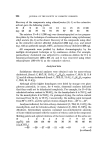
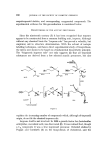
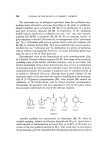
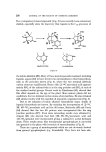
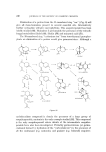
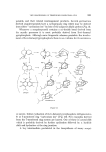
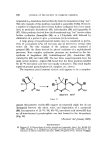
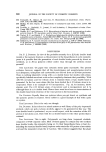
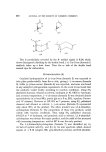
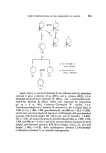
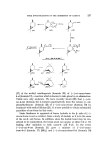
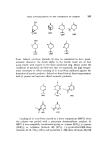
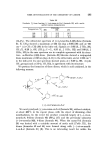
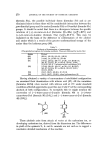
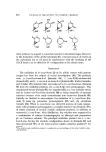
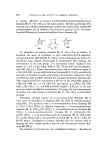
268 JOURNAL OF THE SOCIETY OF COSMETIC CHEMISTS H2N• • NH2 (490) [(49) (50) • N H2H2N•____ (5/) (51o) ( 5lb ) NH2 ' I (54) NH2 (540) N• trans-4-amine (formula 52), (+)-cis-caran-cis-5-amine (formula 53) and (--)-cis-caran-tran,-5-amine (formula 54). With suitable elaboration these .amines might give compounds of useful physiological properties. They are in fact strong bases which rapidly form carbonates with atmospheric carbon dioxide.

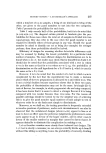
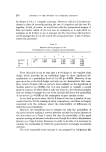
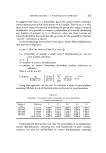
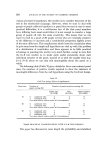
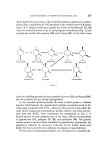
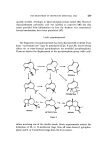
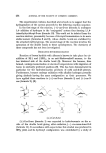
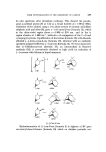
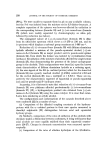
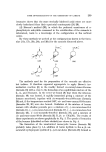
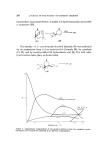
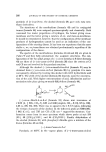
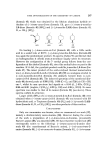
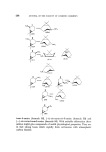
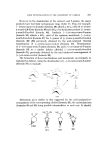
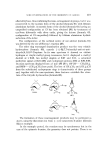
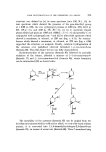
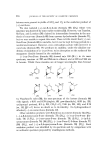
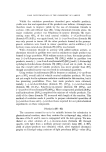
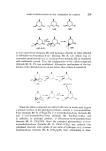
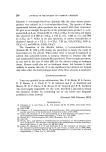
SOME INVESTIGATIONS OF THE CHEMISTRY OF CARENE 260 (--)-cis-Caran-trans-4-amine (formula 52) was obtained in two ways, (a) from the oxime of (--)-cis-caran-4-one (formula 18) by reduction with sodium in ethanol under these conditions the more stable amine is formed, and, (b) from cis-caran-4a-borane (formula 16) by treatment with hydroxy- lamine o- sulphonic acid, a reaction which is known to take place with configurational retention (40). (+)-cis-Caran-cis-4-amine (formula 51) was also obtained in two ways, (a) the toluene p-sulphonate of (--)-cis-caran-trans-4-ol (formula 17) was reacted with lithium azide (41) in methanol, giving the azide (formula 55) with inverted configuration at C4. This was reduced with retention of con- figuration to the cis-4-amine (formula 51). (b) The oxime of (--)-cis-caran-4-one (formula 18) was reduced in acetic acid over platinum, though very slowly, to a mixture of (q-)-cis-caran-cis-4- amine (formula 51) (3 parts) and its 4- epimer (formula 52) (1 part), already described. This reduction followed stereochemically the course of that followed in the reduction of the ketone itself. The all cis-amine (formula 51) was separated from its epimer (formula 52) through its more sparingly soluble toluene p-sulphonic acid salt. The reverse separation is possible with the hydrochlorides. The preparation of the remaining caranamines mentioned above was accomplished (37) by a combination of the methods described above. Suffice it to say that (+)-cis-caran-cis-5-amine (formula 53) formed a sparingly soluble tartaric acid salt and its 5- epimer (formula 54) formed a sparingly soluble oxalate. (--)-cis-Caran-trans-2-amine (formula 50) was also isolated via its oxalate whilst (--)-trans-caran-cis-'2-amine (formula 40) formed a sparingly soluble toluene p- sulphonate. The difference in the solubilities of the amine salts proved of great value in their isolation in a pure state. We arrived at the preferred conformations of the amines by several methods. Thus (a) we used conformational analysis, (b) we compared the actual with the theoretical band-width of the nmr signal of the --C H (NH2) proton (42) calculated from the Karplus equation (43, 44). The calculated band widths are only approximate (45), nevertheless there is sufficient difference between these values for alternative conformers to make the calculations meaningful, (c) we compared the specific rotations of the caranamines with those of the corresponding alcohols. On the basis of these data we assign the conformations (formulae 40a, 50a, 51a, 52a, 53a and 54a) to the caranamines described above. In the case of (+)-cis-caran-cis-4 amine (formula 51), which has the preferred boat form
Purchased for the exclusive use of nofirst nolast (unknown)
From: SCC Media Library & Resource Center (library.scconline.org)