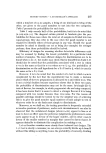
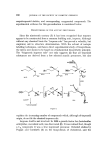
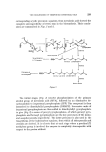
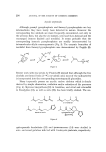
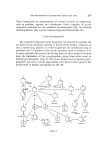
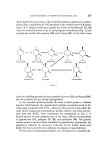
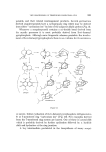
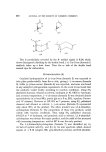
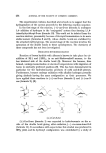
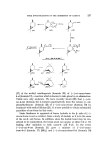
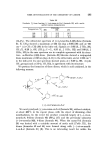
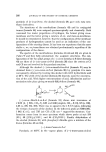
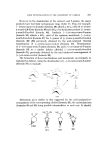
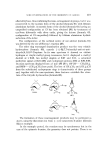
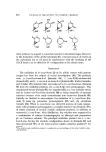
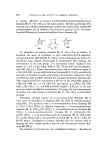
274 JOURNAL OF THE SOCIETY OF COSMETIC CHEMISTS other evidence to support a concerted reaction in the initial stages. However in the formation of the alcohol (formula 61), rearward attack of water on the carbonium ion at C3 must be synchronous xvith the breaking of the C2-C3 bond so as to afford the R- configuration at the chiral centre. OXIDATION The oxidation of (+)-car-3-ene (2) at its allylic centres with gaseous oxygen has been the subject of recent investigation (18). The products were (+)-car-2-en-trans-4-ol (formula 64), (--)-car-3(lO)-en-trans-4-ol (formula 65), and (--)-cis-car-4-en-trans-3-ol (formula 66). Earlier Semmler and Schiller (51) isolated what was believed to be car-3-en-5-one (formula 67) from the oxidation products of (+)-car-3-ene with permanganate. This unsaturated ketone {formula 67) was regarded (52) as a very unstable entity and its isomer car-3-en-2-one (formula 68) as being incapable of separate existence because of its ready isomerisation into eucarvone (formula 69). Initially we decided to reinvestigate the oxidation of (+)-car-3-ene (for- mula 2)using (a) potassium permanganate (53) and, (b) chromium trioxide (54). When (+)-car-3-ene was stirred in acetone at room temper- ature with potassium permanganate, a complex mixture was obtained, 10% of which consisted of neutral volatile oxidation products, in addition to recovered (+)-car-3-ene. After distillation, the volatiles were separated by a combination of column chromatography on silica-gel and preparative glc on Carbowax columns. The principal oxidation product was (--)-car- 3-en-5-one, having the absolute configuration shown in (formula 67) and this represented 75% of the total neutral volatile oxidation products*. Its *The yield of each oxidation product is expressed as a percentage of the total volatile oxida- t ion products.

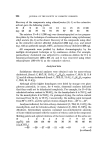
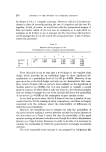
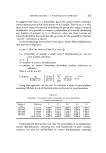
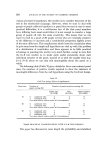
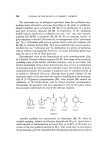
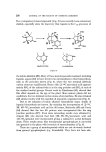
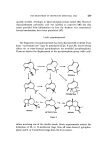
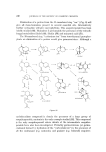
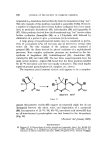
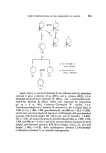
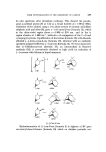
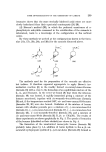
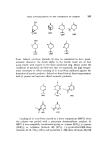
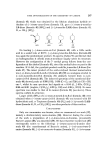
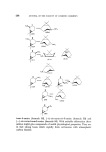
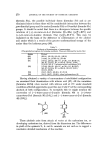
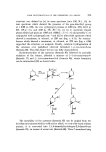
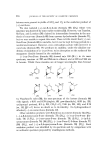
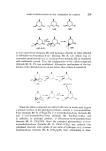
SOME INVESTIGATIONS OF THE CHEMISTRY OF CARENE 275 structure was defined by (a) its mass spectrum (m/e 150, M+), (b) its nmr spectrum which showed the presence of the gem-dimethyl group at x 8.09 (s, 13H), the two cyclopropyl protons at 8.130 (m, 2H), 8.13 (s, 3H, CH3C----C ), and 4.33 (s, 1H, HC=C), (c) its ir spectrum (liquid phase) which had peaks at 1 1395 and 1 1358 (C = C--C = 0 and possibly C = O conjugated with cyclopropyl) cm-1 and (d) its ultraviolet spectrum which showed a maximum, in ethanol, at 229 nm (log, c 4.11). Its semicar- bazone which showed a maximum, in ethanol, at 272 nm (log c 4.36) supported the structure we assigned. Finally, catalytic hydrogenation of the carenone over palladised charcoal furnished (+)-cis-caran-5-one (formula 25). Thus this elusive ketone was fully characterized. Hydroboronation of the carenone (formula 137) followed by peroxide oxidation of the borane, afforded a mixture of (--)-cis-caran-trans-4~ (formula 17) and (--)-cis-caran-trans-5-ol (formula 24), whose formation can be rationalised (55) as shown below. (17) HO• •,•4) The instability of the carenone (formula 137) can be judged from the fact that on treatment with ice-cold acid or alkali, or even with warm sodium acetate, it is converted into 1,1,4-trimethylcyclohepta-2,4-diene-13-one (formula 70), an isomer of eucarvone (formula 139). These 7-membered ring
Purchased for the exclusive use of nofirst nolast (unknown)
From: SCC Media Library & Resource Center (library.scconline.org)