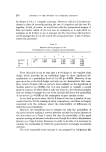
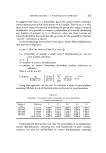
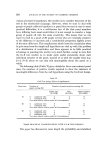
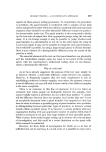
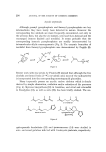
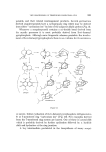
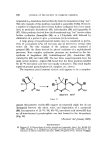
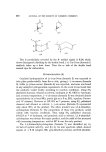
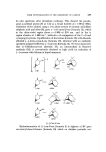
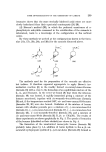
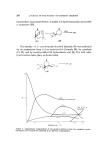
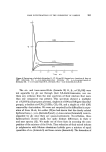
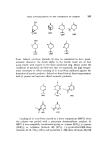
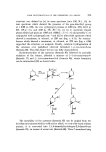
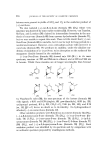
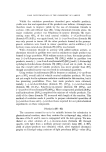
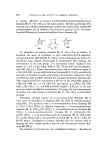
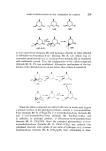
JOURNAL OF THE SOCIETY OF COSMETIC CHEMISTS Another area which is proving very important is the application of mono or sesquiterpenoids to pest control. The area of insect hormones and related com- pounds is certainly going to be a very important field in the future. Another group of interesting compounds is the cytotoxic sesquiterpenoids. These may have applications in cancer chemotherapy so that specific terpenoids need to be searched for. Abscisic acid {Fig. 1oe) is a very important plant hormone. There may be analogues of this compound as we do not know how universal this hormone is. Much of the present work relies on the very large specific rotation of abscissic acid so that it can be de- tected in very small quantities. However, there may well be analogues which are even more active biologically that have as yet to be found.

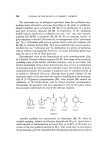
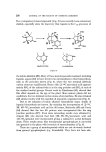
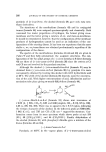
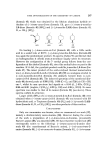
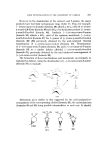
J. Soc. Cosmet. Chern. 22 249-284 (1971} ¸ 1971 $octety of Cosmetic Chemists of Great Britain ß ' rig ' A remew of some nves atons the chemistry of carene of W. COCKER* Presented on 21st April 1970, at the Symposium on "Perfumery", organised by the British Society of Perfumers and the Society of Cosmetic Chemists of Great Britain, at Eastbourne, Sussex. Synopsis---The HYDROGENATION, HYDROBORONATION, PYROLYSIS, AMIN- ATION, OXIDATION, and the PHOTOCHEMICAL ISOMERISATION of (+)-CAR-3- ENE, a potential raw material for the fine chemical industry, have been performed, and are here reviewed. CARANOLS, CARANONES, CARANAMINES and their rearrangement products have been SYNTHESISED. The bicyclic terpene, carene, exists in nature as (q-)-car-2-ene (formula 1) and {+)-car-3-ene {formula 2). Both are present in Indian and in Baltic {1) oils of turpentine, (q-)-car-3-ene {formula 2) being the more abundant. Both are however found in sufficient quantity to make them potentially valuable as starting points for the synthesis of terpenoids. Although a considerable amount of investigation was carried out in the early nineteen twenties, particularly by the late Sir John Simonsen and his conaborators (2), the advent of the techniques of chromatography and spectroscopy has made a re-examination of the chemistry of this bicyclic monoterpene a profitable exercise, with a view to its economic use, as well as the uncovering of some interesting chemistry. We started on this work some five years ago. There is a considerable body of evidence based upon conformational analysis and n.m.r. spectra (3) that the configuration and preferred con- formation of (+)-car-3-ene is the boat form (formula 3) rather than the upturned boat form {formula 4). *Chemi'cal Laboratory, Trinity College, Dublin 2, Ireland. 249
Purchased for the exclusive use of nofirst nolast (unknown)
From: SCC Media Library & Resource Center (library.scconline.org)