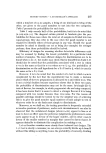
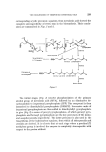
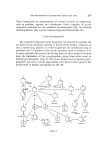
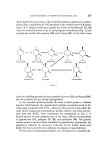
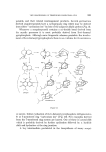
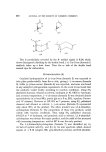
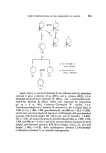
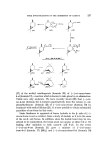
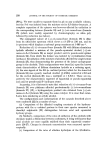
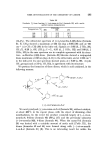
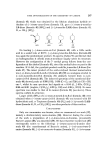
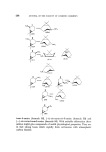
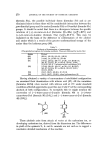
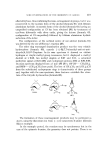
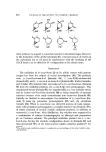
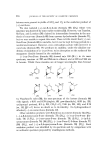
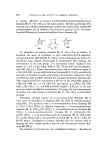
272 JOURNAL OF THE SOCIETY OF COSMETIC CHEMISTS however, be remembered that a carbonium ion formed by deamination (sometimes known as a hot carbonium ion) frequently behaves differently from one produced by solvolysis or by protonation of the hydroxy group. There is one further point, the formation of formula 31 by deamination may be a synchronous process as in route (b). The deamination of the cis-caran-4-amines (formulae 51 and 52) proved to be most interesting because of the diversity of their products. Thus both afforded eight products, in each case, two being the epimeric 4-ols (formulae 17=17a and 20=20a). In addition, however, the epimeric 3-ols, (+)- trans-caran-cis-3-ol (formula 60, R •, s-Me R2, [•-OH) and (+)-cis-caran- trans-3-ol (formula 60 R •, [•-Me R2, a-OH) (48) were formed in minor quantities. These are formed from a carbonium ion at C3, resulting from hydride transfer from C3 to C4, and subsequent attack of water at the former centre. The higher yield of the former alcohol suggests product development control, but there is no other evidence in support of this suggestion. Ring rearrangements also took place in the deamination of the caran- 4-amines. One of the products was the previously unknown alcohol R(--)- trans-3- [ 1-hydro xyethyl]-6, 6-dim ethylbicyclo [3,1,0• hexane (formula 61). It was obtained in a pure condition by careful chromatography on alumina followed by preparative glc on Castorwax. The identity of this alcohol was based on its properties and its nmr spectrum which showed the gem- dimethyl group as a singlet at z 9.05 (6H), the side-chain methyl as a doublet at 8.95, an obscured multiplet at 8.9-9.28 derived from the two cyclopropyl protons and a broad signal at 8.2-8.36 (SH) derived from the four equivalent methylene protons and one hydroxyl group. The a- carbinol proton appeared as a quintet at z 6.6 (J 6Hz) resulting from its almost equal coupling with the adjacent protons. The trans-configuration of the cyclopropyl group and hydroxyethyl side-chain follow from the fact that there is only very small nmr deshielding (ca. 1Hz) in pyridine of the gem- dimethyl signals which are coincident in carbon tetrachloride. The less stable cis- arrangement should give a large (ca. 16Hz) deshielding of the nearer ge•n-dimethyl group to the carbinol grouping (49). Oxidation of the alcohol (formula 61) gave the optically inactive symmetrical ketone, trans-3-acetyl-6, 6-dimethylbicyclo[3,1,01hexane (for- mula 62) whose maximum in the infra-red at 1 704 cm- l, at z 9.02i(CH 3) 2C1 and 7.96 (CH3CO) in its nmr spectrum, and at m/e 152 (M+), 109[M+-- CH3CO and/or M+--(CH3)2CH 1 (base peak) and 43[CH3C0 + and/or (CH3) 2CH+J in its mass spectrum established its structure. It was un-

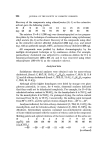
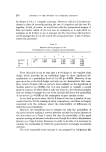
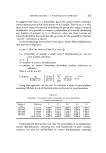
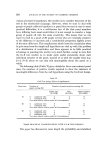
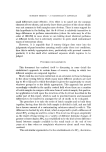
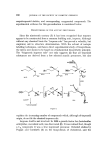
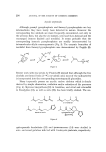
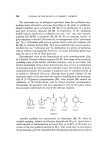
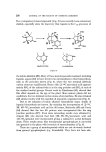
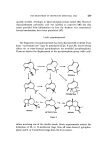
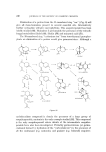
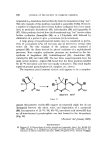
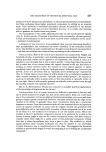
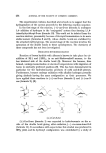
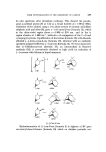
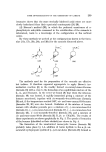
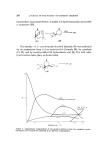
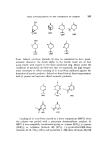
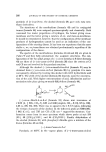
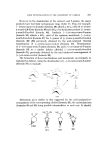
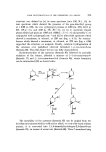
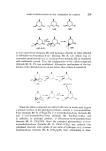
SOME INVESTIGATIONS OF THE CHEMISTRY OF CARENE 273 affected by base, thus confirming the trans- arrangement of groups, but it was reconverted to the racemic form of the alcohol (formula t31) with lithium aluminium hydride. A racemic form of the alcohol (formula 131) having an unspecified configuration at C3 has been obtained (50) by treatment of car-3-ene dibromide with silver oxide, giving the ketone (formula t32 configuration at C3 unspecified) followed by lithium aluminium hydride reduction of the latter. The configuration at the carbinol centre of our alcohol (formula t31) was derived by the use of Horeau's reaction (20). The other ring rearranged deamination product was the very volatile hydrocarbon (formula 133), namely (+)-3•,7,7-trimethyl-anti-cis-anti- tricycloI4,1,0,02,4]heptane. In its nmr spectrum it showed no olefinic hydrogen or vinylic methyl group resonances, but it displayed a methyl doublet at z 0.05, two methyl singlets at 8.07 and 0.11, a saturated methylene signal at 8.21 (2H) and cyclopropyl protons (SH) at 8.01-0.135. Its mass spectrum displayed ions at m/e 13t3 (M+), 107 (M +-- CH3CH2), and 03[M +--- (CH 3) 2CH] (base peak). The loss of CH 3CH2 and (CH 3) 2 CH from the substituted cyclopropane rings is characteristic of these groups and, together with the nmr spectrum, these features establish the struc- ture of the tricyclic hydrocarbon (formula 133). hN02• NH2 (•2a) H''O•H HO H CH• CH 3 The formation of these rearrangement products may be portrayed as above, using the diazonium ion from (--)-cis-caran-trans-4-amine (formula 52a) as example. In the example quoted, the reaction may be synchronous but in the case of the epimeric 4-amine, the geometry does not pertain. There is no
Purchased for the exclusive use of nofirst nolast (unknown)
From: SCC Media Library & Resource Center (library.scconline.org)