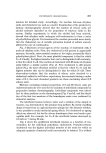
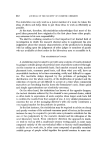
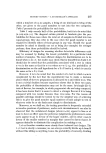
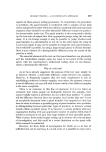
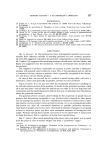
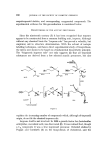
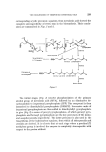
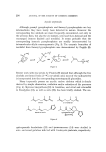
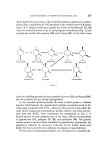
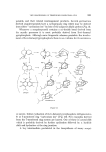
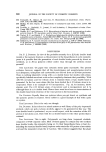
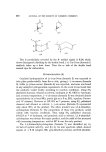
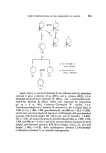
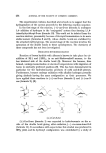
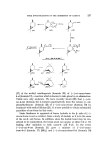
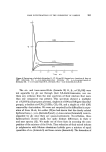
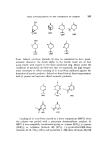
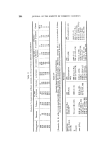
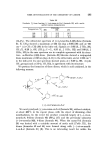
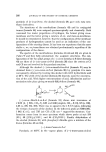
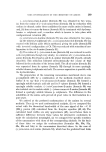
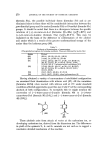
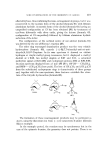
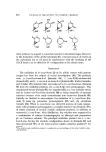
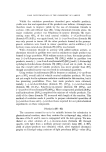
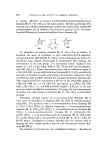
254 JOURNAL OF THE SOCIETY OF COSMETIC CHEMISTS The experimental evidence described above leads us to suggest that the hydrogenation of the carenes proceeds by the following reaction sequence. In the first stage of the reaction, (-[-)-car-2-ene (formula 1) undergoes 1,4- addition of hydrogen to the 'conjugated' system thus forming 1,1,4- trimethylcyclohept-2-ene (formula 10). This could not be isolated from the reaction mixture, presumably because of its rapid isomerisation to its more stable isomers (formulae 8 and 9), whose double bonds are stabilised by the attached methyl groups. The second stage of the reaction involves the saturation of the double bonds in these cycloheptenes. The chemistry of these compounds has not been investigated. OXIVATIVE H¾I)ROBOaONATION Reaction of boron hydride with alkenes is known to take place by cis- addition of H(-) and (+)BH2, in an anti-3/Iarkownikoff manner, to the less hindered side of the double bond (5). Moreover the boranes, thus formed, undergo isomerisation at elevated temperatures with migration of boron to sterically preferred positions (6). This has been demonstrated in particular for the hydroboronation products of a-(4) and [1-(7)pinenes. Furthermore, boranes undergo oxidation with alkaline hydrogen peroxide giving alcohols having the same configuration as their precursors. We have applied these reactions to (+)-car-2-ene (formula 1) and (+)-car-3- ene (formula 2), (8). 9 •" • (11) (11a) OH (15a) o /2a (/4) ( + )-C ar-2-ene (+)-Car-2-ene (formula 1) was expected to hydroboronate on the a- side of the double bond giving, after oxidation,(--)-cis-caran-trans-2-ol (formula 11). In accordance with expectation this alcohol was produced in 85% yield, and its hydroxyl configuration was established by a study of

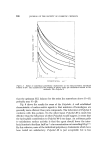
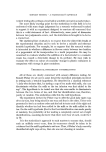
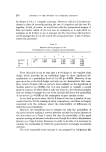
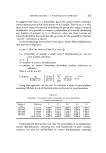
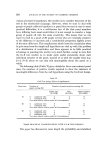
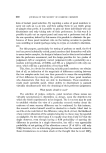
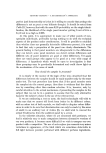
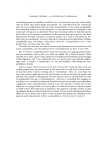
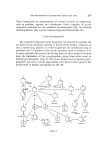
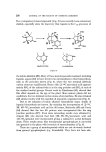
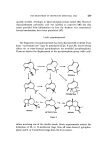
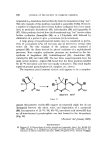
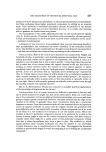
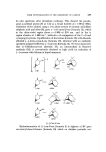
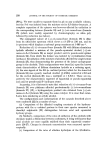
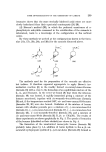
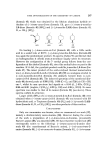
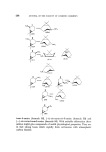
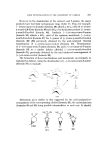
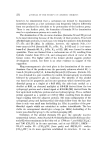
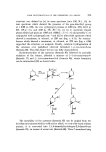
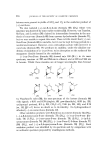
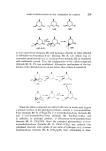
SOME INVESTIGATIONS OF THE CHEMISTRY OF CARENE 255 its nmr spectrum, after deuterium exchange. This showed the pseudo- axial a-carbinol proton (H at C-2) as a broad doublet at • 7.06 (J 8Hz). Oxidation of the alcohol, using a two phase system of chromic acid-dilute sulphuric acid and ether (9), gave (--)-½/s-caran-2-one (formula 12), which in the ultra-violet region shows •----1 900 at 210 nm, and in the ir region absorbs at 1 689 crn -•, indicative of conjugation of the C=0 and cyclopropyl systems. Equilibration of the ketone (formula 12) with ethoxide afforded (--)-trans-caran-2-one (formula 13), identical with an authentic specimen prepared (10) from (--)-carvone (formula 14). We have shown (11) that (q-)-dihydrocarvone (formula 15), an intermediate in Baeyer's synthesis (10), is conveniently obtained in high yield by reduction of (--)-carvone with lithium in liquid ammonia. ß (16) 2 1(/7) • (/7a) (18a) 5 H • 0 ( 20a ) ( + )-C ar-$-ene Hydroboronation of (q-)-car-3-ene (formula 2) in diglyme at 20 ø gave cis-caranyl-trans-4-borane {formula 16) which on alkaline peroxide oxi-
Purchased for the exclusive use of nofirst nolast (unknown)
From: SCC Media Library & Resource Center (library.scconline.org)