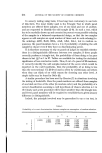
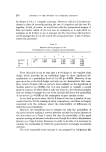
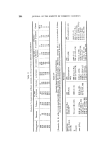
SENSORY TESTING -- A STATISTICIAN'S APPROACH 223 The subject's response We have so far considered these tests from the point of view of the test organiser the statistician has to be aware of the fact that it is of no avail designing elaborate procedures and methods for their analysis if it is not possible to obtain enough experimental material - in this instance, people willing and able to act as subjects. It will be recalled that although the discussion has so far been concerned with looking for differences, we have referred to the use of these techniques to assist with preference assessments. Working on the assumption that only those people who are aware of a difference have any valid basis for having a preference, it is possible to use the higher order n+n tests as a means of jointly assessing the ability to detect a difference and, having done this, to only take note of the preferences of those individuals who have made the correct responses. We ourselves make extensive use of the 6-½6 test for the purpose of assessing odour as we have seen, this effectively permits us to identify the individual panel members who can discriminate, and who can discriminate on that particular occasion. In short, we pick a specialist panel for the job in hand, and we pick that panel for sensitivity at the very time that we are interested in obtaining their choices. Thus, if they are temporarily suffering from catarrh and cannot use their sense of smell, then they auto- matically exclude themselves on that occasion only, without prejudice to their further selection on another occasion. Moreover, if the panel member is not well motivated, and does not adequately smell the samples, then he or she will likewise fail to discriminate and therefore will effectively be excluded from the panel. This gets over the whole problem of a rapidly changing pattern of testing if pre-picked panels were used, the greater part of the time would be occupied in selecting new panels rather than using the existing ones. By the use of the techniques just described, we select and use simultaneously. A typical set of results using a panel size of 30 looks as follows- the Table V. Result of a 6+6 test (R. & C. O.P. test 6 200) 6 correct $ correct 4 correct 3 correct Prefer A No preference Prefer B s - - •o% 6 s 2 43% 4 $ 1 33% - 4 - •4% (n=$O)

224 JOURNAL OF THE SOCIETY OF COSMETIC CItEMISTS figures are taken from a test on an alternative de-naturant used for the alcohol in an aftershave. From this we can deduce the following: of the total panel of 30, 1t3 (53%) were able to discriminate (got six or five correct, significant at P 0.001, see Table IV), and of those discriminating, nine preferred A and two preferred B (with five declaring no preference) showing a clear pre- ference for A. Long experience shows that panel members not merely do these tests but enjoy doing them. The task gives an intellectual challenge and there is no problem of motivation panel members ask eagerly if they have "got the test right", and this it is possible to tell them as an incentive to do better. A straight preference comparison between two samples has no "right" or "wrong" answer, and the subject who asks whether his or her answer is "right" in a paired comparison is under a misapprehension about the purpose of preference questions of this kind. But the challenge of the n-t-m type of test, with its right and wrong answers which may be com- municated to the subject without invalidating further testing, leads to considerable enthusiasm and maintains a high degree of motivation over long years of testing. One question which is frequently asked about this form of test concerns sensory fatigue it is suggested that sensory fatigue rules out the possibility of a subject smelling as many as twelve samples and correctly distinguishing between them. Our experience is otherwise in the field of odour we have no difficulty in getting subjects to distinguish between sets of twelve with quite trivial differences between them. Indeed, for an investigation of this very point, we arranged for a panel of some 3:3 members to repeat the same test four times in succession (forty-eight jars smelled altogether) and the rate of discrimination (52%, 58%, 50%, 50%) remained effectively con- stant over the four tests. On the other hand, there are limitations, not so much of physical sensory fatigue, but of ability to get rid of one substance before sensing the next which limits the ability to taste long series of samples. 2-3-1 (triangle tests) are usually the upper limit to the size of test that can be offered to the taste panellist. Pungent tastes which linger in the mouth and deaden the taste buds are difficult to classify whether they represent true sensory fatigue is perhaps arguable. It would be wrong to suggest that sensory fatigue was not present in the larger scale t3+t3 type testing of smells, however constant the response remained over time. It would be arguable that it makes discrimination of
Purchased for the exclusive use of nofirst nolast (unknown)
From: SCC Media Library & Resource Center (library.scconline.org)