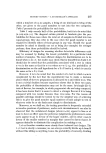
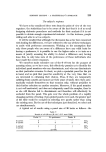
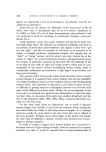
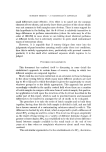
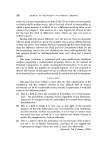
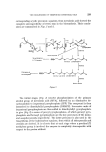
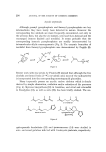
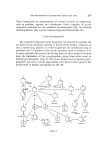
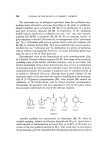
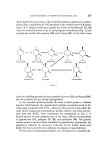
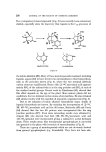
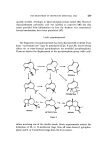
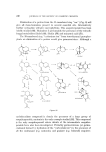
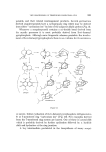
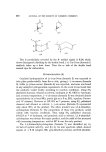
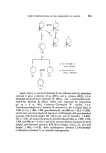
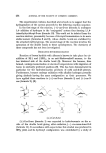
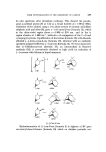
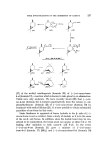
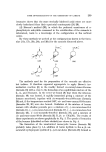
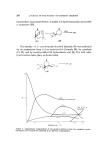
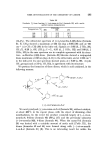
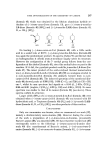
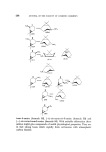
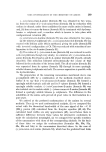
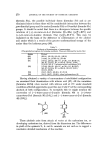
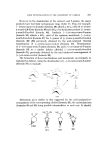
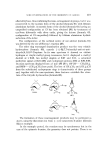
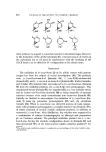
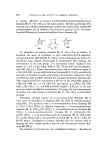
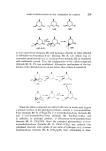
256 JOURNAL OF THE SOCIETY OF COSMETIC CHEMISTS dation afforded (--)-cis-caran-trans-4-ol (formula 17). The identity of this alcohol was confirmed, by (a) reduction of its toluene p- sulphonic ester with lithium aluminium hydride to (--)-cis-carane (formula 5) (12), (b) its nmr spectrum which shows a complex multiplet in the region of ß 7.0. However, deuteriation removed a broad singlet at • 6.96 (OH) revealing a multiplet centred on • 7.04 derived from the a-carbinol proton (H4) which has two axial-axial (J 9Hz) and one axial-equatorial (J 6Hz) couplings. This accords with the half-chair conformation (17a) in which both hydroxyl and 10- methyl groups are equatorial. Oxidation of (--)-cis-caran-trans-4-ol (formula 17) by Brown and Garg's method (9) gave (--)-cis-caran-4-one (formula 18) which was virtually unchanged when treated with sodium ethoxide. This initially surprising behaviour is consistent with the compound (formula 18) being a stable ketone (13). However, the solvent shifts (14, 15) for the 10-methyl CDC13 and A CC14 doublet, AC6H6 C5H5 N are +0.03 and---0.07 respectively thus suggesting that this ketone exists as conformer (formula 18a). Models show that it is likely to be more stable than the trans-isomer (formulae 19a, b). Thus in (formula 19a), there is an additional H3/9- methyl interaction, whilst in (formula 19b) an additional H5/10- methyl interaction exists. Catalytic hydrogenation of (--)-cis-caran-4-one (formula 18) over Adams's platinum catalyst gave a mixture of (--)-cis-caran-trans-4-ol (formula 17) (1 part) and its epimer (+)-cis-caran-cis-4-ol (formula 20) (9 parts). The predominance of the less stable, axial alcohol in this reaction is to be expected (16). The half-chair conformation of the alcohol (formula 20----20a) is shown by the signal of the equatorial H4 at • 6.35 (doublet, J 6Hz) compared with the multipier at • 7.04 (J 9Hz) for its epimer (formula 17= 17a). Reduction of (--)-cis-caran-4-one (formula 18) with lithium aluminium hydride gave a mixture of the epimeric alcohols (formulae 17 and 20), in which the more stable, equatorial alcohol (formula 17) predominated in the ratio 7:3 (13). The major alcohol (--)-cis-caran-trans-4-ol (formula 17) was isolated via its toluene p- sulphonic ester. The properties of the alcohols (formulae 17 and 20) and their ketone (formula 18) agree well with those described by Gollnick et al (17-10). (--)-cis-Car-l-ene We initially prepared (--)-cis-car-4-ene (formula 21) by the pyrolysis

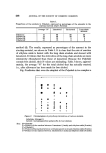
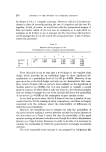
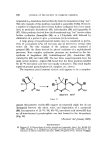
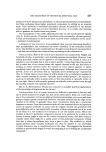
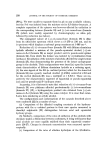
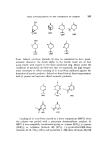
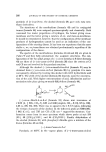
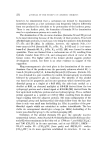
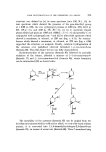
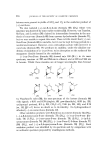
SOME INVESTIGATIONS OF THE CHEMISTRY OF CARENE I I• '•-'• C--SCH• = L P,,• ./• • /H•S 257 MeLi o ////0 H 5 / J (24) HO (17) of the methyl xanthogenate (formula 22) of (--)-cis-caran-trans- 4-ol (formula 17), a reaction which is known to take place by cis-elimination. Yields were only moderate. We have recently found {20) that (--)-cis- car-4-ene (formula 21) is formed quantitatively from the toluene p- sul- phonylhydrazone (formula 23) of (--)-cis-caran-4-one (formula 18) by treatment with methyl lithium (21). It is now possible to obtain subs{antial quantities of car-4-ene by this route. Steric hindrance to approach of boron hydride to the [•- side of (--)- cis-car-4-ene is not so evident, from a study of models, as it is in the cases of the car-2- and 3-enes. In addition, since the double bond may be con- sidered to be synunetrical, the boron atom can appear at either C4 or C5, leading, after oxidation to both caran-4- and 5-ols. In the event, (--)-cis-car-4-ene (formula 21) gave a mixture of (--)-cis-caran- trans-4-ol (formula 17) (20%) and (--)-cis-caran-trans-5-ol (formula 24)
Purchased for the exclusive use of nofirst nolast (unknown)
From: SCC Media Library & Resource Center (library.scconline.org)