SENSORY TESTING -- A STATISTICIAN'S APPROACtt 213 venient testing site, perhaps a local hall or a mobile caravan in a market place. The most likely starting point for the statistician in this field is to be confronted with some single judgement by a research worker and be asked to support it with an experiment designed to convince all concerned that this is a valid statement of fact. Alternatively, some point of dissension between two judgements occurs, and the statistician is brought in to devise a crucial test. The statistical line of attack is to request from the client full details of the experimental situation and to seek to devise a suitable and relevant testable hypothesis. For example, let us suppose that the research worker is interested in xvhether a difference in flavour exists between two batches of a peppermint oil for incorporation in a tooth preparation. He may be concerned to evaluate whether the addition of a bacteriostat to a cosmetic cream has caused a detectable change in its perfume. He may wish to evaluate the effect on colour of n-months' storage in plastic containers in comparison with storage in glass containers. THEORETICAL PROBABILITY CONSIDERATIONS All of these are clearly concerned with sensory difference testing. Sir Ronald Fisher (1) set out in some detail the statistical principles involved in setting such a testable hypothesis. He described in a classical reference "a lady who declares that, by tasting a cup of tea made with milk, she can discriminate whether the milk or the tea infusion was first added to the cup". The hypothesis to be tested was that she was unable to discriminate between the two forms of tea, and that her identification was, therefore, purely at random. The statistician calls this the null hypothesis. The experiment devised by Fisher was to offer the good lady eight cups of tea in turn, four being mixed in one way and four in the other. These were presented to her in a random order and she had to taste each of the eight and identify whether tea had been added to the milk or the milk added to the tea. On the null hypothesis (that is that her identification was made purely at random), the probability of her making a completely correct set of eight identifications, assuming she knew that there were four of each, would be 1 in 70. It is the statistician's approach to such matters to assume that, should such an unlikely event occur, then its occurrence should be taken to be evidence that the null hypothesis is not true. Thus, if Fisher's lady correctly identified all eight cups of tea, then she was not choosing at random.

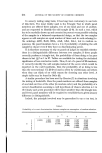
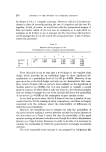
214 JOURNAL OF THE SOCIETY OF COSMETIC CHEMISTS In sensory testing using taste, it has long been customary to use tests of this form. The most widely used is the Triangle Test in which panel members are offered three samples, two of one kind and one of another, and are requested to identify the odd sample (2-6). In such a test, which has to be carefully drawn up and executed to present every possible ordering of the samples in a balanced experimental design, so that the two samples appear as odd samples an equal number of times and in such ordering (i.e. the orderings ABB, BAB, BBA, AAB, ABA, BAA, but in random se- quences), the panel members have a 1 in 3 probability of picking the odd sample by chance even if they have no discriminating power. It is therefore necessary to rely on panels of judges to establish whether there is a distinguishable difference between two samples if three people correctly perform a triangle test, the probability of them doing so by pure chance is but («)3 or 1 in 27. Tables are available for testing the statistical significance of less conclusive results. Thus, if out of a panel of 20 members, 11 correctly identify the odd samples instead of the seven which would be expected on the null hypothesis, then the probability of so doing is less than the conventional 1 in 20 level used so often by statisticians and others when they can think of no valid reason for choosing any other level. A simple table may be found in Ostle (6). A similar procedure has been used by Harries (7) in situations involving the testing of foodstuffs. Here the panel members are offered three samples of one kind and two of the other (in random order) and the probability of a correct classification assuming a null hypothesis of chance selection is 1 in 10. Clearly such a test procedure will be more sensitive than the triangle test, and fewer panel members will be required to establish that a given sensory difference is distinguishable. Indeed, the principle involved may be generalised to an n+m test, in Table I. Probability of correct discrim[nation between samples on assumption of random selection. m n 1 2 3 4 5 6 (1.000) 0.333 0.250 0.200 0.167 0.143 (0.333) 0.100 0.067 0.048 0.036 (0.100) 0.029 0.018 0.012 (0.029) 0.008 0.005 (0.008) 0.002 (0.002)
Purchased for the exclusive use of nofirst nolast (unknown)
From: SCC Media Library & Resource Center (library.scconline.org)