SENSORY TESTING - A STATISTICIAN'S APPROACH 225 small differences more effective, if its effect is to cancel out the common elements of two odours, and merely leave those portions of the odours which were not common to both samples more obvious. There is some support for this hypothesis in the finding that the 6-t-6 test is relatively insensitive to large differences in perfume concentration (where the ratio may be of the order of 100:150) in cases where we are talking about identical perfumes at different levels, but is extremely sensitive to quite small contaminant traces of extraneous odour. However, it is arguable that if sensory fatigue does enter into the judgements of panelmembers assessing smells under these test conditions, then this is entirely appropriate since, particularly with personal cosmetic products it is the smell after continued exposure which requires to be judged. FURTHER DEVELOPMENTS This document has confined itself to discussing in some detail the statistician's approach to certain forms of sensory testing in which two different samples are compared together. Much work has now been carried out on an extension to these techniques in the odour testing field in which many more different products are used (up to 10 or 12) and in which the subject is given the opportunity to create whatever groups he or she thinks appropriate. This approach has proved exceedingly valuable in the quality control field where there are a number of batch samples to compare with some form of control sample this particu- lar application is built upon the structure of the 69-6 test described in the earlier part of this report, which is used to provided known and measured differences to be inserted in amongst the set of smells to be evaluated. The procedure is to take the series of batch samples and to bulk them together having done this the bulk sample is divided in half, and one half has a known amount of a contaminating substance mixed in with it. This difference is checked by a 69-6 test, which is expected to yield a difference of about 30% scoring six and five correct. This level was hit upon empirically as the result of long testing on a variety of different formulae changes of greater or lesser degree 30% was established to be the kind of test difference found between samples available in the retail trade at the end of two years at a time when no complaints whatsoever about smell were being received. This and similar arguments led to the establishment of a 30% discrimina-

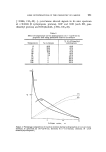
226 JOURNAL OF THE SOCIETY OF COSMETIC CHEMISTS tion level it is now interesting to see from Table HI that this level corresponds to a basic p of 0.5 in other words, this is the kind of level of detectability at which a panel member is as likely to say a difference exists as often as not whenever he judges it. This seems to be a very logical sort of level to take for the base line kind of differences below which one does not want to bother to know. Having built this known difference into the test set, then the operation calls for panel members to group the samples into as many different groups as they can detect. Any samples which are grouped together more frequently than the difference between the Bulk and the Contaminated Bulk (to use the terminology used in the test situation) are then indistinguishable the test samples should be indistinguishable from each other and a control sample. This same technique is combined with some multivariate statistical analyses employing a mathematical procedure known as the method of Principal Components to enable meaningful interpretation to be put on the way in which the samples are grouped together. It is not proposed to discuss this further in this paper except to indicate that the techniques we have described have considerable potential for further use and development. CONCLUSION This paper has been written to show that the close collaboration of the statistician and the cosmetic chemist in this difficult field of sensory assessment can be of considerable mutual benefit. In particular, I would lay stress on the following points:- (1) This is a field in which the concepts of probability are of vital import- ance - the probability of making choices regardless of any discrimina- ting power as compared with the probability to be found when making discrimination. (2) This is a field in which it is very easy to lose sight of the essential purposes of the tests unless great care is exercised by both statistician and the cosmetic chemist. In particular, it is too easy to assume that too much has been proved by a very limited test simply because it makes life complicated to believe otherwise. (3) This is a field in which the statistician can use the tools of his trade to get out a lot of hidden information, provided he can suggest the experimental designs before the work is done, not afterwards. (Received: 7th February 1970)
Purchased for the exclusive use of nofirst nolast (unknown)
From: SCC Media Library & Resource Center (library.scconline.org)