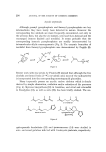
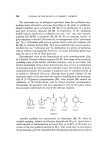
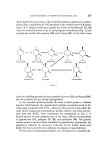
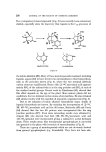
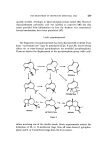
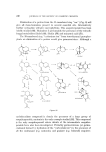
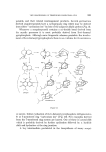
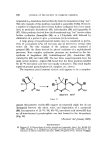
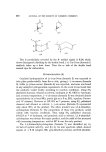
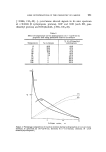
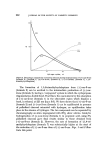
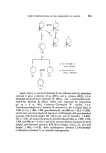
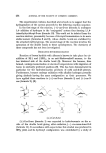
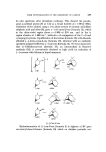
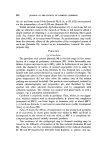
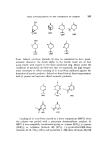
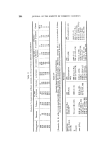
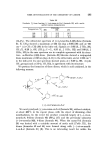
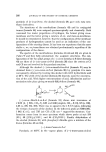
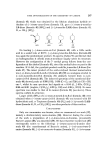
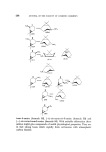
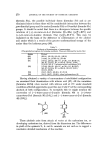
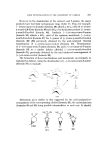
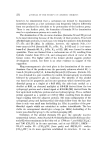
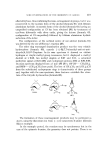
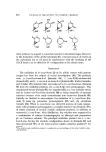
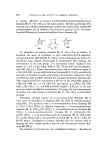
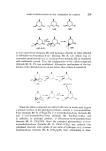
280 JOURNAL OF THE SOCIETY OF COSMETIC CHEMISTS Likewise (--)-m-menth-3-en-5-one (formula 84), the other ketone photo- product was reduced to (--)-cis-m-menthan-5-one. The spectra of these unsaturated ketonic photo-products are in accord with their structures. We give as an example the spectra of the principal photo-product, (--)-cis- m-menth-8-en-5-one (formula 83 R, CH 3C =CH2). In the infra-red region this absorbed at 3 067 (C=CH2), 1 712 (C=O), 1 645 (C=C), and 890 (C=CH2) cm-1, whilst in its nmr spectrum, in carbon tetrachloride, it displayed signals at z 5.2 (s, C--CH2), 7.76 {m, CH2COCH2), 8.25 (s, CH 3C = C), and 8.95 (d, J 6Hz, CH 3C). The formation of the dihydro ketone, (--)-cis-m-menthan-5-one [formula 83 R, (CH 3)2CH• during the photolysis is clearly the result of intervention by the solvent. When either ether or hexane is employed as solvent this saturated ketone is formed, whereas in benzene only the a, [I- unsaturated ketone (formula 84) is produced. There is ample precedent, at any rate in the case of ether (63), for the solvent acting as hydrogen donor. Hexane could also act as hydrogen donor, but benzene is most unlikely to assume this role. It is also significant that alcohols are formed only when ether, the best hydrogen donor of the three solvents, is employed. ACKNOWLEDGMENTS I am very grateful to my collaborators, Drs. P. H. Boyle, M. S. Carson, D. P. Hanna, A. C. Pratt, P. V. R. Shannon and P. A. Staniland and Messrs. W. D. P. Burns, S. M. Evans, D. H. Grayson and P. B. Kulkarni who were largely responsible for the work described. I also wish to thank the Chemical Society for permitting me to use tables and diagrams published in their Journal. (Received: 19th February 1970) REFERENCES (1) Simonsen, J. L. and Owen, L. N., The terpenes, II 65, 73 (1949). (Uniwrsity Press, Cambridge). (2) ibid, 61-99. (3) Acharya, S. P. Conformations of 3-carerie and 2-carerie. Their conformational preference and the reactivity of the double bond. Tetrahedron Letters, 4117 (1966). (4) Cocker, W., Shannon, P. V. R. and Staniland, P. A. The chemistry of terpenes, Part I. Hydrogenation of the pinenes and carenes. J. Chem. Soc. C 41 (1966). (5) Brown, H. C. tIydroboronation 123 (1962) (Benjamin, New York). (6) ,:bi•, 136. (7) Brown, H. C. and Zweifel, G. Hydroboronation of Terpenes, II. The hydroboronation of a- and [t-pinene. The absolute configuration of the dialkylborane from the hydroboro- nation of a- pinene, J. Am. Chem. Soc. 86 393 (1964). (8) Cocker, W., Shannon, P. V. R. and Staniland, P. A. The chemistry of terpenes, Part III. Oxidafire hydroboronation of Car-2-,-3-, and-4-enes. J. Chem. Soc [C] 485 (1967). The chemistry of terpenes. Part IV. The hydroboronation of (+)-Car-3-ene at elevated temperatures. J. Chem. Soc [C] 915 (1967).

SOME INVESTIGATIONS OF THE CHEMISTRY OF CARENE 281 (9) Brown, H. C. and Garg, C. P. The chromic acid oxidation of organoboranes. A convenient procedure for converting olefins into ketones via hydroboronation. J. Am. Chem. Soc. 83 2952 (1961). (10) Baeyer, A. Ortbestimmungen in der Terpenreihe. Bet. 27 1915 (1894). (11) Cocker, W., Hanna, D. P. and Shannon, P. V. R. The chemistry of terpenes. Part ¾I. Pyrolysis and acid-catalysed rearrangements of (-{-)-Car-3-ene and some derivatives. J. Chem. Soc. [C] 489 (1968). (12) Cocker, W., Shannon, P. V. R. and Staniland, P. A. The chemistry of terpenes, Part II. The physical properties of some cis-trans substituted cyclohexanes. J. Chem. Soc. [C] 946 (1966). (13) Brown, H. C. and Deck, H. R. Selective Reductions, VIII. The stereochemistry of reduction of cyclic and bicyclic ketones by the alkoxy-substituted lithium aluminium hydrides. J. zlm. Chem. Soc. 87 5620 (1965). (14) Williams, D. H. and Bhacca, N. S. Solvent effects in n.m.r. spectroscopy-II. Solvent shifts in some steroida[ sapogenins. Tetrahedron 21 1641 (1965). (15) Williams, D. H. Chemical shifts induced by pyridine in ketones. Tetrahedron Letters 2305 (1965). (16) Barton, D. H. R. The stereochemistry of cyclohexane derivatives. J. Chem. Soc. 1027 (1953). (17) Gollnick, K. Studten in der Caranreihe, V. Tetrahedron Letters 327 (1966). (18) Gollnick, K., Schroeter, S., Ohloff, G., Schade, G. and Schenck, G. O. Zur photosensi- bilisierten O 2- ]•ber•ragung auf ( +)-Caren-3..4 nnale• 687 14 (1965). (19) Kuczynski, H. and Chabudzinski. Z. Stereochemia Ukladu Karanu. Roczniki Chem. 35 227 (1961). (20) Carson, M. S., Cocker, W. and Kulkarni, P. B. Preparation of (-)-cis-Car-4-ene. Tetra- heelton Letters 669 (1970). (21) I)auben, W. G., Lorber, M. E., Vietmeyer, N. D., Shapiro, R. H., Duncan, J. H. and TomeL K. J. Preparation of conjugated dienes from tosylhydrazones of a, [l-unsaturated ketones and alkyllithium reagents. ]. •lm. Chem. Soc. 90 4762 (1968). (22) Carson, M. S., Cocker, W., Grayson, I). H., Pratt, A. C. and Shannon, P. V. R. The chemistry of terpenes. Part VII. The stereochemistry of the cis-Caranols. Some evidence for their conformational preferences. ]. Chem. Soc. [C] 1136 (1968). (23) Rader, C. P. Conformational study of cyclohexanols in dimethylsulphoxide, Chem. Soc. 88 1713 (1966). (24) Barton, I). H. R. The conformation of the steroid nucleus. l• vperientia 6 316 (1950). (25) House, H. O. Modern synthetic reactions 83 (1965) (Benjamin, New York). (26) Schreiber, J. and Eschenmoser, A. l•ber die relative Geschwindigkeit der Chromosaure- oxidation sekundiirer, alicyclischer Alkohole. ttelv. Chim..4eta 38 1529 (1955). (27) Richer, J. C. and Gilardeau, C. Mechanism of chromic oxidation of secondary alcohols. Canacl. ]. Chem. 43 538 (1965). (28) Eliel, F.. L., Allinger, N. L., Angyal, S. J. and Morrison, G. A. Conformational analysis 269 (1965) (Interscience, New York). (29) Marquet, A. and Horeau, A. D4termination des configurations par "d4doublement partiel". VII, Bull. Soc. Chim. trrance 124 (1967) where earlier refs. are given. (30) Pesnelle, P. and Ourisson, G. Hydroboration of a-gurjunene. ]. Org. ½hem. 30 1744 (1965). (31) Cocker, W., Hanna, D. P. and Shannon, P. V. R. Products of the pyrolysis of (+)-Cax- 3-ene and related compounds. Tetrahedron Letters 4547 (1966). (32) Sully, B. D. Perfumery chemicals from pinene. Chem. Ind. London 263 (1964). (33) Gollnick, K. and Schade, G. Studten in der Caranreihe--II. Uber die Pyrolyse der Acetate yon (+)-(1R:4:6S)-Caran-trans-4-ol und (+)-(1R:4S:6S)-Caran-cis-4-ol: (+)- (1R:6S)-A 4-carene und (+)-(1R:4R)-trans-A2,a-p-Menthadiene. Tetrahedron 22 123 (1966). (34) (a) Bardyshev, I. I. Properties of sylvestrene, Doklady ,4kad. Nauk S.S.S.R. 90 1035 (1953). (b) Levina, R. Y., Kim, D. G., Smirnova, E. N., Orlava, N. D. and Treshchova, E.G. Synthesis of hydrocarbons. LIX. Bicyclo [0.1.3]hexanes with two quaternary carbon atoms. Zhur. Obshchei Khim. 27 1779 (1957) [Chem. ,4bs. 52 4518a (1958)]. (c) Rudakov, G. A. and Marcherskil, A. T. Catalytic transformations of terpenes. V. Catalytic transformations of 3-carene over metatitanic acid. Sbornik Statei Obschei Khim. 2 1432 (1953) [Chem. Abs. 49 5390e (1955)]. (35) Cf. Komae, H. Catalytic reactions of Japanese acid clay with 1,8-cineole and withlimon- ene, ]. Sci. Hiroshima Univ. A24 699 (1960) [Chem. •lbstrs 56 6005a (1962)].
Purchased for the exclusive use of nofirst nolast (unknown)
From: SCC Media Library & Resource Center (library.scconline.org)