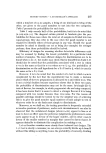
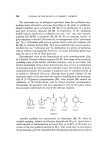
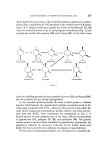
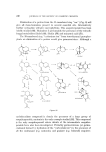
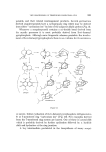
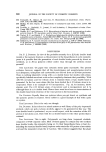
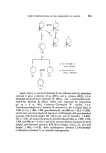
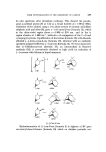
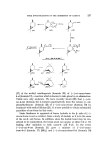
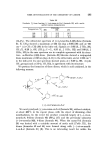
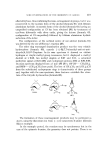
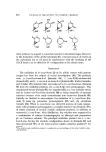
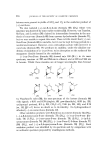
258 JOURNAL OF THE SOCIETY OF COSMETIC CHEMISTS (80%). We were unable to separate them by glc on any available column, but the 5-ol was isolated from the mixture via its 3,5-dinitro-benzoate. A complete separation of the epimers was however effected by oxidation to the corresponding ketones (formula 18) and (+)-cis-caran-5-one (formula 25) (which were readily separated by chromatography on silica gel), followed by reduction (see below). The conjugated nature of (+)-cis-caran-5-one (formula 25) is clear from its ultraviolet spectrum which shows e=3 279 at 210 nm, and its ir spectrum which displays a carbonyl group maximum at 1 685 cm-1. Reduction of (+)-cis-caran-5-one (formula 25) with lithium aluminium hydride afforded a mixture of the pseudo-equatorial alcohol, (+)-cis- caran-cis-5-ol (formula 26) as major product and its pseudo-axial epimer (formula 24), from which the former was isolated by crystallisation from methanol. Reoxidation of the mixture of alcohols afforded the single ketone (formula 25), thus demonstrating the presence of the intact cyclopropane group in the alcohols. Their configurations were based (a) upon the known steric characteristics of lithium aluminium hydride as a reducing agent, (b) the nmr signals of the 5H (a- carbinol proton) which for the trans-5-ol (formula 24) was a poorly resolved doublet (J 4.5Hz) centred at • 6.0 and for the cis-5-ol (formula 26) was a multiplet at ß 5.5-6.1. These are res- pectively the characteristics expected of equatorial or pseudo-equatorial and axial or pseudo-axial 5- hydrogen atoms. In passing, it is of interest to note that reduction of (+)-cis-caran-5-one (formula 25) over platinum afforded predominantly (+)-cis-m-menthane (formula 27) (12), a hydrogenolysis product also obtained from (+)-cis- caran-cis-5-ol (formula 26) using the same catalyst. It is clear that caran- 5-ol is here simulating an allylic alcohol. The configurations and conformations of the caranols described above were confirmed (22) in a number of ways. (a) Comparison of the dihedral coupling constants of the hydroxy- protons with the a-carbinol protons in their nmr spectra measured in dimethyl sulphoxide (23) distinguishes between axial and equatorial hydroxy groups. (b) Similarly, comparison of the rates of oxidation of the alcohols with chromate makes a distinction between conformers, it being well known that axial alcohols are more rapidly oxidised than their equatorial counter- parts (24-27). Changes in chromate concentration were measured spectro- scopically. (c) Comparison of the rates of alkaline hydrolysis of the 3,5-dinitro-

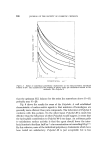
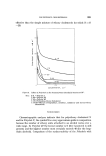
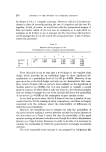
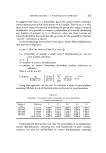
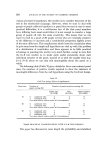
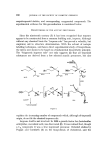
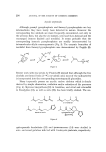
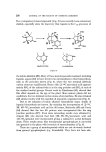
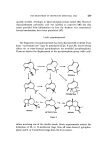
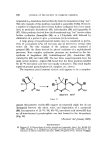
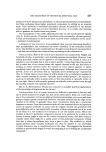
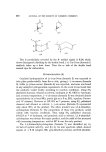
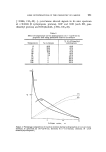
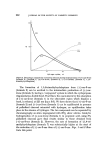
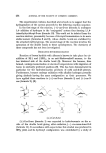
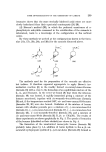
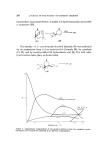
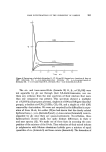
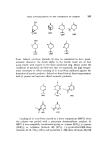
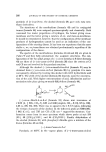
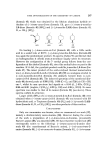
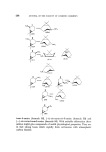
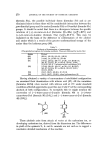
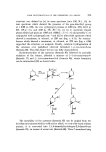
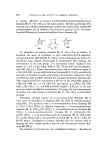
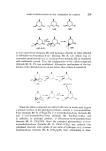
SOME INVESTIGATIONS OF THE CHEMISTRY OF CARENE 259 benzoates shows that the more sterically hindered axial esters are more slowly hydrolysed than their equatorial counterparts (24, 28). (d) Horeau's method (29), in which the preferred enantiomer of a- phenylbutyric anhydride consumed in the esterification of the caranols is determined, leads to a knowledge of the configuration at the carbinol centre. By these methods we arrived at the configurations shown in the form- ulae (1 la, 17a, 20a, 24a, and 26a) for the caranols discussed above. 7 CH2B CH2[• =_ (28) • (2•) ($o} R The methods used for the preparation of the caranols are effective but tedious. It therefore appeared appropriate to apply Brown's iso- merisation reaction (6) to the readily formed cis-caranyl-trans-4-borane (formula 16) with a view to the formation of an equilibrium mixture of the 2-, 4-, and 5-boranes. In the event we found (8) that when the 4-borane (formula 16) was heated, it rapidly isomerised giving a mixture of the boranes mentioned, together with cis-m-menth-4-enyl-8-borane {formula 28) and, if the temperature reached 140 ø, cis- and trans-caranyl-lO-boranes (formulae 29, 30) were also formed. Oxidation of the mixture of borane isomers with alkaline peroxide gave a mixture of (--)-cis-caran-trans-2-ol (formula 11), (--)-cis-caran-trans-4-ol (formula 17), (--)-cis-caran-trans-5-ol (formula 24), (--)-cis-m-menth-4-en-8-ol (formula 31), and a mixture of cis- and trans-caran-10-ols (formula 32 R, [i-, a- CH20H). The results of these experiments are shown graphically in Fig. 8. The speeds of formation of the boranes (identified as their alcohols) are shown in Fig. 4. The formation of the unsaturated monocyclic borane (formula 28) probably takes place by 1,4- addition of boron hydride to the a, [i- un- saturated cyclopropane system of (--)-cis-car-4-ene (formula 21) formed as
Purchased for the exclusive use of nofirst nolast (unknown)
From: SCC Media Library & Resource Center (library.scconline.org)