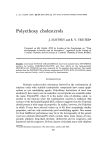
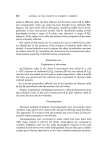
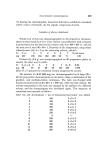
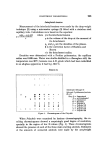
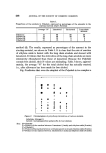
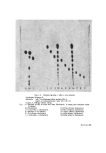
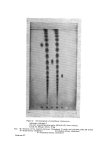
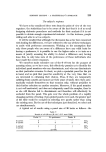
POLYETHOXY CHOLESTEROLS 203 On heating the chromatoplate, lanosterol derivatives exhibited a transient yellow colour eventually, all the organic compounds charred. Isolation of ethoxy cholesterols Product (a) (1.5 g) was chromatographed on 15 preparative chromato- plates in three batches of five. Four elution was performed with benzene/ acetone/water for the first two the volume ratio was 400+ 100+ 1 and for the next two it was 140+60+ 1. Recovery of the components, using ether/ ethanol/water (14+ 5 + 1) as the extracting solvent, yielded:- N: 0+ 1 2 3 4 5 6 7 8 and more mg: 457 160 184 182 139 92 71 132 Product (b) (2.9 g) was chromatographed on 20 preparative plates in exactly the same way to yield:- N: 0+1+2 3 4 5 6 7 8+9 8-22 mg: 88 35 51 68 79 103 353 1 090 (from N=7 upwards the resolution became progressively poorer) The mixture N =8-22 (800 mg) was chromatographed on 8 large (20 X 40 cm) preparative chromatoplates in one batch, using a combination of the gradient- and multiple-elution techniques. The tank was charged with benzene/acetone/water (140+60+1 1 500 ml). After the first elution, the solvent-composition in the tank was change d by the addition of a different solvent, and the chromatogram was developed again. This sequence of operations was repeated as follows:- After the nth development v ml of benzene/acetone/water was added. 1 100 5+5+2 2 100 5+5+2 3 lOO 5+5+2 4 500 6+4+ 1 5 100 5+5+2 6 250 5+5+2 7 0 -- 8 250 5+5+2 9 250 5+5+2 10 250 5+5+2 11 250 5+5+2 12 500 4+6+3

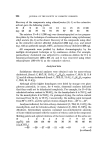
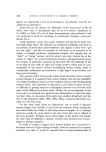
204 JOURNAL OF THE SOCIETY OF COSMETIC CHEMISTS Recovery of the components using ethanol/water (4+ 1) as the extractive solvent gave the following yields:- N: 8 9 10 11 12 13 14 15 16 17-20 mg: 23 42 79 94 91 78 67 58 53 95 The mixture N----0-t-1 (300 mg) was chromatographed on ten prepara- tire plates by the technique of continuous development using cyclohexane/ ethyl acetate (4-t-1) as the eluent. Recovery of the compounds using ether as the extractive solvent afforded cholesterol (222 mg), m.p. and mixed m.p. with an authentic sample, 148øC, and mono-ethoxy cholesterol (68 mg). All compounds were purified by further chromatography by the multiple development technique or by continuous elution. For example, penta-ethoxy cholesterol was subjected to continuous elution for 6 h in benzene/acetone/water (400+100q-1) and it was recovered using ether/ ethanol/water (190-t-9-t-1) as the extractive solvent. Analytical data Satisfactory elemental analyses were obtained only for mono-ethoxy cholesterol, (found: C, 80.7 H, 11.6% C29H5002 requires: C, 81.0 H, 11.6 %) and di-ethoxy cholesterol (found: C, 78.2 H, 11.4% C 31H5403 requires: C, 78.5 H, 11.4%). Although all the higher homologues were dried by storage over phos- phorous pentoxide, in vacuo, for 4 weeks, elemental analyses indicated that they could not be dehydrated completely. For example, for N=3 the calculated carbon content is 76.55%, for the hemihydrate it is 75.1% and for the monohydrate it is 73.8%. On prolonged drying, the carbon content increased from 74.1% to 75.7%. Concurrently, the melting point increased from 80 ø to 101øC, and the optical rotation changed from --23 ø to --27 ø. Analyses indicated, for tetra-ethoxy cholesterol (C, 72.6 H, 11.0%) the monohydrate, and for tetradeca-ethoxy cholesterol (C, 63.4 H, 9.9%) the dihydrate. Intermediate members contained non-stoichiometric amounts of water which increased with the number of ethoxy units in the compound. Melting points and optical rotations of the lower members of the series are: N 1 2 3 4 5 6 7 9 13 16 mp(øC) 116 108 101 90 84 76 70 60 46 44 [a]D(CHC13) m33 ---29 --27 --23 --21 m20 --19 --9 •6 (in ethanol)
Purchased for the exclusive use of nofirst nolast (unknown)
From: SCC Media Library & Resource Center (library.scconline.org)