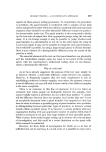
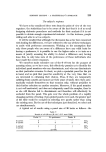
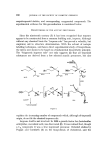
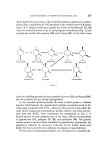
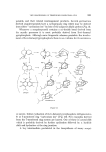
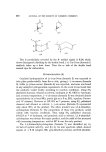
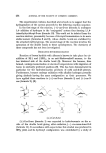
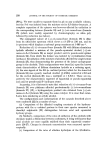
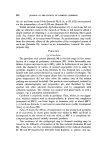
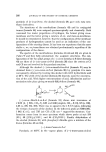
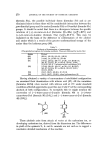
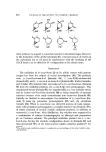
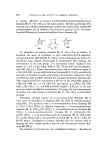
232 JOURNAL OF THE SOCIETY OF COSMETIC CHEMISTS sesquiterpenoid skeleta, and corresponding oxygenated compounds. The experimental evidence for this generalisation is considered below. BIOSYNTHESIS OF THE ACYCLIC PRECURSORS Since the nineteenth century (5) it has been recognised that terpenes appear to be constructed from a common building unit, isoprene. Although without any chemical basis the "isoprene rule" has proved a valuable, but empirical, aid to structure determination. With the advent of isotopic labelling techniques, and hence direct experimental study of biosynthesis, the rule is now shown to be based on a fundamental biosynthetic principle. The "biogenetic isoprene rule" not only suggests {2) that all terpenoid substances are derived from a few selected acyclic precursors, but also HO . H• I-I• HO O O OH M VA DMAPP ATP • • H AX •, IATP Figure explains the increasing number of compounds which, although of terpenoid origin, do not fit the classical isoprene rule. Isoprene itself is not involved. In 1956 a growth factor for Lactobacillus acidophilus, mevalonic acid, was discovered (6). It was realised that, though a C 6 compound, it was a true isoprenoid precursor. Detailed studies by Popj•k and Cornforth (4) on the biosynthesis of cholesterol, and the

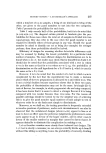
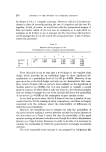
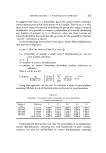
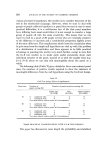
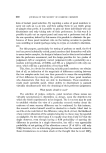
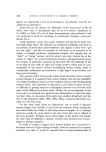
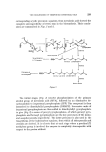
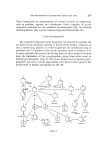
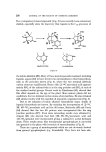
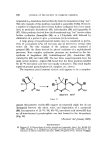
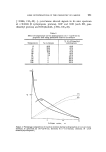
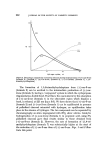
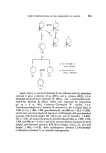
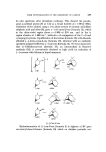
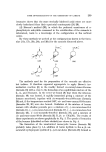
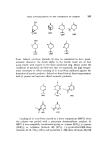
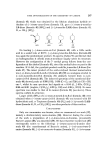
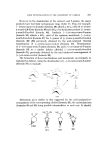
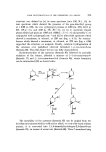
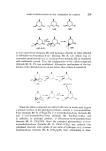
THE BIOGENESIS OF TERPENOID ESSENTIAL OILS 233 corresponding acyclic precursor, squalene, from mevalonic acid showed the complete stereospecificity of every step in the biosynthesis. Their conclu- sions are summarised in Figs. 1 and oe. 0 . "' 0 similarly & Triterpenes Farn½syl pyrophosphate s•milarly Direrpenes & • • ,, ©©o T½ tr• t ½ rpcncs Gcranyl gcraniol pyrophosphate Gutta Pcrcha Figure The initial stages (Fig. 1) involve phosphorylation of the primary alcohol group of mevalonic acid (MVA), followed by an eliminative de- carboxylation to isopentenyl pyrophosphate (IPP) This compound is then isomerised to dimethylallyl pyrophosphate (DMAPP). Successive units of isopentenyl pyrophosphate are then added to dimethylallyl pyrophosphate to give (Fig. oe) a series of prenyl pyrophosphates, of which geranyl pyro- phosphate and farnesyl pyrophosphate are the key precursors of the mono- and sesquiterpenoids respectively. The latter precursor is also used in the biosynthesis of the hydrocarbon squalene, from which all triterpenoids and steroids are derived. It is of note that at each stage where a prochiral (7) methylene group is involved the enzyme is completely stereospecific with respect to the proton utilised.
Purchased for the exclusive use of nofirst nolast (unknown)
From: SCC Media Library & Resource Center (library.scconline.org)