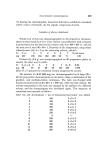
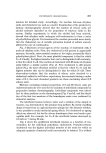
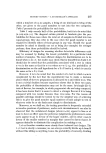
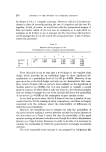
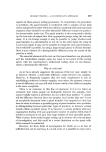
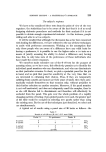
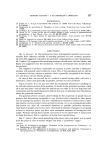
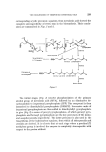
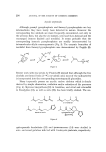
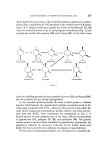
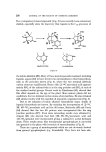
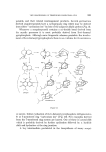
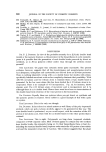
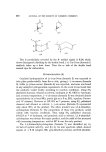
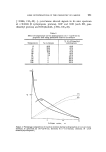
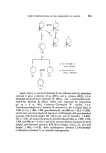
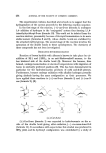
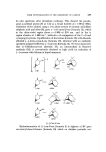
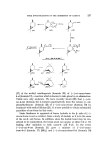
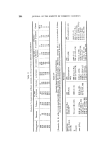
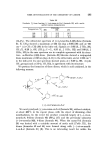
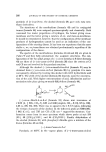
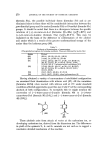
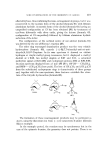
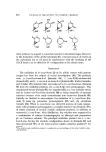
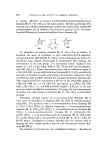
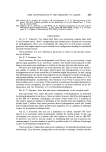
270 JOURNAL OF THE SOCIETY OF COSMETIC CHEMISTS (formula 51a), the possible half-chair forms (formulae 5lb and c) are eliminated since in these there will be considerable interaction between the gem-dimethyl group and the amino (formula 5 lb) or 10-methyl (formula 5 lc) groups. It should be noted that there is a divergence between the specific rotations of (+)-cis-caran-cis-4-ol (formulae 20=20a) ([a1•+49øC) and (+)-cis-caran-cis-4-amine (formula 51a) ([a]•+27.3øC). This may be explained on the basis of the difference in conformation of the alcohol and amine which is a result of the greater conformational energy of the amino than the hydroxy group (46). Table V. Products of deamination of caranamines [The products are given by formulae numbers. These are followed by yields ( •)] •4 min• Product (49) (56-14), (45-19), (46-41), (48-24) (50) (11-26), (11, •-OH-21), (57-49) (51) (17-12), (20-12), (60 R l, a-CH3, R2, •-OH-14), (60 R1, •-CH3, R2, a-OH-4), (61-14), (2-29), (21-8.5), (63-1). Uncharacterised substances (5.5) (52) (17-18), (20-15), (60 R l, a-CH3, R2, •-OH-7), (60 R1, [I-CH•, R2, a-OH-2), (61-12), (2-21) (21-13), (63-8). (53) (24-7), (26-7), (31-81), (2+21-5) (54) I (24-7), (26-7), {31-81), other hydrocarbons Having obtained a variety of caranamines of established configuration we examined their deamination with nitrous acid (47). All the caramines (formulae 49-54) when reacted with nitrous acid at 0øC under standard conditions afforded appreciable quantities (see Table V) of the corresponding alcohols of both configurations. To exemplify this we might mention the conversion of (--)-trans-caran-cis-2-amine (formula 49) to (+)-trans- caran-trans-2-ol (formula 56) (14%) and (--)-trans-caran-cis-2-ol (formula 45) (19%). ? H0 {o7l These alcohols arise from attack of water at the carbonium ion, or developing carbonium ion, derived from the diazonium ion. The differences in yield of the epimeric 2-, 4- and 5- caranols are not such as to suggest a conclusive detailed mechanism of the reaction.

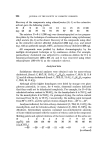
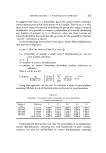
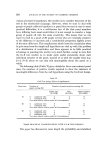
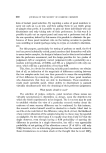
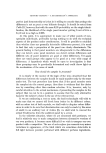
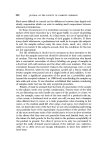
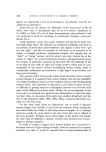
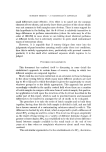
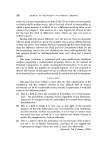
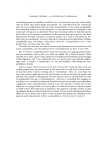
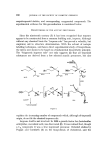
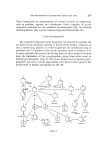
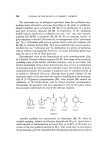
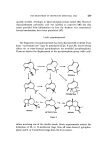
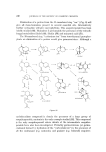
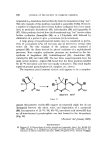
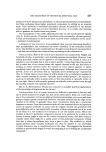
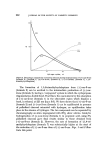
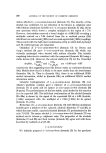
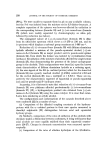
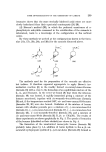
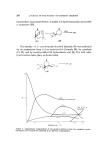
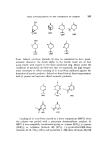
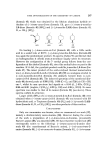
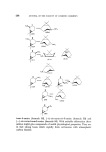
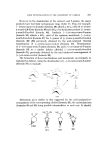
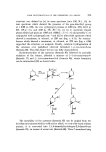
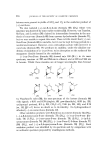
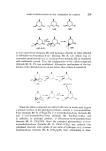
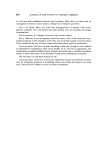
SOME INVESTIGATIONS OF TIlE CHEMISTRY OF CARENE 271 However in the deamination of the caran-2- and 5-amines the major products have lost their cyclopropane rings (Table V). Thus, for example, (--)-trans-caran-cis-2-amine (formula 49) affords a 41% yield of (+)-trans- p-menth-2,8-diene (formula 46) and 24% of its hydration product (+)-trans- p-menth-2-en-8-ol (formula 48). Similarly (--)-cis-caran-trans-2-amine (formula 50) affords a 49% yield of the epimeric menthenol, (--)-cis-p- menth-2-en-8-ol (formula 57) the 1- epimer of (+)-trans-p-menth-2-en-8-ol (formula 48) (33) previously obtained by the acid-catalysed thermal isomerisation of (--)-trans-caran-cis-2-ol (formula 45). Deaminations of (--)-cis-caran-trans-5-amine (formula 54) and (+)-cis-caran-cis-5-amine (formula 53) in a similar fashion afforded (--)-cis-m-menth-4-en-8-ol (formula 31), previously obtained by the acid catalysed rearrangement of (+)-cis-caran-cis-5-ol (formula 26). The formation of these menthadienes and menthenols can formally be explained as follows, using the deamination of (--)-cis-caran-trans-5-amine (formula 54) as example. (,54 a ) (58) Mechanism (a) is similar to that suggested for the acid-catalysed re- arrangement of the corresponding alcohol (formula 26), the carbonium ions (formulae 58 and 59) being possible intermediates in each case. It should, R• IR2 (61) (62) (65)
Purchased for the exclusive use of nofirst nolast (unknown)
From: SCC Media Library & Resource Center (library.scconline.org)