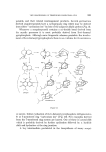
j. Soc. Cosmet. Chem. 22 231-248 (1971) ¸ 1971 Society of Cosmetic Chemists of Great Britain The biogenesis of terpenoid essential oils G. P. MOSS* Presented on 20th April 1970 at the Symposium on "Perfumery", organised by the British Society of Perfumers and the Society of Cosmetic Chemists of Great Britain, at Eastbourne, Sussex. Synopsis--The BIOSYNTHESIS of mono- and SESQUITERPENOIDS is reviewed with especial reference to the ESSENTIAL OILS. INTRODUCTION Although there has been considerable speculation (1-3) on the detailed routes by which plants produce terpenoid essential oils there has been relatively little direct study of this problem. This arises in part from some of the technical difficulties inherent in this research. With the present knowledge concerning the biosynthesis of selected terpenoids it is possible to rationalise most terpenoid structures in biosynthetic terms. However, it cannot be emphasised too strongly that there is no substitute for direct experimental proof. Although the biogenesis of a particular terpenoid usually appears obvious, the plant may have evolved a less direct, or even totally different approach to the synthesis of the compound. Terpenoid biosynthesis may be conveniently considered in two stages - the formation of the universal acyclic precursors and related compounds and the formation of cyclic terpenoids. The acyclic precursors have been studied in considerable detail (4). Geranyl pyrophosphate and farnesyl pyrophosphate are then the precursors of all the numerous mono- and *Department of Chemistry, Queen Mary College, London, E. 1. 231

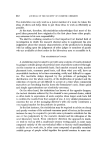
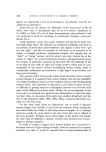
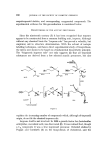
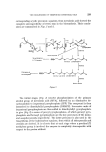
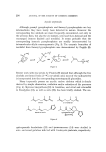
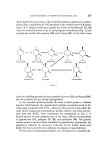
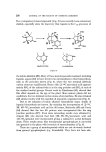
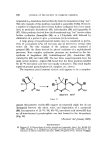
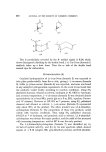
232 JOURNAL OF THE SOCIETY OF COSMETIC CHEMISTS sesquiterpenoid skeleta, and corresponding oxygenated compounds. The experimental evidence for this generalisation is considered below. BIOSYNTHESIS OF THE ACYCLIC PRECURSORS Since the nineteenth century (5) it has been recognised that terpenes appear to be constructed from a common building unit, isoprene. Although without any chemical basis the "isoprene rule" has proved a valuable, but empirical, aid to structure determination. With the advent of isotopic labelling techniques, and hence direct experimental study of biosynthesis, the rule is now shown to be based on a fundamental biosynthetic principle. The "biogenetic isoprene rule" not only suggests {2) that all terpenoid substances are derived from a few selected acyclic precursors, but also HO . H• I-I• HO O O OH M VA DMAPP ATP • • H AX •, IATP Figure explains the increasing number of compounds which, although of terpenoid origin, do not fit the classical isoprene rule. Isoprene itself is not involved. In 1956 a growth factor for Lactobacillus acidophilus, mevalonic acid, was discovered (6). It was realised that, though a C 6 compound, it was a true isoprenoid precursor. Detailed studies by Popj•k and Cornforth (4) on the biosynthesis of cholesterol, and the
Purchased for the exclusive use of nofirst nolast (unknown)
From: SCC Media Library & Resource Center (library.scconline.org)