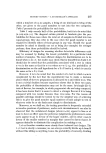
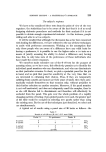
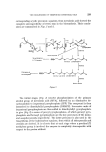
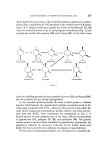
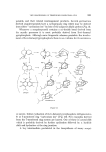
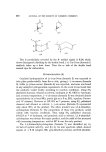
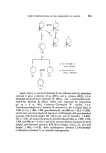
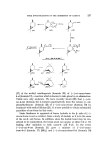
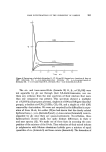
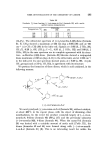
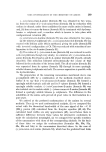
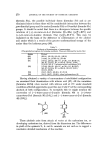
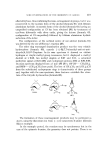
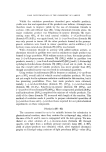
SOME INVESTIGATIONS OF THE CHEMISTRY OF CARENE 253 b io a, Hz at I0.1 MN m -• Pt/C, C•.H50H. b, H2at I01 kN Pd/C, C•HsCO2H Again, when (+)-car-3-ene (formula 2) was refluxed with 5% palladised charcoal it gave a mixture of m- (20%) and p- cymene (30%), 1,1,4- trimethylcyclohept-3-ene (formula 8) (25%), and 1,1,4-trimethylcyclo- hept-4-ene (formula 9) (25%), which were separated by preparative glc on a 6 m, 30% Castorwax-Chromasorb W column. 1,1,4- Trimethylcyclohept-3-ene (formula 8) absorbed in the ir (liquid film) at 1 650 (C--C), 1 383, 1 362 (gem-dimethyls), and 808 cm-1 (R2C--CHR), and its nmr spectrum displayed signals at • 9.08 (singlet, 6H, gem-dimethyl protons), 8.37 (broad singlet, 3H, CH3C=C), and 4.7 (doublet, J 6.SHz, 1H, C=CH). Its isomer (formula 9) absorbed (liquid film) at 1 650, 1 375, 1 $55, and 856 cm- 1 in the ir and in its nmr spectrum it resonated at x9.14 (singlet, gem-dimethyl protons), 8.30 (broad singlet, CH3C=C), and 4.73 (triplet, J 6Hz, C=CH). Both cycloheptenes afforded 1,1,4-trimethyl- cycloheptane (formula 7) on catalytic hydrogenation.

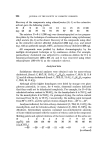
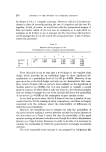
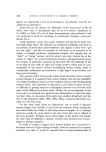
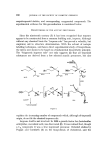
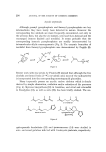
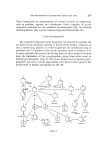
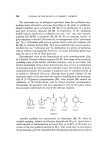
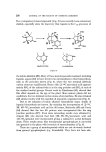
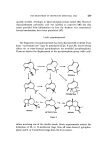
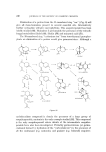
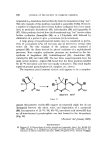
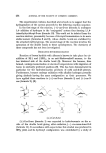
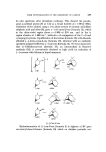
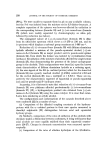
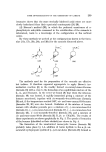
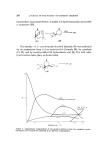
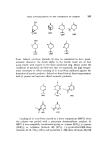
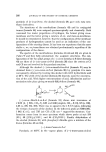
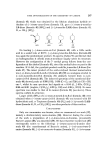
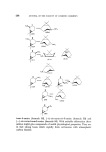
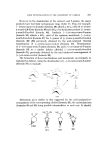
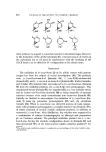
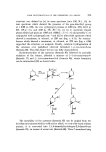
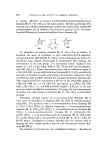
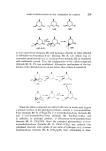
254 JOURNAL OF THE SOCIETY OF COSMETIC CHEMISTS The experimental evidence described above leads us to suggest that the hydrogenation of the carenes proceeds by the following reaction sequence. In the first stage of the reaction, (-[-)-car-2-ene (formula 1) undergoes 1,4- addition of hydrogen to the 'conjugated' system thus forming 1,1,4- trimethylcyclohept-2-ene (formula 10). This could not be isolated from the reaction mixture, presumably because of its rapid isomerisation to its more stable isomers (formulae 8 and 9), whose double bonds are stabilised by the attached methyl groups. The second stage of the reaction involves the saturation of the double bonds in these cycloheptenes. The chemistry of these compounds has not been investigated. OXIVATIVE H¾I)ROBOaONATION Reaction of boron hydride with alkenes is known to take place by cis- addition of H(-) and (+)BH2, in an anti-3/Iarkownikoff manner, to the less hindered side of the double bond (5). Moreover the boranes, thus formed, undergo isomerisation at elevated temperatures with migration of boron to sterically preferred positions (6). This has been demonstrated in particular for the hydroboronation products of a-(4) and [1-(7)pinenes. Furthermore, boranes undergo oxidation with alkaline hydrogen peroxide giving alcohols having the same configuration as their precursors. We have applied these reactions to (+)-car-2-ene (formula 1) and (+)-car-3- ene (formula 2), (8). 9 •" • (11) (11a) OH (15a) o /2a (/4) ( + )-C ar-2-ene (+)-Car-2-ene (formula 1) was expected to hydroboronate on the a- side of the double bond giving, after oxidation,(--)-cis-caran-trans-2-ol (formula 11). In accordance with expectation this alcohol was produced in 85% yield, and its hydroxyl configuration was established by a study of
Purchased for the exclusive use of nofirst nolast (unknown)
From: SCC Media Library & Resource Center (library.scconline.org)