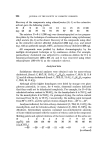
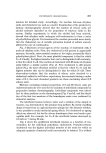
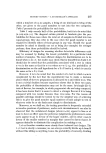
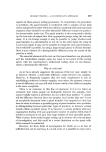
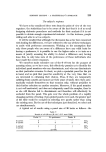
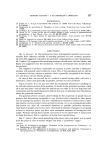
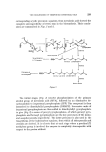
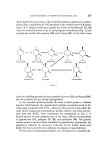
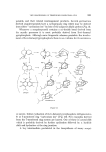
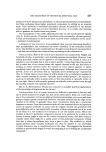
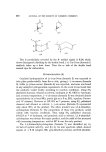
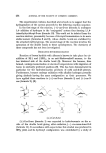
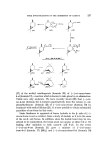
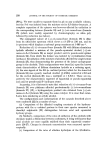
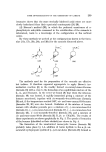
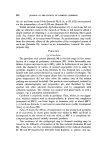
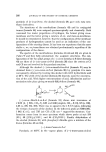
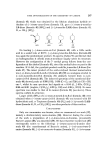
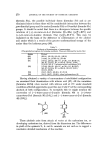
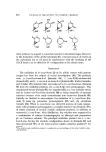
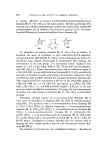
SOME INVESTIGATIONS OF THE CHEMISTRY OF CARENE I I• '•-'• C--SCH• = L P,,• ./• • /H•S 257 MeLi o ////0 H 5 / J (24) HO (17) of the methyl xanthogenate (formula 22) of (--)-cis-caran-trans- 4-ol (formula 17), a reaction which is known to take place by cis-elimination. Yields were only moderate. We have recently found {20) that (--)-cis- car-4-ene (formula 21) is formed quantitatively from the toluene p- sul- phonylhydrazone (formula 23) of (--)-cis-caran-4-one (formula 18) by treatment with methyl lithium (21). It is now possible to obtain subs{antial quantities of car-4-ene by this route. Steric hindrance to approach of boron hydride to the [•- side of (--)- cis-car-4-ene is not so evident, from a study of models, as it is in the cases of the car-2- and 3-enes. In addition, since the double bond may be con- sidered to be synunetrical, the boron atom can appear at either C4 or C5, leading, after oxidation to both caran-4- and 5-ols. In the event, (--)-cis-car-4-ene (formula 21) gave a mixture of (--)-cis-caran- trans-4-ol (formula 17) (20%) and (--)-cis-caran-trans-5-ol (formula 24)

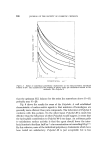
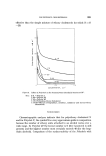
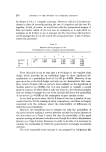
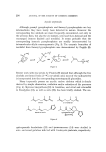
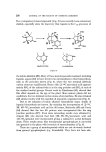
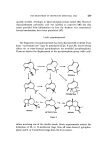
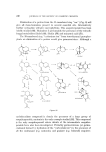
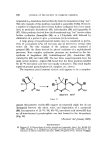
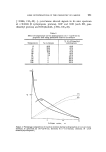
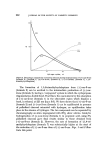
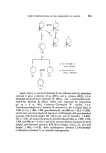
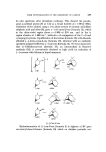
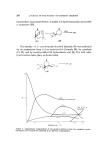
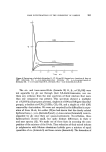
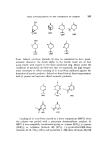
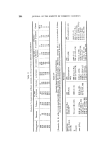
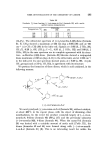
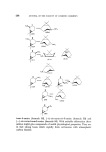
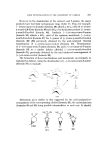
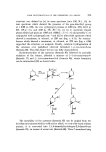
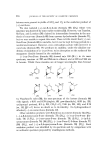
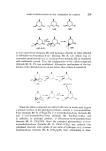
258 JOURNAL OF THE SOCIETY OF COSMETIC CHEMISTS (80%). We were unable to separate them by glc on any available column, but the 5-ol was isolated from the mixture via its 3,5-dinitro-benzoate. A complete separation of the epimers was however effected by oxidation to the corresponding ketones (formula 18) and (+)-cis-caran-5-one (formula 25) (which were readily separated by chromatography on silica gel), followed by reduction (see below). The conjugated nature of (+)-cis-caran-5-one (formula 25) is clear from its ultraviolet spectrum which shows e=3 279 at 210 nm, and its ir spectrum which displays a carbonyl group maximum at 1 685 cm-1. Reduction of (+)-cis-caran-5-one (formula 25) with lithium aluminium hydride afforded a mixture of the pseudo-equatorial alcohol, (+)-cis- caran-cis-5-ol (formula 26) as major product and its pseudo-axial epimer (formula 24), from which the former was isolated by crystallisation from methanol. Reoxidation of the mixture of alcohols afforded the single ketone (formula 25), thus demonstrating the presence of the intact cyclopropane group in the alcohols. Their configurations were based (a) upon the known steric characteristics of lithium aluminium hydride as a reducing agent, (b) the nmr signals of the 5H (a- carbinol proton) which for the trans-5-ol (formula 24) was a poorly resolved doublet (J 4.5Hz) centred at • 6.0 and for the cis-5-ol (formula 26) was a multiplet at ß 5.5-6.1. These are res- pectively the characteristics expected of equatorial or pseudo-equatorial and axial or pseudo-axial 5- hydrogen atoms. In passing, it is of interest to note that reduction of (+)-cis-caran-5-one (formula 25) over platinum afforded predominantly (+)-cis-m-menthane (formula 27) (12), a hydrogenolysis product also obtained from (+)-cis- caran-cis-5-ol (formula 26) using the same catalyst. It is clear that caran- 5-ol is here simulating an allylic alcohol. The configurations and conformations of the caranols described above were confirmed (22) in a number of ways. (a) Comparison of the dihedral coupling constants of the hydroxy- protons with the a-carbinol protons in their nmr spectra measured in dimethyl sulphoxide (23) distinguishes between axial and equatorial hydroxy groups. (b) Similarly, comparison of the rates of oxidation of the alcohols with chromate makes a distinction between conformers, it being well known that axial alcohols are more rapidly oxidised than their equatorial counter- parts (24-27). Changes in chromate concentration were measured spectro- scopically. (c) Comparison of the rates of alkaline hydrolysis of the 3,5-dinitro-
Purchased for the exclusive use of nofirst nolast (unknown)
From: SCC Media Library & Resource Center (library.scconline.org)