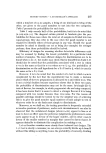
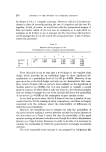
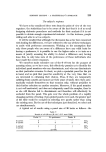
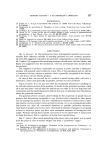
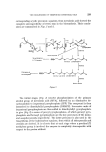
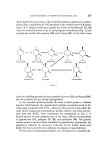
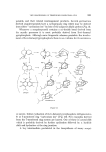
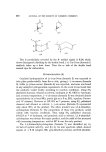
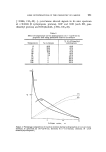
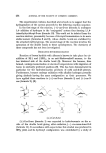
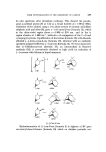
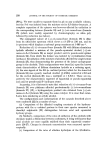
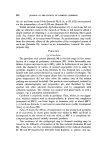
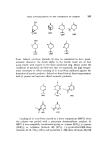
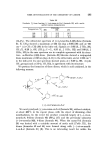
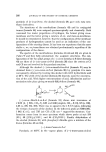
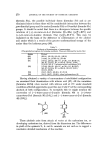
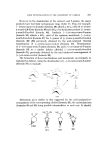
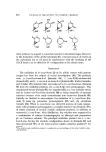
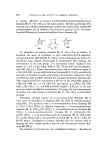
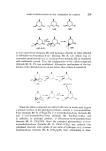
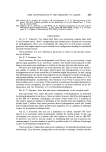
SOME INVESTIGATIONS OF THE CHEMISTRY OF CARENE Table III Products % from heating (q-)-cis-caran-cis-$-ol (formula 26) with acetic acid at various temperatures 265 . Formulae Temperature øC (43) (44) (31) 180 71.7 12.2 16.7 210 74.5 13.3 11.6 300 61.8 21.7 3.4 (14.4%). The ultraviolet spectrum of (+)-p-mentha-2,4(8)-diene (formula 41 R, CH3) showed a maximum at 244 nm (log e 3.93) (35) and at 731 cm-1 (cis CH =CH) (36) in the infra-red. Signals at • 9.02 (d, J 7Hz, 3H, CH 3-7), 8.29 Is, 6H, (CH 3)2 C=Cl, 4.55 (d, J 11Hz, H2) and 3.68 (d, J 11Hz, H3) in the nmr spectrum are in complete agreement with its struc- ture. m-Mentha-l,3(8)-diene (formula 42) likewise showed a conjugated diene maximum at 245 nm (log e 4.11) in the ultraviolet, and at 1 630 cm-• in the infra-red. Its nmr spectrum showed peaks at • 8.29 (s, 9H, vinylic CH 3 groups) and at 3.9 (s, 1H, H2), in agreement with its structure. We portray the formation of these dienes, which is acid catalysed, in the following manner. o, Hf • '--•-(40)(41 R,CHz,) ""/ H+ • b '•+.• -H+ • (42) ( q- )-cis-Caran-cis-$-ol We next pyrolysed (q-)-cis-caran-cis-5-ol (formula 26), without catalyst, at about 480øC, in the vapour phase, with the object of obtaining other menthadienes. In the event the product consisted largely of (--)-cis-m- mentha-4, 8-diene (formula 43) (80%) (17) and the previously unknown (q-)-m-mentha-3(8), 4-diene (formula 44). When the caran-5-ol (formula 26) was heated with a catalytic amount of acetic acid (Table III), the dienes (formulae 43 and 44) were formed along with (--)-cis-m-menth- 4-en-8-ol (formula 31) (8). This is an interesting result for unlike the

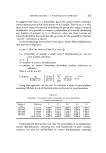
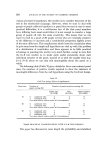
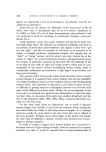
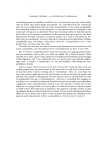
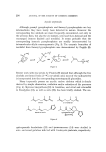
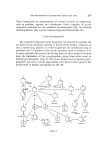
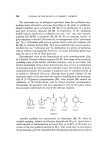
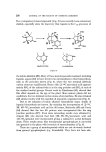
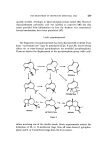
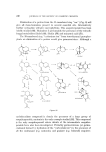
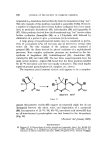
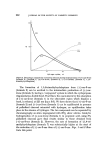
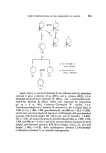
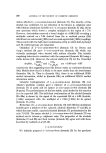
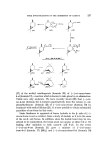
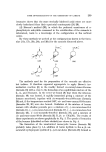
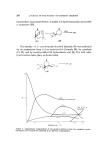
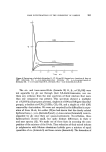
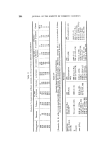
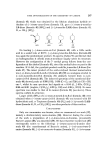
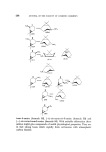
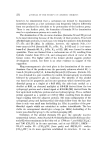
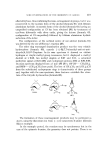
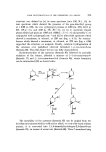
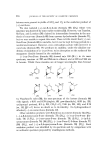
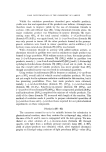
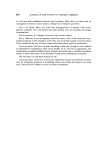
266 JOURNAL OF THE SOCIETY OF COSMETIC CHEMISTS pyrolysis of (+)-car-3-ene, the alcohol (formula 26) gave only meta men- thane derivatives. The structures of the menthadiene (formula 43) and its conjugated isomer (formula 44) were assigned spectroscopically and chemically. Both consumed two molar proportions of hydrogen, the former giving cis-m- menthane and the latter giving a mixture of cis- and trans-m-menthanes. It should be remembered, however, that the configurations of the menthane products of hydrogenation cannot be used as an indication of the con- figurations of the starting dienes. It has been our experience that the more stable o-, m-, or p-menthanes are obtained predominantly regardless of the configurations of the dienes. The spectra of the menthadienes (formulae 41-44 and 46) are given in Table IV and they fully substantiate the assigned structures. The con- figurations of the two alkyl groups of (--)-cis-m-mentha-4, 8-diene (formula 43) are those of (+)-cis-caran-cis-5-ol (formula 26) since the centres at C1 and C3 are not involved in the pyrolysis reaction. Although the alcohol (--)-cis-m-menth-4-en-8-ol {formula 31)may be obtained from (+)-cis-caran-cis-5-ol (formula 26) by pyrolysis it is more conveniently obtained by treating this alcohol with 0. IN hydrochloric acid at 20øC. The yield of the alcohol (formula 31) depends upon the concentra- tion of the acid. With higher concentrations of acid, dehydration and iso- merisation take place giving m-menth-3(8),4-diene (formula 44). 1('26 ) (44) (--)-cis-m-Menth-4-en-8-ol (formula 31) shows nmr resonances at ß 9.02 (d, J 5Hz, CH 3-7), 8.91 and 8.86 (singlets, CH 3- 9, 10), 8.5 (s, OH), 4.25 (s, 2H, H4, H5). There was no signal in the T 5-7.5 region, indicating the tertiary character of the alcohol. In the infra-red, peaks at 3 268 (OH), 1 642 (C----C), and 735 (cis CH-•CH) cm-1 support the structure. Con- firmation comes from its mass spectrum which shows peaks at m/e 154 (M+), 59 [(CH 3) 2COH+I, and 44 (CH •COH+). Finally dehydration of the alcohol (formula 31) with phosphoryl chloride gave a mixture of the dienes (formulae 43 and 44). (--)-trans-C aran-cis-2-ol Pyrolysis, at 410øC in the vapour phase, of (--)-trans-caran-cis-2-ol
Purchased for the exclusive use of nofirst nolast (unknown)
From: SCC Media Library & Resource Center (library.scconline.org)