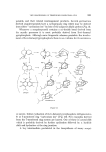
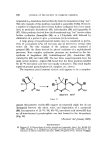
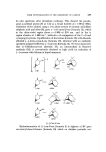
SOME INVESTIGATIONS OF THE CHEMISTRY OF CARENE 283 (62) Carson, M. S., Cocker, W., Evans, S. M. and Shannon, P. V. R. The Che•nistry of Ter- penes. Part XI. Volatile products of the photolysis of (+)-cis-Caran-5-one. J. Chem. Soc. [C] 1447 (1970). (63) Dauben, W. G., Schutte, L. and Wolfe, R. E. Solution photolysis of cis- and trans-2- Methylcyclopropyl methyl ketone. J. Org. Chem. i•4 1849 (1969). Kropp, P. J. in Chap- man, O. L. Organic Photochemistry ?? I (1967) (Arnold, London). DISCUSSION DR. E. T. THEIMER: You stated that there was convincing evidence that both 2- and $-carene had a "boat" configuration and therefore give exclusively cis-carane on hydrogenation. Have you investigated the behaviour of 2,10-carerie on hydro- genation? One might expect a more stretched out configuration leading to substantial amounts of trans-carane. THE LECTURER: Are you referring in particular to what we all call beta carene the car-l , 10erie? DR. E. T. THEIMER: Yes. THE LECTURER: We have hydrogenated car-l , 10-ene, and as you surmise, we get almost equal quantities of cis- and trans- cararies. The double bond is placed so that there is not much more hindrance to attack on the top side than the bottom side. We have also hydrogenated car-4-ene (formula 21). This is recent work which I was unable to include in the paper. Based upon the hydrogenation of car-2-ene, hydrogenation of car-4-ene across the 4,7- positions might be expected. In fact, during this hydrogenation the double bond migrates out of conjugation with the cyclopropane ring giving initially car-$-ene which is converted to car-2-ene and thence to 1,1,4- trimethylcycloheptane. Incidentally, the reduction of car-4-ene is much slower than that of either car-2- or car-S-erie. If the reaction is monitored, the initial formation of car-S-erie can be recognised, and this is converted to car-2-ene followed by its dis- appearance and the formation of 1,1,4-trimethylcycloheptane. DR. E. T. THEIMER: Does this take place independently of the catalyst used? THE LECTURER: Yes, under the same conditions of hydrogenation as described for the hydrogenation of car-$-ene. I have no doubt, however, that if we hydrogenated at 10.1 MN m-2 pressure of hydrogen, cis-carane would result. It is a question of the relative speeds of addition of hydrogen to the double bond and migration of the double bond. I believe that under pressure direct hydrogenation across the double bond would be faster than either double bond migration or 1,4- addition of hydrogen to give 1,1,5-trimethylcyclohept-2-ene. DR. E. T. THEruER: Did you use a palladium on carbon catalyst? \Ve know that it is an extremely rapid isomerisation catalyst for double bonds. In the case of B-pinene, you can go to a-pinene with that system in about 5 min at 160-170 ø. If, however, you were to use say, nickel or something that was not so good an iso- merising agent, I wonder whether it would be possible to get 1,4- addition of hydrogen to give 1,1,5-trimethylcyclohept-2-ene. THE LECTURER: I think that under such conditions 1,1,5-trimethylcyclohept-9.-ene would result. It is, however, strange that car-4-ene fails to undergo a similar reaction

284 JOURNAL OF THE SOCIETY OF COSMETIC CHEMISTS to car-2-ene with palladised charcoal and hydrogen. Both show the same sort of conjugation in their uv and ir spectra arising from overlap of n-systems. DR. G. P. Moss: Have you tried the hydrogenation of carenes with homo- geneous catalysis? It is well known that this method does not normally encourage isomerisations. THE LECTURER: No, though we have it very much in mind. Me. J. MCIVER: I saw no mention about the odour value of the numerous com- pounds produced in this extensive work. Has any work been carried out on the odour of the materials are any of these compounds particularly useful to perfumers? THE LECTURER: We have not done anything of this sort, though we have passed on materials for evaluation to some of our friends. To us, who are not perfumers, the caranols have modified menthol odours. Likewise the ketones have modified menrhone odours. I think that many of our products would merit professional evaluation. MR. MCIVER: Do any show promise at all? THE LECTURER: I have not received any information about our products. Evalua- tion, for perfumery purposes, is something which was outside the scope of our work and I have left it to others to carry out these evaluations.
Purchased for the exclusive use of nofirst nolast (unknown)
From: SCC Media Library & Resource Center (library.scconline.org)