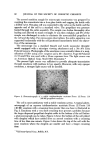
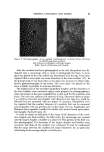
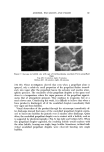
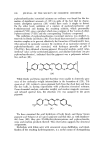
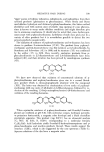
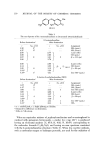
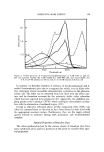
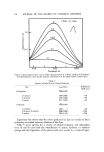
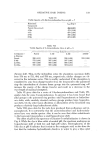
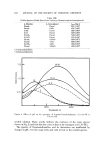
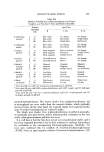
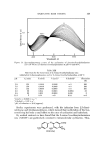
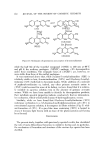
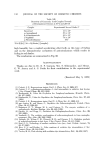
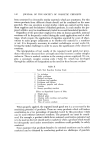
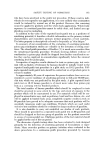
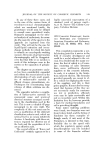
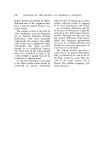
92 JOURNAL OF THE SOCIETY OF COSMETIC CHEMISTS The aerosol emulsion sample for microscopic examination xvas prepared by weighing the concentrate into a 4-oz glass bottle and capping the bottle with a drilled valve. The glass cell was connected to the valve on the bottle and the opposite end of the cell to a standard valve. The propellant was pressure loaded through the entire assembly. The sample was shaken thoroughly after loading and allowed to stand overnight. It xvas then reshaken and 5'% of the sample was discharged in order to eliminate the nonemulsified propellant in the cell and dip tubes. For microscopic observations, the entire apparatus xvas supported horizontally with the cell positioned immediately below the object- rive of the microscope. The microscope xvas a standard Bausch and Lomb monocular dynoptie model equipped with a microipso viewing attachment and a 31/4 x 41/4 Leitz Polaroid camera. Photographs of the emulsions were normally taken at a mag- nification of 150x using a 15x eyepiece and a 10x objective. Type 52 Polaroid 4 x 5 Land Film was used with a 15-see exposure time. The light source was an American Optical Corp. Model 651 illuminator.* The present light source was sufficient to provide adequate transmission through emulsions with medium to low opacity. However, with very opaque emulsions, a stronger light source will be needed. Figure 2. Photomicrograph of a stable triethanolamine myristate/Freon 12/Freon 114 (40/60) propellant emulsion The cell is most satisfactory with a stable enmlsion system. A typical photo- micrograph of an aqueous h'iethanolamine myristate/Freon loe/Freon 114 (40/60) emulsion with a creaming tinhe greater than one hour is illustrated in Fig. oe. Emulsions with a very short creaming time present a problem because the larger dispersed propellant droplets settle to the bottom of the cell before a photomicrograph can be taken. Figure 3 shows the bottom of the cell plated with droplets which have settled from an aerosol enmlsion with a creaming time of less than one minute. Figure 3 also shows the top of the cell xvith the sanhe emulsion where the droplets are smaller and have a longer creaming time. *American Optical Corp., Buffalo, N.Y.

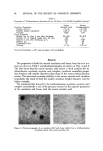
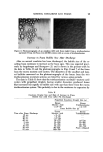
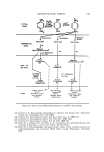
AEROSOL EMULSIONS AND FOAMS 93 Figure 3. Photomicrographs of an unstable triethanolamine myristate/Freon 12/Freon 114 (40/60) propellant emulsion Left. Bottom of cell plated with large droplets Right. Top of cell showing small droplets After the emulsion had been photographed in the cell, the product was dis- charged onto a microscope slide in order to photograph the foam. A cover glass was placed on the foam which was illuminated from the top. It has been reported that a cover glass can cause distortion of the foam bubbles (17). In the present work, it was found that a cover glass was necessary to obtain satis- factory photomicrographs of the foams. The cover glass was placed on the foam as lightly as possible to minimize distortion. The droplet sizes of the emulsified propellant droplets and the diameters of the foam bubbles were estimated using a scale prepared by photographing a stage micrometer at the same magnification as that used for the emulsions and foams. The scale was calibrated in intervals of 10/•. Diameters down to about 2/• could be estimated and droplets with diameters less than 2/z could be detected but not measured with any degree of accuracy. Edmundson (18) has reported that the smallest diameter of a particle that can be measured microscopically with any precision lies in the range of 1-9./•. Augsburger and Shangraw have reported a method for bubble size analysis based upon photo- micrographs of aerosol foams (2). In order to obtain an indication of the range of the diameters of the emul- sion droplets and foam bubbles, the field under the microscope was scanned until the largest droplet or bubble was observed. This portion of the field was then photographed. The diameters of the largest droplets and bubbles were measured, and those of the smallest were estimated. It must be emphasized that the range between the smallest and largest diameters has no particular relationship to the average droplet or bubble size.
Purchased for the exclusive use of nofirst nolast (unknown)
From: SCC Media Library & Resource Center (library.scconline.org)