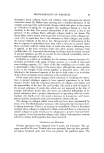
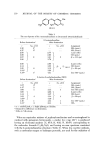
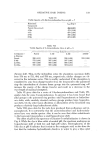
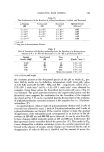
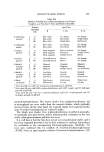
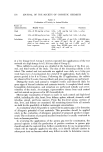
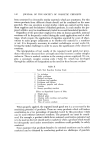
126 JOURNAL OF THE SOCIETY OF COSMETIC CHEMISTS Studies have shown that C-methylation of the diimine decreases the rate of reaction with the m-aminophenolate ion by a factor of 4, while C-chlorination of the diimine increases the rate by a factor of 1.5. Summary of Mechanisms The mechanism studies of the reaction of diimines with various m-disubsti- tuted benzenes have shown that, in the pH range normally employed in oxi- dative dyeing, the rate-controlling step is the nucleophilic attack of the di- irainJure ion on the most electron-rich form of the coupler, i.e., that form bear- ing neutral amino groups and/or ionized hydroxy groups. This reaction gives a leuco dye (diphenylamine derivative) which undergoes rapid oxidation to the indo dye. At a particular pH, the rate of reaction of various diimines with a particular coupler is in the order C-chlorodiimine diimine C-methyldiimine. The reactivity of couplers is increased by alkyl or alkoxy substituents. Stability o[ Indo Dyes and Dyeings The stability of shades produced in oxidative dyeing is not as good as one could wish for. The only documented data on the stability of dyeings pro- duced by individual reactant pairs are those reported by Tucker (13), who made measurements on dyed tresses in a standard fadeometer. No study of the stability of individual dye species in aqueous solution has been previously reported. Examination of Tucker's results shows that, in a fadeometer, perceptible fading generally occurs within one day. For dyeings with p-phenylenediamine and meta disubstituted couplers he reports the following order of stability: 2,4-diaminoanisole 2,4-diaminotoluene m-phenylenediamine 6-meth- yl-3-aminophenol resorcinol m-aminophenol. However, since Tucker does not specify whether the fading he considered was off-shade or on-shade, the order given may not correspond to the relative practical importance of the reactions of individual dye species. We have now made a study of the fading of individual dye species on hair tresses stored in clear glass and dark glass bottles at 0, 35, and 88% relative humidity and room temperature. The results, for tresses stored in dark bot- tles, are given in Table XII while we found that those stored in a north •vin- dow, in clear glass bottles, showed only a very slightly accelerated ageing effect. From Table XII, it is quite clear that the relative humidity has a marked effect on the rate of off-shade fading of all the dyeings examined. This is particularly marked in the case of dyeings with 2-amino-5-methylin- daminc where almost complete retention of the original color was observed after 3 months at 0% RH, while complete loss (by conversion to the diamino- phenazine) was observed after 3 months at 88% RH. The dyeings with p-phenylenediamine and 2,4-diaminoanisole (giving 2- amino-5-methoxyindamine) are markedly more stable than those with 2-

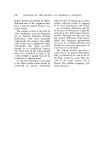
OXIDATIVE HAIR DYEING 127 Table XII Stability of Shades from p-Phenylenediamine and Various Couplers, as a Function of Time and Relative Humidity Relative Humidity (%) Age/Color 0 1 mo. 3 IllO. 2,4-Diamino- ( 0 Blue-violet No change No change toluene a 35 Blue-violet Blue-black Purple-black 88 Blue-violet Purple-blue Red-brown 2,4-Diamino- { 0 Blue-violet No change No change anisole 88 Blue-violet Blue-black Blue-black m-Amino- { 0 Deep magenta Brown overtone No changebrown phenoP 35 Deep magenta Brownish Golden 88 Deep magenta Golden brown Brown m-Amino- ( 0 Greenish brown Brown No change phenol ø 88 Greenish brown Brown No change 6-Methyl- { 0 Magenta Magentared-brown 3-amino- 35 Magenta Magenta Magenta phenoP 88 Magenta Pinkish brown Lt.
Magenta 4-Methyl- ( 0 Grey-blue Greyish Greyish 3-amino- 35 Grey-blue Greyish Greyish phenoP 88 Grey-blue Brown-grey Grey-brown 4-Ethyl- { 0 Pink-brown resorcinoP 88 Pink-brown Lt.
Pink-brown tan Lt.
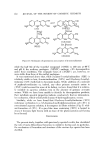
Pink-brown tan Tress dyed 20 min with 0.1% 2-amino-5-methylindamine at pH 9.95. Tress dyed 20 min with 0.05% p-phenylenediamine and 0.05% coupler and 3% hydrogen peroxide at pH 9.95. Tress dyed 20 min with 0.1% p-phenylenediamine and 0.1% m-aminophenol and 3% hydrogen peroxide at pH 9.5. amino-5-methylindamine. The brown shades from p-phenylenediamine and m-aminophenol are more stable than the magenta shades, which gradually become brown. On the other hand, the magenta shades from p-phenylenedia- mine/6-methyl-3-aminophenol are relatively stable. The bluish grey shades from p-phenylenediamine/4-methyl-3-aminophe- nol gradually turn grey-brown, clearly indicating that cyclization to the very stable violet phenoxazinium salt does not occur. It is well known that the blue dyes in hair are not particularly stable, and it has been suggested that this is due to their tendency to undergo intramolecu- lar cyclization to the corresponding 2,8-diaminophenazine (32,48,49). We have now confirmed this by isolation of 3-methyl-2,8-diaminophenazine (XXXII) from an aged aqueous solution of 2-amino-5-methylindamine (XI)
Purchased for the exclusive use of nofirst nolast (unknown)
From: SCC Media Library & Resource Center (library.scconline.org)