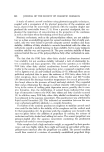
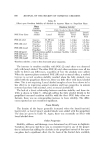
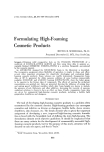
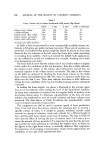
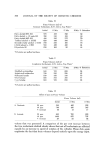
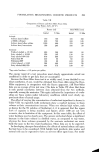
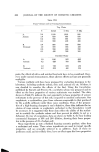
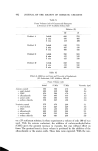
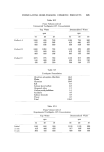
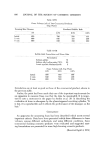
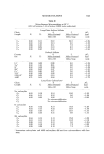
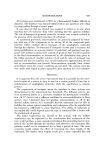
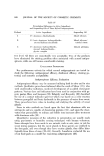
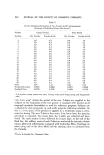
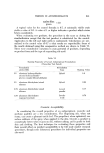
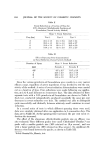
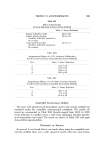
6OO JOURNAL OF THE SOCIETY OF COSMETIC CHEMISTS Table VIII Foam Volumes (ml) at Varying Concentrations Tap Water % Initial 2 Min 5 Min A. 5.0 1160 1010 800 Anionic 1.0 820 655 550 0.2 595 565 510 0.1 550 405 400 B. 5.0 860 660 500 Nonionic 1.0 800 585 455 0.2 550 465 350 0.1 430 $05 $00 Distilled Water A. 1.0 1140 905 600 Anionie 0.2 920 760 550 B. 1.0 780 605 450 Nonionic 0.2 530 400 350 paste, the effects of saliva and residual food soils have to be considered. How- ever, under normal circumstances, these adverse effects on foam are generally negligible. Various synthetic soils have been proposed for evaluating shampoos in the laboratory, including synthetic sebum, oleic acid, mineral oil, etc. Of these, it was decided to consider the effects of the first. Using the formulation published by Barnett and Powers (8), a synthetic sebum was prepared and its effect on the foam properties of various surfactants was studied. The data, shown in Table IX, indicate the vast superiority in foam properties of anionic surfactants in the presence of this soil, compared to nonionic surfactants. One amphoteric, a cycloimidine, gave foam volumes comparable to that produced by the a-olefin sulfonate under these same conditions. Thus, if the prepara- tion of a high-foaming shampoo is one's objective, these data indicate the in- clusion of some anionic or amphoteric surfactant in the formulation would be necessary. It is suggested that these data reflect the ability of the surfact- ant to emulsify the synthetic sebum and thus prevent its ability to act as a defoamer. By way of comparison, data are shown in Table X, for four leading commercial shampoos at 10% and 20% dilution, showing their foam proper- ties in the presence of 3% of sebum soil. Many ingredients go into a finished foaming cosmetic product. other than a surfactant and water. These minor ingredients are used to impart specific properties, and are generally referred to as additives. Each of these in- gredients could, and most likely does, have an effect upon the foam properties.

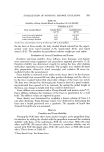
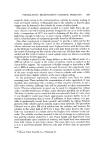
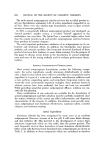
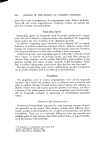
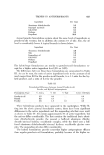
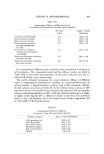
FORMULATING HIGH-FOAMING COSMETIC PRODUCTS 001 Table IX Foam Volumes (ml) in Presence of 3% Sebum Soil, in Tap Water a Surfactant Concentration (%) 2.O 5.O 10.0 Sodium lauryl surf ate Initial 600 750 900 2 min 465 610 750 5 min 450 580 715 a-Olefin sulfonate Initial 300 ... 650 2 min 175 ... 450 5 min 175 ... 420 Sodium lauryl ether sulfate Initial 100 ... 420 2 min 80 ... 9.80 5 min 80 ... 270 Tridecyl alcohol q- 15 EO Initial 10 . .. 30 2 rain 10 ... 10 5 min 10 ... 10 t-Octyl phenol q- 9 EO Initial 10 ... 480 2 min 10 ... 320 5 min 10 ... 230 Fatty alcohol q- 12 EO Modified cycloimidine Initial 380 ... 630 2 min 250 ... 59.0 5 min 235 ... 470 •6.5 grains per gallon hardness. It is beyond the scope of this paper to consider all possible additives in great detail and their effects upon foam. It should suffice to point out that minor adjustments such as only a change in pH, or the addition of an essential oil, without which many products would be doomed to marketing failure, could be enough to change foam volumes. Bubble baths are relatively simple to formulate, but shampoos and especially dentifrices, on the other hand, are more complex formulations, as will be described later. A few of the more widely used cosmetic additives were selected and stu- died for their effects upon the foam properties of an anionic surfactant and a non:onic surfactant. It was obviously impossible to study every commercially available additive and every surfactant. The effect of the additive upon the viscosity of the product was also of interest, since some formulators believe that one can increase the foam volume of an existing product merely by in- creasing its viscosity. The data, in Table XI, show the effect of 0.2% additive
Purchased for the exclusive use of nofirst nolast (unknown)
From: SCC Media Library & Resource Center (library.scconline.org)