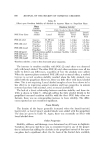
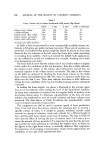
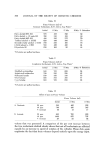
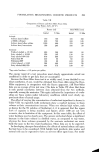
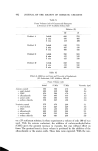
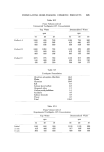
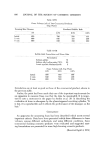
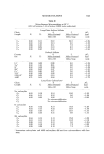
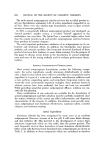
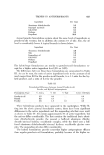
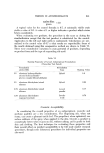
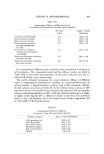
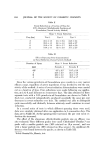
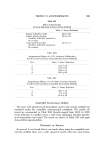
MICROEMULSIONS 613 Table II Water-Benzene Microemulsions at 30 ø C (40.0 ml benzene 1.44 ml water 0.0032 moles surfactant) Chain Length C6 C•o C•., C• Counter Ion Li + Na + K + Rb + Cs + NH, + (CH:,)•N + AMP Long-Chain Sodium Sulfates k I /xG, X, Xs Moles Pentanol Moles Pentanol kcal Moles Oil Moles Soap mole 0.96 0.11 0.12 23.5 --1.29 0.90 0.12 0.13 9.0 --1.22 0.'88 0.10 0.11 7.5 --1.32 0.90 0.09 0.10 9.5 --1.38 0.90 0.36 0.04 9.5 --1.94 Dodecy] Sttlfates k I AGs X• X• Moles I'entanol Moles Pentanol kcal Moles Oil Moles Soap mole 0.86 0.08 0.09 6.0 --1.39 0.90 0.10 0.11 9.0 --1.32 0.86 0.08 0.09 6.0 --1.39 0.80 0.06 0.07 4.0 --1.53 0.83 0.06 0.07 5.0 --1.55 0.80 0.08 0.08 4.0 --1.41 0.85 0.09 0.10 5.5 --1.34 0.71 0.04 0.04 2.5 --1.75 Chain Length X• Long-Chain Carboxy]ates • k I X• Moles Pentanol Moles Pentanol kcal Moles Oil Moles Soap 'mole Na carboxylate C•.o 0.91 0.12 C• 0.90 0.11 C•G 0.85 0.02 C•s Coo K carboxylate C•.0.95 0.12 C. 0.94 0.11 C•G 0.92 0.10 C•s 0.90 0.10 Rb carboxylate C• 0.94 0.11 C• 0.91 0.13 C• 0.89 0.11 C• 0.88 0.10 C•o 0.88 0.09 0.14 10.0 --1.22 0.12 9.0 --1.29 0.02 5.5 --2.26 No microemulsification No microemulsification 0.13 18.5 --1.27 0.12 15.5 --1.30 0.11 12.0 --1.33 0.11 9.0 --1.34 0.13 15.0 --1.28 0.14 10.5 --1.19 0.13 8.0 --1.24r 0.12 7.0 --1.28 0.10 7.0 --1.36 Ammonium carboxylates and AMP carboxylates did not form microemulsions with ben- zene.

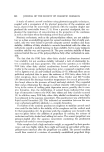
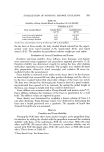
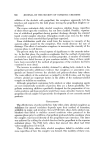
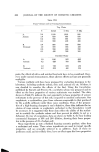
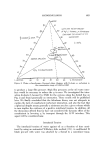
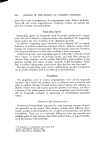
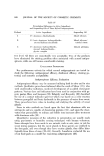
614 JOUBNAL OF THE SOCIETY OF COSMETIC CHEMISTS The same trends were noted when benzene was substituted for n-hexade- cane and carboxylates were used as the surfactants. However, no leveling in the value of I was observed except when rubidium was the counterion and then it occurred at higher value, C•s. The values of I were significantly high- er in benzene than in n-hexadecane in the case of the carboxylates. In all cases, the AG8 was lower in benzene than in n-hexadecane. The behavior of the long-chain sulfates in benzene was slightly different in that a minimum value was reached C•o and Cs, and C•.2 and C•4 demonstrated the same requirements for cosurfactant. The effect of changing the counterion is not as clear cut. The sterically larger counterions, such as tetramethyl and tetraethylammonium ion, re- quired the largest amount of pentanol in the interface in hexadecane but these cations did not show any significant difference from Cs +, K +, Li +, Rb +, and NH4 +, in benzene when the dodecyl sulfate was the anion. The value I did not show any ordering in terms of the size of the counterion for the alkali cations and it is felt that this type of experiment is not sensitive enough to detect fine differences in very simqar counterions. In conclusion, these results indicate, in the systems discussed, strong inter- actions between the surfactant and cosurfactant molecules are not necessary for microemulsion formation. Up to noxv the discussion has dealt with the case of dilute W/O micro- emulsions. Ternary phase diagrams of a four-component system were pre- pared. In the present example shown here, certain clear isotropic regions of low viscosity are observed when the K-oleate concentration was held con- stant (Fig. 2). On the ternary diagram there are two regions on microemul- sions. It is also clear that the four components have to be mixed in the right proportions. Association between the surfactant and cosurfactant has rarely been in- vestigated in these systems. Interaction between the water and surfactant has been observed in water in chloroform microemulsions stabilized by decyltri- methylammonium bromide (11). Schulman and Montagne (12) investigated the conditions necessary for the formation of microemulsions in systems capa- ble of forming strong hydrogen bonds by a film balance method, the validity of which they later doubted (13). They found that in systems capable of form- ing strong intermolecular hydrogen bonds, microemulsions could be formed. Those systems not capable of forming intermolecular hydrogen bonds did not form microemulsions. These results indicated that, in the systems dis- cussed, strong interactions between the surfactant molecules and surfactant and cosurfactant molecules were necessary for microemulsion formation. The results reported in this study conflict with this view. The work of Fowkes (14) with mixed films of sodium cetyl sulfate and cetyl alcohol at planar air-aqueous NaC1 interfaces lent support to the view that strong stoi- chiometric complexing between the alcohol and surfactant was not necessary
Purchased for the exclusive use of nofirst nolast (unknown)
From: SCC Media Library & Resource Center (library.scconline.org)