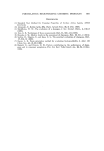
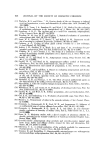
MICROEMULSIONS 619 (11) (12) (13) (14) (15) (16) (17) (10) Gillberg, G., Lehtinen, H., and Friberg, S., NMR and infrared investigation of the conditions determining the stability of microemulsions, J. Colloid Inter[ace Sci., 33, 40 (1970). Zlochower, I. A., and Schulman, J. H., Ann. N.Y. Acad. Sci., 92, Art. 2, 366 (1967). Schulman, J. H., and Montagne, J. B., Formation of microemulsions by amino alkyl alcohols, Ibid., 92, Art 2, 366-71 (1961). Cooke, C. E., and Schulman, J. Y., Surface Chemistry, 1955, pp. 231-51. Fowkes, F. M., Mixed monolayers of cetyl alcohol and sodium cetyl sulfate, J. Phys. Chem., 67, 1982 (1963). Rosano, H. L., Gerbacia, W., Feinstein, M., and Swaine, J., Determination of the critical surface tension using an automatic wetting balance, J. Colloid Interface Sci., 36, 29'8 (1971). McBain, J. W., and Woo, T., Spontaneous emulsification and reactions overshooting equilibrium, Proc. Royal Soc., A163, 182 (1937). Kaminski, A., and McBain, J. W., Spontaneous emulsification of pure xylene in an aqueous solution through mere adsorption of a detergent in the interface, Ibid., A198, 447 (1949). (18) Davies, J. T., and Rideal, E. K., Interfacial Phenomena, Academic Press, New York, 1961, p. 364. (19) Gerbacia, W., and Rosano, H. L., Microemulsions: Formation and stabilization, J. Colloid Interface Sci., 44, 243-8 (1973).

I. Soc. Cosmet. Chem., 25, 621-638 (November 1974) Antiperspirants: New Trends in Formulation and Testing Technology ERIC JUNGERMANN, Ph.D.* Presented December 11, 1973, New York City Synopsis-Aluminum chlorhydroxide has been the most widely used active ingredient in ANTIPERSPIRANT FORMULATIONS. Recently, new chemicals, such as basic aluminum bromide, and combinations of aluminum, zirconium, and other metal salts have been introduced. In addition, new product forms are constantly being developed with dif- ferent performance and cosmetic characteristics. The properties of the new active ingredients and the new formulations are discussed with respect to formulation VERSA- TILITY, COSMETIC ELEGANCE] and EFFICACY. General methods used to evaluate staining potential, and deodorant and antiperspirant efficacy of these products are re- viewed. A normal activity method for determining antiperspirant efficacy is compared with a method based on a thermally controlled environment, and the results obtained with these two techniques are discussed. INTRODUCTION Antiperspirant formulations based upon metal salts such as aluminum, zinc, or magnesium chlorides, suIfates, acetates, or sulfocarbolates as the active ingredients have been known for a long time (1, 2). The most important anti- perspirant chemical used is basic aluminum chlorhydroxide (ACH) which is safer, less corrosive, and readily formulated into a variety of products (3). The deodorant and antiperspirant market has changed dramatically over the years. Until ca. 1960, the most important product forms were lotions, creams, sticks, or powders, representing a 100 million dollar per year busi- ness. In 1960, aerosol deodorants, primarily alcoholic solutions containing an antimicrobial agent, came into the market, and by 1966, doubled the size of the business (4). Early attempts to develop antiperspirants in an aerosol form ran into trouble because of the acidic nature of the active ingredients. Most problems involved packaging incompatibility, valve clogging, and perfume stability. They mostly were solved by the mid-sixties (5), resulting in the introduction of a number of different types of aerosol antiperspirants. *Armour-Dial, Inc., Greyhound Tower, Phoenix, Ariz. 85077. 621
Purchased for the exclusive use of nofirst nolast (unknown)
From: SCC Media Library & Resource Center (library.scconline.org)