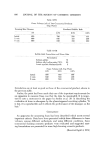
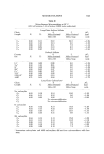
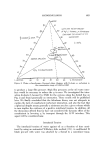
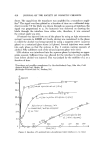
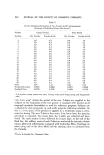
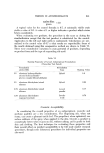
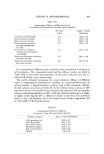
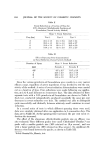
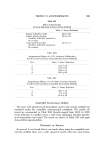
MICROEMULSIONS 617 All systems were maintained at 30øC in a thermostated beaker 4.90 cm in diameter. The interface was cleaned initially before any injections were done by using suction through a narrow piper. It was observed that less alcohol was required to reduce y• to zero when injecting into n-hexadecane than when injecting into the aqueous solution. The rate of transport of pentanol across the interface was severely reduced in the presence of the absorbed monolayer of surfactant. As mentioned previously, microemulsions are generally prepared by titrat- ing with one of the components or by mixing all of the component parts together. Either method allows transport of the amphiphatic molecules through the interface. To determine if transport of some part is necessary for microemulsification, an aqueous solution of surfactant and pentanol was pre- pared. The solution contained the amount of pentanol that would be present in the final microemulsion, as determined by the distribution data given in the tables presented. Another solution of oil and its ratio of pentanol was prepared and the two solutions were m!xed together for approximately 20 min but no microemulsion was formed. Microemulsions generally form almost immediately when the correct conditions are provided. The systems were not even stable with regard to phase separation upon standing for a few minutes. Discussion It is apparent from the above experiments that it is possible for the inter- facial tension of a system to drop to zero for a certain period of time due to redistribution of amphiphatic molecules while the equilibrium y• remains positive. The requirement of transport across the interface in these systems was demonstrated in the experiments last described. The diffusion process has been mentioned before as a necessary condition for spontaneous emulsifica- tion ( 16, 17) but it is not a sufficient condition for microemulsification in these systems since 1-pentanol does not produce microemulsions in all of the dodecyl sulfate systems. It is reasonable that the surfactant must be able to stabilize the system against coagulation and coalescence after the cosurfactant has lowered y sufficiently to cause dispersion. The ability of surfactant to accomplish this would depend upon the type of interfacial film it forms with the alcohol and oil present. The larger requirement for alcohol in the systems with the bulkier counterions may be explained by the consideration that surfactants of this type would produce a more expanded interfacial film permitting faster trans- port of the alcohol through the interface and, therefore, the maximum film pressure would not be maintained for as long a period of time. The same reasoning would explain the effect of increasing the chain length of the surfactant. The shorter chain lengths would give a more expanded film and

618 JOURNAL OF THE SOCIETY OF COSMETIC CHEMISTS permit faster transport of the alcohol. If the chain length is too long, however, transport through the interface would be too slow and the effect of the alcohol in lowering Ti would be diminished. It has previously been pointed out that strong association between the surfactant and cosurfactant is not necessary for microemulsification and that nonionic and ionic amphiphatic molecules, in general, absorb independantly (17, 18). The calculated free energies for adsorption of the pentanol are small, indicating little association between the surfactant and cosurfactant-in agreement with Rosano et al. (5). The absence of strong interfacial complex- ing between the suroeactant and cosurfactant was also indicated in NMR studies of W/O microemulsion in CCla stabilized by long-chain sulfates (10). It was pointed out by Adamson (6) that only a small binding energy between the surfactant and cosurfactant (100 cal/mole) is, in fact, necessary to prevent coagulation of the microemulsion droplets. The above values are well within this range. This does not exclude the possibility of strong associa- tion in the interfacial film occurring when it is feasible (19,). It seems then, that there are two parts to the process of microemulsion formation, dispersion and stabilization. The previous arguments in terms of film penetration, interfacial complexing, interfacial tension, etc., should be applied, bearing in mind the effects due to redistribution of the amphiphatic molecules amongst the phases present. It is also possible that if enough surfactant and cosurfactant are present in the right proportions, the equilib- rium T• could be zero which would imply a spontaneous dispersion. This would be the situation assumed by Schulman. (Received June 16, 1973) REFERENCES (1) Hoar, T. P., and Schulman, J. H., Transparent water-in-oil dispersions. The oleopathic hydromicelle, Nature, 152, 102 (1943). (2) Stoeckenius, W., Schulman, J. H., and Prince, L. M., The structure of myelin figures and microemulsions as observed with the electron microscope, Kolloid-Z., 169, 170 (1960). (3) Prince, L. M., A theory of aqueous emulsions. I. Negative interfacial tension at the oil/water interface, J. Colloid Interface Sci., 23, 165-73 (1967). (4) Prince, L. M., A theory of aqueous emulsions. II. Mechanism of film curvature at the oil/water interface, Ibid., 29, 216-21 (1969). (5) Rosano, H. L., Peiser, R. C., and Eydt, A., Les microemulsions, Rev. Ft. Corps Gras, 16, 249-57 (1969). (6) Adamson, A. W., J. Colloid Interface Sci., 29, 261-7 (1969). (7) Winsor, P. A., Hydrotropy, solubilization, and related emulsification processes, Part I, Trans. Faraday Soc., 44, 376 (1948). (8) Winsor, P. A., Hydrotropy, solubilization, and related emulsification processes, Part IX, Ibid., 46, 762 (1950). (9) Schulman, J. H., Stoeckenius, W., and Prince, L. M., Mechanism of formation and structure of microemulsions by electron microscopy, J. Phys. Chem., 63, 1677 (1959).
Purchased for the exclusive use of nofirst nolast (unknown)
From: SCC Media Library & Resource Center (library.scconline.org)