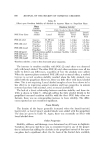
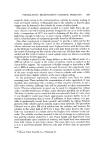
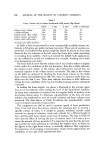
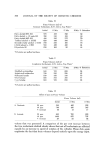
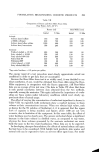
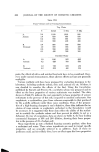
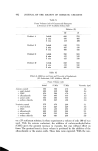
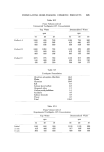
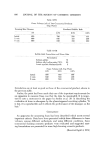
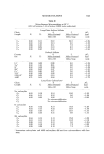
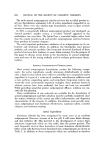
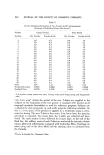
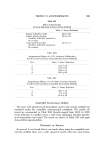
STABILIZATION OF NONIONIC AEROSOL EMULSIONS 589 Table VIII Relationship between Aerosol E•nulsion and Foam Stability * Polyoxyethylene Fatty Ether Emulsion Stability b No alcohol Lauryl Myristyl Cetyl Stearyl Foam Stability* No alcohol Lauryl Myristyl Cetyl Stearyl POE (4) POE (23) POE (10) POE (20) POE (10) POE (20) Lauryl Lauryl Cetyl Cetyl Stearyl Stearyl 1 min 1 min 1 min 1 min 1 rain 5 rain 30 rain 1 min 1 min 1 min 1 min 5 min 30 rain 1 rain 1 rain 1 rain 15--30 min 5 rain 30min lmin lmin lmin 5--15rain 5rain 30 rain 1 rain 1 rain 1 min 15--30 rain 5rain 5 rain 5 rain 15 rain 5 rain 15 rain 5 rain 30--60 min 15--30 min 30--60 rain 2 hr 30-60 min 2 hr 2 hr 2 hr 2 hr 2 hr 2 hr 2 hr 2 hr 2 hr 2 hr 2 hr 2 hr 2 hr 2 hr 2 hr 2 hr 2 hr 2 hr 2 hr aFrom (9) aerosols formulated with 90% aqueous concentrate and 10% Propellant 12/114 (40/60). bTime to first observable phase separation. *Time to first observable collapse. POE (2) cetyl ether. The other emulsions with POE (2) cetyl ether were very stable, regardless of how the alcohols were added. A major increase in emulsion stability was obtained with POE (10) cetyl ether and POE (10) stearyl ether systems by adding the alcohol blends with the propellant. The surfactant-fatty alcohol complexes were formed at the propellant-water interface and stabilized the emulsions. The general structure of the complexes formed directly at the propellant droplet interface undoubt- edly differs from that of complexes preformed in the aqueous phase. The increase in emulsion stability obtained by adding fatty alcohols with propellant occurred with the three POE fatty ethers with the lower HLB val- ues (5.3-12.9). This indicates the complexes had a low affinity for water. They probably function at the interface as solid stabilizers. Previous work had shown that the most efficient stabilizers were insoluble in both the aqueous and propellant phases at use concentrations (13). However, it is necessary for the stabilizers to be wetted by both phases in order to be attracted to the pro- pellant-water interface (14). The present work supports this generalization. The fatty alcohol complexes with POE (23) lauryl ether, POE (20) cetyl ether, and POE (20) stearyl ether failed to stabilize the emulsions regardless of whether the alcohols were added with the propellant or were present ini- tially in the aqueous phase. A reasonable explanation for this is that the sur- factant-alcohol complexes were too water-soluble to act as solid stabilizers. These surfactants all have high HLB values (15.3-16.9). Thus, even when the complexes were formed directly at the propellant droplet-water interface by

590 JOURNAL OF THE SOCIETY OF COSMETIC CItEMISTS addition of the alcohols with propellant, the complexes apparently left the interface and migrated to the bulk phase, leaving the propellant droplets un- stabilized. The reason surfaetant-fatty alcohol complexes stabilize foams, regardless of their effect upon the emulsions, has not been daftfled. Possibly, vaporiza- tion of solubilized propellant during product discharge disrupts the oriented liquid crystal complex structure. Disruption could occur even by the turbu- lence created when nonsolubilized propellant vaporized. Foam stabilization could also result from the increase in viscosity of the aqueous phase caused by the complexes. This would decrease the rate of drainage. The effect of molecular complexes in increasing the viscosity of the aqueous phase is well known. The present study has several aspects of significance to the cosmetic indus- try. In the first place, the results re-emphasize that the method of preparing an emulsion can profoundly affect emulsion properties. A number of cosmetic products have failed because of poor emulsion stability. Many of these might have been successful if the method of preparation of the emulsion had been examined in more detail. The increase in emulsion stability obtained by adding fatty alcohols in the propellant provides additional evidence that complexes or association com- pounds are formed between the alcohols and polyoxyethylene fatty ethers. The water affinity of the surfaetant, as judged by its HLB value, and the type of fatty alcohol are important factors in the ability of the surfaetant-aleohol complex to stabilize an emulsion. Although propellants containing fatty alcohols or other eomplexing agents are not commercially available at present, they are a future possibility. Pro- pellants containing additives specifically designed for the preparation of cos- metic emulsion and foam products would have many attractive features. Such propellant blends might well permit the development of new cosmetic aerosol products. CONCLUSIONS The effectiveness of polyoxyethylene fatty ether-fatty alcohol complexes as stabilizers for aerosol emulsions depends upon their method of formation, solubility in water, and structure. Several POE fatty ether-fatty alcohol com- binations that failed to stabilize aerosol emulsions when premixed in the aqueous phase prior to addition of propellant produced stable emulsions when the complex was formed directly at the propellant-water interface. The latter was achieved by adding the alcohol dissolved in the propellant to the aqueous surfaetant phase. The POE fatty ethers that showed this effect had HLB values ranging from 5.3 to 12.9. Three POE fatty ether-fatty alcohol complexes failed to stabilize emul- sions regardless of how the complex was formed. The inability of these eom-
Purchased for the exclusive use of nofirst nolast (unknown)
From: SCC Media Library & Resource Center (library.scconline.org)