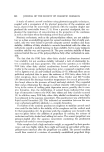
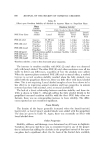
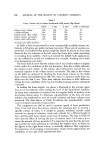
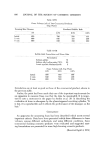
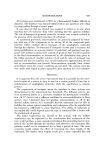
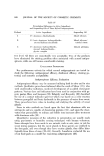
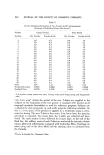
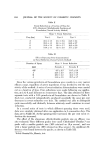
634 JOURNAL OF THE SOCIETY OF COSMETIC CHEMISTS Table X Sweat Reduction as a Function of Time for 3.5% Aluminum Chlorhydroxide Powder-in-oil Formulation (Nounal Activity Method) Mean % Sweat Reduction Time (hrs) Test 1 Test 2 Test 3 22.4 _ 3.8 21.1 _ 2.9 24.6 _ 2.4 20.0 __+ 4.3 20.3 _+_ 4.0 24.0 _ 2.7 18.9 __+ 3.6 18.0 _+ 3.7 19.2 _ B.0 14.0 __+ 4.1 12.4 _+ 2.6 17.1 _ 2.5 Table XI Effect of Spraying Time (Concentration) on Sweat Reduction (Normal Activity Method) Duration of Spray (see) Mean % Sweat Reduction Formula A Formula B 0.5 8.5 _ 2.5 10.7 _ 2.5 I 22.8 __+ 2.9 25.1 _ 4.5 2 28.0 __+ 3.2 30.3 _+ 3.7 4 34.9 _ 3.8 35.7 _ 3.7 Since the various powder-in-oil formulations gave results in a very narrow cfflcacy range, regardless of active ingredient, it was decided to test the sen- sitivity of the method. A series of sweat reduction determinations were carried out as a funct!on of time. Four collections were made following one applica- tion, at 3, 6, 9, and 12 hours on 3 successive days. The data obtained in three separate tests with a 3.5% powder-in-oil formulation are shown in Table X. Each test, conducted independently, produced essentially the same per cent decreases in sweat reduction over time. The method was able to distinguish quite successfully and distinctly between relatively small variations in sweat reduction. In a second series of tests in which different spraying times were used, data were similarly obtained after one application in 3 consecutive days. The data are in Table XI. As the spraying time increased, the per cent sweat re- duction also increased. The effect of the aluminum chlorhydroxide particle size on efficacy was also evaluated. Three different grades were used: Chlorhydrol Ultrafine,* one grade with a smaller particle size (56% retained on 10-/x screen), and one with a larger particle size (96% retained on 10-/x screen). No significant dif- ferences were found between the grades, as shown in Table XII. ø Reheis Chemical Co., Phoenix, Ariz.

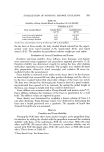
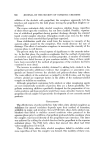
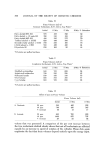
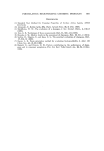
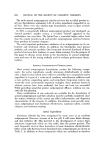
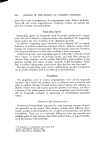
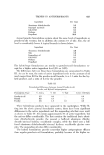
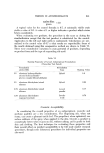
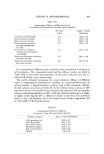
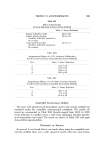
TRENDS IN ANTIPERSPIRANTS Table XII Effect of Particle Size on Sweat Reduction (Normal Activity Method) 635 Mean % Sweat Reduction Regular (UltraFine ACH) Smaller particle size than UltraFine ACH (96% retained on 10-tz screen) Larger particle size than UltraFine ACH (56% retained on 10-tz screen) 22.8 ñ 2.9 24.9 _ 3.3 23.9 ñ 3.1 Table XIII Antiperspirant Efficacy of a 3.5% Aluminum Chlorhydrate Powder-in-oil Formulation (Controlled Environment Method) Test Mean % Sweat Reduction 1 12.6 ñ 3.6 2 33.6 _ 5.2 3 16.0 _ 4.1 4 22.3 _ 9.8 Table XIV Antiperspirant Efficacy of a 3.5% Basic Aluminum Bromide Powder in-oil Formulation (Controlled Environment Method) Test Mean % Sweat Reduction 1 35.0 _ 4.2 2 6.7 _ 6.0 3 21.2 ñ 4.2 Controlled Environment Method The same 3.5% powder-in-oil formulation used in the normal method was evaluated under the controlled environmental conditions. The results ob- tained are summarized in Table XIII. Results ranged from 12.6% to 33.6% sweat reduction. In another series, a 3.5% basic aluminum bromide powder- in-oil formulation was tested. The results are shown in Table XIV and again showed little reproducibility. DISCUSSION OF RESULTS In general, it was found that in our hands when using the controlled envi- ronment method, there was a wide spread of results when the same fonnu-
Purchased for the exclusive use of nofirst nolast (unknown)
From: SCC Media Library & Resource Center (library.scconline.org)