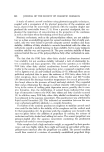
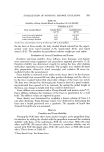
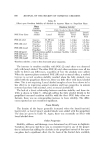
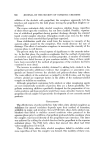
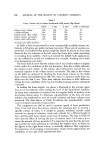
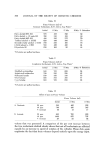
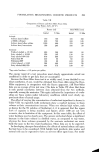
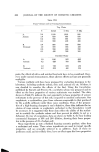
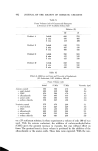
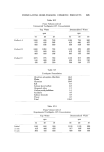
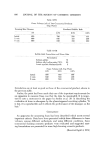
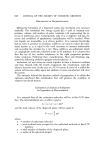
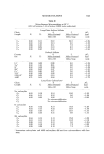
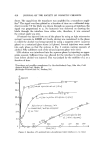
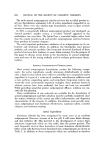
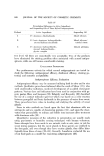
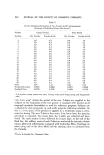
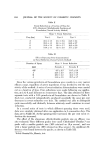
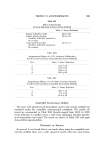
MICROEMULSIONS 611 Combining the two equations gives: 3V r - (1) rtXo- For water-in-benzene microemulsions stabilized by potassium oleate and p-methylcyclohexanol, the calculated droplet size agreed with those by light scattering if a er = 70 A 2 is used (6). Using eq i to calculate the weight of sodium lauryl sulfate (SDS) to micro- emulsify 5 ml of H20 in n-hexadecane, the following values were used: r = 500 3, or o---50 3, -0 per molecule. Therefore, n = 0.6 x 10 =• molecules which corresponds to 0.287 g of SDS To summarize the preparation: 0.287 g of SDS is dissolved in 5 m] of H-00 25 ml of n-hexadecane is added, then titrated while stirring with 1- pentanol until clarity is achieved. 1-Pentanol is not too soluble in oil or in water and is an efficient cosurfactant with this W/O system. Addition o[ more n-hexadecane will transform the system into a milk but addition of more 1-pentanol will clear the system again. t•ESULTS Figure 1 represents W/O microemulsions prepared by adding 40 ml of n-hexadecane and 0.0032 moles of carboxylic acid, 1.5 ml of 2.2N base solu- tion. and titrating the mixture to clarity with 1-pentanol at 30øC. Ten or 20 ml of oil was then added, causing a transition from the clear micro emul- sion to a macroemulsion with a concomitant increase in turbidity. Clarity was reproduced in the sample by again titrating with alcohol. This procedure was repeated several times to get a sufficient number of points to plot. The intercept (I) was taken to be the number of moles of alcohol at the interface per mole of surfactant. The amount of 1-pentanol dissolved in the dispersed phase was assumed negligible. The slope (K) gave the solubility of the al- cohol in the continuous phase (5). From the data, the free energy per mole for the absorption of alcohol into the interphase from the continuous phase was calculated using the formula: AG.• =- RT lm (X•/X, •) where X•[ and X•, • are the mole fraction of pentanol in the interphase and the continuous phase, respectively. The intercepts, slopes, and AG• are tabulated in Tables I and II for sev- eral surfactant combinations. It was noted all AG• are small negative values for these systems. When n-hexadecane was used as the oil phase, the requirement for penta- nol diminished and the free energy for adsorption decreased slightly as the chain length of the sulfate surfactant was increased. The same trend was shown with the carboxylates although it was less marked.

612 JOURNAL OF THE SOCIETY OF COSMETIC CHEMISTS •0 40 3O •o 10 molesl pentanol mole soap - myris• k,la u• a tt•••••.• a •.-- • '• .• m•tate - •- • • k stearate moles n hexadecane/moleofsoa p 20 3 o •o Eo 60 70 8o 90 Ioo _Figure 1. Microemulsions in n-hexadeeane Table I Water-n-hexadecane Microemulsions at 30 ø C (40.0 ml n-hexadecane 1.44 ml water 0.0032 moles sudactant) Chain Lengfla Xi Long-Chain Sodium Sulfates k I /xG. X. Moles Pentanol Moles Pentanol kcal Moles Oil Moles Soap mole C6 C•o C• C• Counter Ion 0.97 0.96 0.93 0.88 0.86 X• 0.36 0.57 28.5 --0.59 0.35 0.5 24.5 --0.60 0.29 0.41 14.0 --0.70 0.20 0.25 7.5 --0.89 0.21 0.27 6.5 --0.85 Xs Dodecyl Sulfates k Moles Pentanol Moles Oil I AGs Moles Pentanol kcal Moles Soap mole Li + Na + K Rb + Cs + NH? (CHs)•N + (C•H•).oN + AMP 0.78 0.88 0.88 0.83 0.78 0.78 0.92 0.93 0.90 0.22 0.22 0.22 0.24 0.22 0.22 O.28 0.31 0.28 0.29 0.28 0.28 0.31 0.29 O.29 O.38 O.45 0.40 3.5 --0.75 7.5 --0.84 7.5 --0.84 5.0 --0.76 3.5 --0.75 3.5 --0.75 11.5 --0.72 13.5 --0.66 8.5 --0.69
Purchased for the exclusive use of nofirst nolast (unknown)
From: SCC Media Library & Resource Center (library.scconline.org)