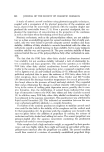
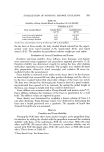
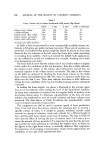
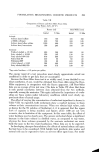
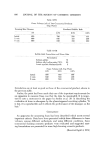
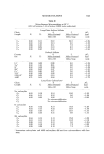
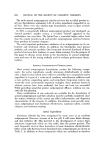
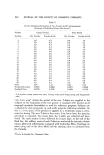
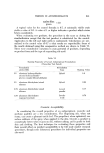
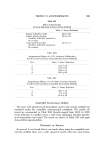
STABILIZATION OF NONIONIC AEROSOL EMULSIONS 585 Table III Solubility of Fatty Alcohol Blends in Propellant 12/114 (40/60) • Solubility at 21 ø C Fatty Alcohol Blend Soluble Ratio Insoluble Ratio (wt %) (wt %) Lauryl/myristyl alcohols 1/9 0.1/9.9 Lauryl/cetyl alcohols 6/4 5/5 Lauryl/stearyl alcohols 8/2 7.5/2.5 "Tested at a concentration of 10 g of blend per 100 g of propellant. On the basis of these results, the fatty alcohol blends selected for the experi- mental work were laury]/myristyl (1/9), lauryl/cetyl (6/4), and lauryl stearyl (8/2). The numbers in parentheses indicate weight per cent ratios. Evaluation of Aerosol Emulsions and Foams Emulsion and foam stability, foam stiffness, foam drainage, and density were measured using equipment and procedures reported previously (7, 8). Emulsion stability was determined visually by noting the time after shaking until phase separation became noticeable. The samples were shaken 20 times after preparation, allowed to stand overnight, and reshaken 20 times im- mediately before the measurement. Foam stability is indicated in the tables in two ways. One is by the decrease in foam height that occurred 60 rain after product discharge and the other is by the time required before first observable collapse of the foam was noted. The data were obtained by discharging the foams in front of a panel contain- ing horizontal lines spaced at x/4-in. intervals. By noting the initial height of the foam, any change in height with time could be determined. Foam stiffness was measured with a Cherry-Burrell curd tension meter* (7). Foam stiffness indicates the resistance of the foam to penetration by a curd knife. The stiffness values are reported in grams. Foam density was determined by weighing a known volume of foam 1.5 min after discharge. Foam drainage values were obtained by discharging the foam into a funnel positioned over a graduate. The quantity of liquid that drained during 60 rain was measured. RESULTS Emulsion and Foam Stability Forming the POE fatty ether-fatty alcohol complex at the propellant drop- let interface by adding the alcohol with the propellant increased the emulsion stability with three of the surfactants-POE (2) cety] ether, POE (10) cetyl ether, and POE (10) stearyl ether. No increase in emulsion stability was ob- served with POE (23) lauryl ether, POE (20) cetyl ether, or POE (20) stearyl ether. This is shown in Table IV. *Cherry-Burrell Corp., Des Moines, Iowa.

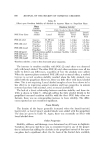
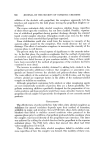
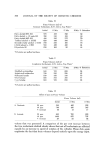
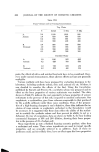
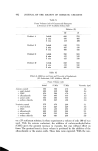
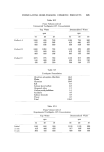
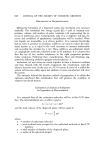
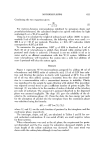
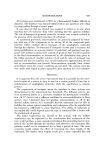
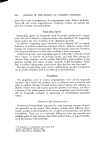
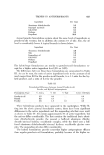
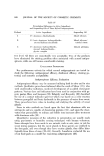
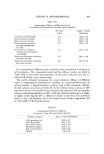
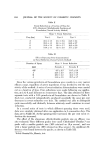
586 JOURNAL OF THE SOCIETY OF COSMETIC CHEMISTS Table IV Effect upon Emulsion Stability of Alcohols in Aqueous Phase cs. Propellant Phase Phase Emulsion Stability • Initially Containing Fatty Alcohol or Alcohol Blend Fatty Lauryl / Lauryl / Lauryl / POE Fatty Ester Alcohol Lamyl Myristyl Cetyl StearyI (1/9) (6/4) (8/9,) POE (2) eetyl Aqueous 30-60 min 4 days 4 days Propellant 16 hrs 4 days 4 days POE (10) eetyl Aqueous 1 min ]-5 min 1 min Pr')pellant 1-,5 min 24 hrs 24 hrs POE (10) stearyl Aqueous 1-5 min 1-5 rain 1-5 min Propellant 1-5 lnin 24 hrs 24 hrs POE (4) lauryl All formulations gelled in container. Stability 24 hrs POE (2,3) lauryl All less than i min POE (20) eetyl All less than i lnin POE (20) stearyl All less than i min •Emulsion stability = time to first observable phase separation. 4 days 4 days 1 min 24 hrs 1-5 min 24 hrs The increase in emulsion stability with POE (2) cetyl ether was observed only with lauryl alcohol. The other POE (2) cetyl ether emulsions were all too stable to detect any differences, regardless of how the alcohols were added. When the aqueous phase contained POE (10) cetyl or stearyl ether, a marked increase in aerosol emulsion stability resulted when the fatty alcohols were added with the propellant. However, there was little effect with lauryl alcohol alone. This is not surprising. Lauryl alcohol complexes have been shown to be less effective in improving aerosol emulsion and foam properties in anionic systems than those with myristyl, cetyl, or stearyl alcohols (6). The lack of a direct relationship between emulsion stability and foam sta- bility is shown in Table V. Although adding the fatty alcohol blends in the propellant increased emulsion stability with the three POE fatty ether sur- factants, there was no corresponding increase in foam stability. The differ- ences reported are not considered significant. Foa•n Densit,t! The density of the foams generally increased when the lauryl/myristyl, lauryl/cetyl, or ]auryl/stearyl alcohol blends were added with the propellant. The data are given in Table VI. Again, there was essentially no effect with lauryl alcohol alone. Other Properties' Stability, stiffness, and drainage were determined on all foams in duplicate. Variations did occur, but there was no consistent trend in any of the proper- ties to indicate that adding the alcohols in the propellant instead of the aque- ous phase had a significant effect. On th.e basis of the limited data available,
Purchased for the exclusive use of nofirst nolast (unknown)
From: SCC Media Library & Resource Center (library.scconline.org)