I. Soc. Cosmet. Chem., 25, 609-619 (November 1974) Microemulsions HENRI L. ROSANO, Ph.D.* Presented January 10, 1973, beltore the New York Chapter, ClOtton, N.J. Synopsis--Transparent emulsions are by definition called water-in-oil or oil-in-water MI- CROEMULSIONS. Where the average diameter of the dispersed droplets is less than one quarter of the wavelength of the incident light, no light scattering will occur and the system will be transparent. The PREPARATION of microemulsions and the FORMA- TION and STABILIZATION of such by phase diagram, NMR, and interfacial tension measurements are reviewed. A new theory of the formation of these microemulsions based on INTERFACIAL DIFFUSION of the surfactant or cosurfactant producing a tem- porary zero interfacial tension is presented. INTRODUCTION Microemulsions are transparent emulsions of high stability. Like macro- emulsions, additional amphiphatic components are needed to form these emulsions. Usually, two additives, a surfactant and a cosurfactant, are re- quired. Unlike macroemulsions, they are optically clear, the spherical droplet diameters of the dispersed phase being less than 1400 A. This is based on the fact that if the diameter of particles in a colloidal system is less than V4 of the wavelength of the incident light, the particles will not scatter light there- by resulting in a transparent system. The dispersed component can be an oil and the continuous phase water or an aqueous solution, in which case the system is described as an oil-in-water (O/W) microemulsion, or the oil and water can exchange roles, in which case one speaks of a water-in-oil (W/O) microemulsion. Since the term was first introduced by Hoar and Schulman (1), micro- emulsions have been studied by him and others using a wide variety of techniques. Numerous explanations of their stability have been offered (1- 10) but as yet no theory explaining their formation and stability has proved completely satisfactory. *Department of Chemistry, The City College of The City University of New York, New York, N.Y. 10031. 609

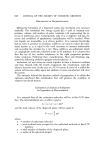
610 JOURNAL OF THE SOCIETY OF COSMETIC CHEMISTS PREPARATION OF MICROEMULSIONS During the formation of a dispersed system the interfacial area increases markedly. The interfacial free energy equals AGs = y•dA at constant tem- perature, volume, and number of moles constants (dA representing the in- crease in interfacial area). Consequently, only if y• is negative will AG8 de- crease and conditions .of spontaneous emulsification will be reached. When two liquids are immiscible, y, is always positive. It is common knowledge that in order to produce an emulsion, additives are used to reduce the inter- facial tension y•. y• is equal to the work necessary to increase isothermally and reversibly the interface by 1 cm 2. These additives are surfactants which are amphiphatic molecules adsorbed at the O/W interface. It is a known fact that the use of two surface substances in the right proportion produce better emulsions. Following these considerations, Hoar and Schulman sug- gested the following method to prepare microemulsions (1). Surfactant, oil, and water are mixed together to form a lactecent emulsion and then titrated with the fourth component, the cosurfactant, until the mixture becomes clear. In the case of a W/O system, if more oil is added the system will become milky again but addition of more cosurfactant will dear the system. The rationale behind this titration method of preparation is to obtain the optimum interfacial film combination that will produce the condition of negative interfacial tension. Calculation o[ Amount o[ Sur[actant in Preparation o[ Microemulsion It is assumed that all the surfactant molecules will be at the O/W inter- face. The total interfacial area A will be equal to A = n x o-= a x 4•rr 2 and the total volume of the dispersed phase will be equal to 4 V = a x ,• rrr • where n = number of surfactant molecules o' = cross-sectional area occupied by the surfactant molecule at the O/W interface a = total number of droplets of the dispersed phase r = radius of the spherical droplet
Purchased for the exclusive use of nofirst nolast (unknown)
From: SCC Media Library & Resource Center (library.scconline.org)