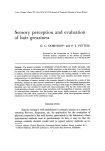
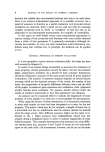
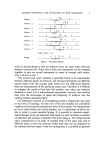
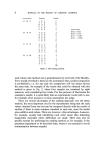
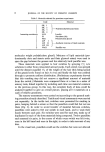
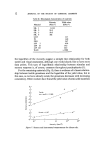
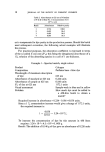
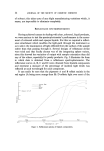
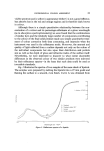
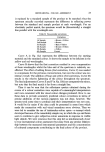
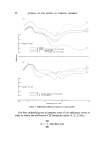
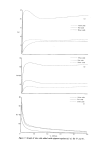
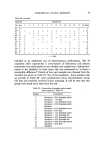
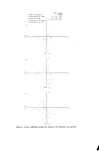
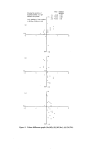
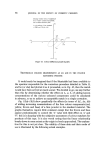
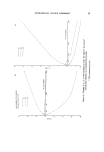
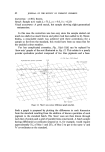
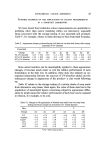
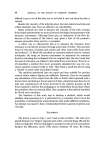
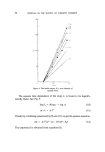
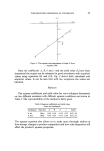
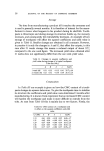
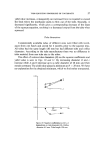
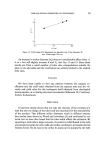
12 JOURNAL OF THE SOCIETY OF COSMETIC CHEMISTS Table II. Rheological characteristics of materials Viscosity Yield value Material (Nsm -a) (kNm -a) SIL 1 SIL 2 SIL 3 SIL 4 LAN PJ PEG LIP I LIP II LIP III WAX 0.114 25.5 50.5 302 1.13 1.40 3.47 6.39 14.6 34.5 ,--,7000 the logarithm of the viscosity suggest a straight line relationship for both tactile and visual assessment, although one would clearly like to have more data points. This type of logarithmic relationship between stimulus and sensory response is, of course, common throughout psychophysics (1). For the remaining materials (Fig. 8), there is evidence of a linear relation- ship between tactile greasiness and the logarithm of the yield value, but in this case, as we have already noted, the greasiness decreases with increasing consistency. Other workers have found the yield value of semi-solid materials 2 • I - Tactile corr. coef ft. I0-' I I0 I0 z 10 3 Viscosity (Nsrn -z) Figure 7. Sensory and instrumental measurements for silicone oils.

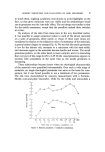
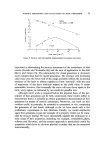
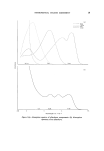
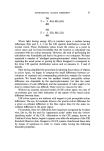
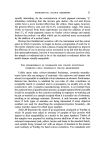
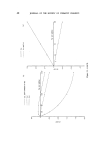
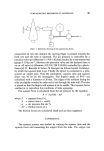
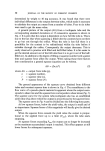
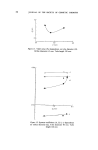
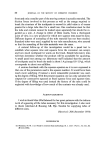
SENSORY PERCEPTION AND EVALUATION OF HAIR GREASINESS 13 o Tactile '0"0'- -- --. 0 corr. coefff. r= 0.98 Visual I I0 10 2 I0" I0 '• Yield value (kN m -2) Figure 8. Sensory and instrumental measurements for greases and waxes. important in determining the sensory assessment of the consistency of skin creams (Suzuki and Watanabe (6)) and the ease of application to the skin (Barry and Grace (7)). The relationship for visual greasiness is obviously more complex than that for tactile greasiness. The increase with increasing yield value over the lower half of the range probably reflects the increasing tendency of the hairs to adhere together to form 'rats-tails', with the ease of separation of the hairs inversely related to the yield value. It seems reasonable, however, that eventually the curve will turn down again in the hard, waxy region, as indicated by our result for paraffin wax. Although more work is required before the physical basis of the per- ception of hair greasiness can be fully understood, these results suffice to demonstrate that it is possible to obtain quantitative measurements of hair greasiness by means of sensory assessment. Moreover, our work on hair switches could, in principle, be extended to assessment in vivo, comparing the greasiness of real heads, although so far we have made only a few preliminary experiments in this direction. Finally, we would emphasize again that greasiness is just one example of a property which can be evalu- ated by sensory testing. We have successfully applied the technique to a wide range of hair properties, including, for example, combability, gloss, softness and 'fly-away', and the sensory approach is particularly useful for properties which have no obvious physical correlate that can be measured instrumentally.
Purchased for the exclusive use of nofirst nolast (unknown)
From: SCC Media Library & Resource Center (library.scconline.org)