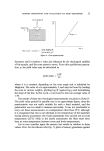
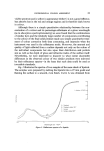
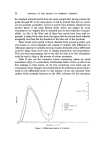
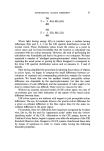
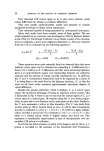
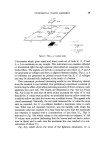
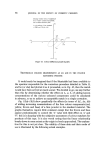
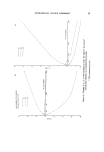
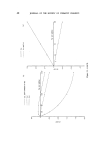
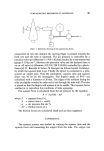
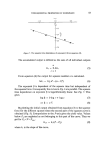
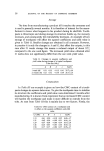
l0 JOURNAL OF THE SOCIETY OF COSMETIC CHEMISTS cone penetrometer was used to measure the yield value (i.e. the minimum stress below which the material ceases to flow). Both of these are standard techniques to be found in most rhealogical textbooks (e.g. Sherman (4)), and need be described only briefly here. The cone-and-plate viscometer (Fig. 5) consists essentially of a slightly conical disc rotating with its apex just touching a flat stationary plate. The fluid sample is contained in the gap between cone and plate, and the torque, Q Torque I G I Speed • D• I •'• Cone Sample..•• i Plate I I I Torque, G Dynamic viscosity, •'/ = Constant x (Speed of rotation,• ) Figure 5. Ferranti cone-and-plate viscometer. G, on the cone can be measured at any rotational speed, f•. It can be shown that the shear rate is constant throughout the sample and that the dynamic viscosity, q, is given by' KG where K is a constant depending only on the geometry of the cone. The plot of G versus f• was a straight line for the thinnest silicone oil, but became increasingly curved for the remaining three and in these cases the 'low shear' viscosity was calculated from the initial slope. The cone penetrometer (Fig. 6) is a standard instrument for characteriz- ing fats and greases, and the method used to obtain yield values from penetration measurements was that described by Haighton (5). In this instrument, a cone, of weight W, penetrates under gravity the flat surface of the sample in a cylindrical cup. As penetration proceeds, the shear stress

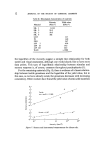
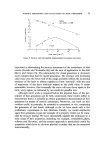
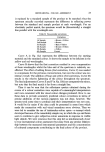
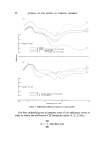
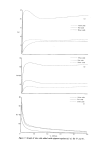
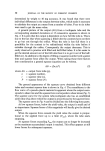
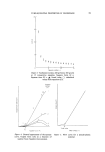
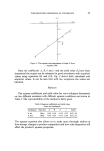
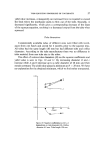
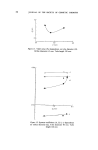
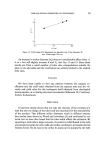
SENSORY PERCEPTION AND EVALUATION OF HAIR GREASINESS ll Cone weight, Penetrotion • log 14/ lope: Yield value =Consfont x Cone weight, 14/ (Penetrotion, oeigure 6. Cone penctromcter. log p decreases until it reaches a value just balanced by the rheological stability of the sample, and the cone ceases to move. From this equilibrium penetra- tion, p, the yield value may be calculated as yield value - kW where k is a constant depending on the cone angle and is tabulated by Haighton. The value of n is approximately 2, and may be found by loading the cone to various weights, plotting log W against log p and determining the slope of the line. In this work, n was found to have an average value of 1.79. The results of these two rheological measurements are given in Table II. The yield value quoted for paraffin wax is an approximate figure, since the penetrometer was not really suitable for such a hard material, and the penetration was too small to measure accurately. It was not practicable to carry out these measurements at a temperature other than 25øC, although it is recognized that this is not identical to the temperature of the materials during sensory assessment: the visual assessments were carried out at room temperature (22øC) while in the tactile assessments the films must have been at some temperature between room and body temperatures. Let us now consider again the sensory test results in relation to these values. First, for the silicone oils (Fig. 7), plots of sensory greasiness against
Purchased for the exclusive use of nofirst nolast (unknown)
From: SCC Media Library & Resource Center (library.scconline.org)