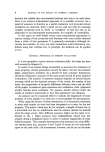
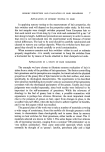
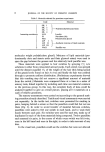
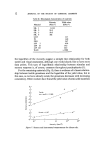
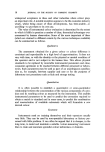
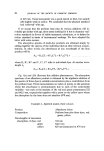
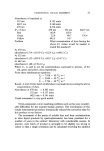
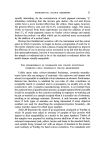
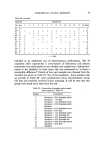
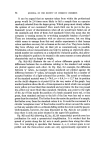
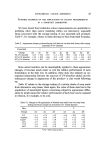
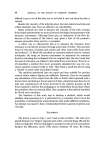
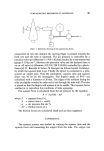
56 JOURNAL OF THE SOCIETY OF COSMETIC CHEMISTS Storage The time from manufacturing a product till it reaches the consumer and is used is generally several months. It is therefore of interest for the manu- facturer to know what happens to his product during its shelf-life. Tooth- paste is thixotropic and during storage its structure builds up, the viscosity increases, and consequently the extrudability decreases. An example of how storage of toothpaste will affect the squeeze coefficients and yield value is given in Table II. Smaller changes are obtained in all constants. However, in practice it is only the changes in A and P0 that affect the outputs, in this case after 21 weeks storage this means a reduced output of about 33}/0 compared to the one week figure. The increased yield value obtained after 21 weeks does not significantly differ from the one week yield value. Table II. Changes in squeeze coefficients and yield value during storage of a typical toothpaste. Tube size 160 g A B b c Po(N) 1 week old 0.31 0.35 -0.12 0.41 25.74-4.8 21weeks old 0.21 0.32 -0.10 0.39 26.3-4-2.6 Composition In Table II1 one example is given on how the CMC content of a tooth- paste changes its squeeze behaviour. To give the toothpaste time to stabilize its structure the coefficients and yield value were determined 3 months after manufacturing. It is known from experience that an increased CMC content will harden the toothpaste and make it more difficult to extrude from the tube. As seen from Table III this is mainly due to two factors. Firstly, the Table III. CMC content of a toothpaste and its effect on the squeeze coefficients and yield value % CMC ,4 B b c Po(N) 1.13 0.41 0.50 -0.10 0.32 16.04-1.7 1.21 0.42 0.54 -0.09 0.31 16.4+!.1 1.29 0.37 0.58 -0.08 0.34 19.14-2.8 1.46 0.25 0.53 -0.03 0.36 18.64-1.2 1.54 0.17 0.17 -0.06 0.37 22.94-1.7

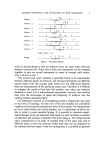
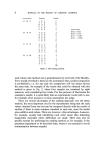
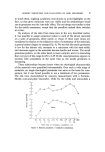
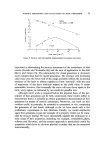
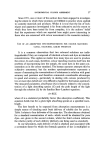
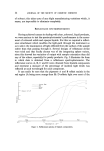
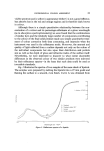
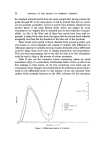
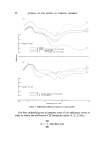
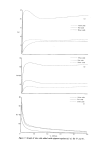
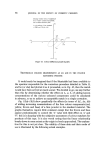
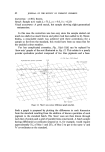
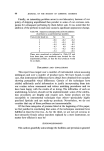
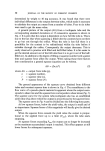
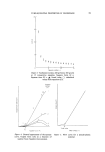
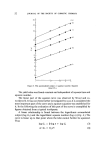
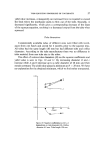
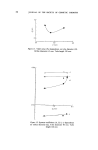
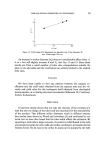
TUBE-SQUEEZING PROPERTIES OF TOOTHPASTE 57 yield value increases, consequently an increased force is required to exceed the limit where the toothpaste starts to flow out of the tube. Secondly, A decreased significantly, which gives a corresponding decrease of the slope of the squeeze equation, resulting in a decreased output from the tube when squeezed. Tube dimensions Commercially available tubes of different sizes were filled with tooth- paste from one batch and stored for 2 months prior to the squeeze tests. All tubes had the same length 120 mm but had different tube and orifice diameters. According to the tube manufacturer there was no difference in tube material from one tube size to the other. The effect of various tube diameters (D) on the squeeze coefficients and yield value is seen in Figs. 10 and ll. By increasing diameter B and c increase while A and b decrease up to a tube diameter of 28 mm and then remain constant. The yield value passed a minimum at D -- 28 mm. We have no explanation for the obtained minimum, which we find rather unexpected. 0'50 - 0'00 [] 3o 35 40 • •(mm) Figure 10. Squeeze coefficients (A, B, b, c) dependence on tube diameter (D). Orifice diameter 6.5 mm. Tube length 120 mm.
Purchased for the exclusive use of nofirst nolast (unknown)
From: SCC Media Library & Resource Center (library.scconline.org)