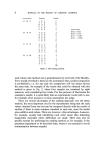
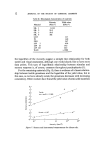
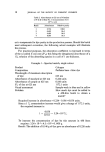
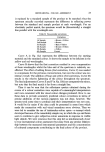
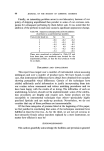
44 JOURNAL OF THE SOCIETY OF COSMETIC CHEMISTS Finally, an interesting problem arose in our laboratory because of our policy of shipping unperfumed face powder to some of our overseas com- panies for subsequent perfuming by them before sale. It was noted that the addition of the perfume in each case caused a significant appearance change. Table VII. Appearance changes produced by the addition of perfume to un-perfumed face powders Face powder shade no. AL Aa Ab 1 +0.6 +0.2 +0.2 2 -2.5 +0.4 0.0 3 -0.5 +0.2 -0.2 4 -0.7 0.0 +0.4 5 -1.1 +0.2 +0.4 6 -3.4 +1.1 +0.5 These were monitored as indicated in Table VII and from these data, new standards were devised for the unperfumed powders, so that the final products would be on shade. DISCUSSION AND CONCLUSIONS This report has ranged over a number of instrumental colour-assessing techniques and over a number of product types. We have found, in each case, that instrumental differences have always been obtained from samples showing perceptible visual differences. Certain of the techniques have yielded sufficiently useful information to justify incorporating them into our routine colour assessment and colour matching procedures and we have been happy with the results of so doing. The difficulties of such an undertaking, however, should not be underestimated: some of the calibra- tion procedures are lengthy and require care. Some products are less susceptible to instrumental techniques than others--particularly highly pearlized lipsticks and eye make-up products. Nevertheless, we do not consider that any of these problems are insurmountable. Of the three categories of promise listed at the beginning of this paper, we feel justified in concluding that some of the techniques examined have fulfilled at least the first two. As for the third, we are not yet anxious to have attractive female colour matchers replaced by a mere instrument, no matter how efficient it may be! ACKNOWLEDGMENTS The authors gratefully acknowledge the facilities and permission granted

INSTRUMENTAL COLOUR ASSESSMENT 45 to them by Yardley of London Limited for the preparation and publication of this paper. (Received: 17th January 1975) REFERENCES (1) Hunter, R. S. Photoelectric colour difference meter, J. Opt. Soc. Am. 48 985-995 (1958). (2) Fujwara, M., Kato, S., Yuasa, S., Morita, K. and Fujita, A. Colour control in make-up production. Cosmet. Perfirm. 88 49-54 (1973).
Purchased for the exclusive use of nofirst nolast (unknown)
From: SCC Media Library & Resource Center (library.scconline.org)