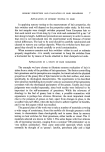
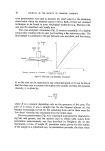
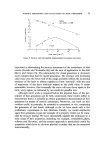
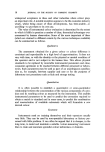
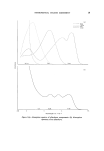
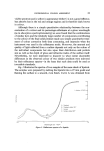
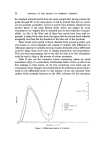
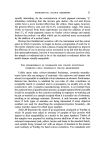
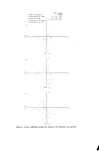
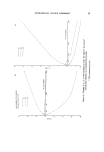
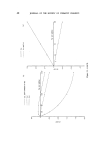
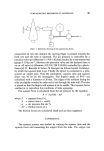
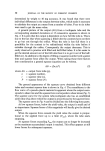
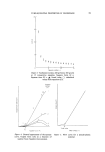
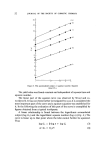
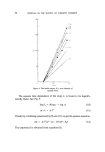
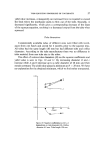
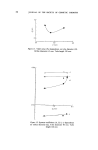
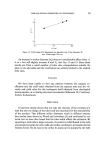
54 JOURNAL OF THE SOCIETY OF COSMETIC CHEMISTS 40- 3O • 2O ß 2.0 0.5 0-2 0 •o 50 ,oo Figure 8. The initial output, Gl,t, as a function of squeeze force. The squeeze time dependence of the slope k, is found to be logarith- mically linear. See Fig. 9. log k, = B.log t + log A (10) or k, = A.t B (11) Finally by combining equations (6), (9) and (11) we get the squeeze equation. AG = A.tB.{n•--(n--1)•}.(P--Po) (12) The exponent [3 is obtained from equation (8).

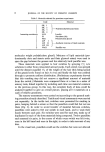
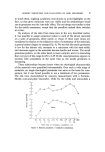
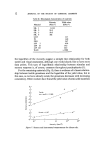
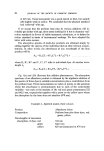
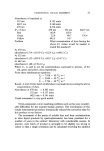
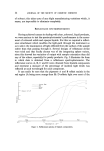
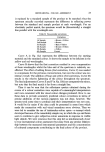
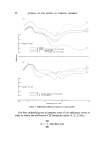
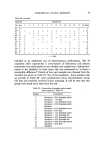
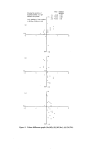
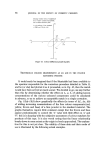
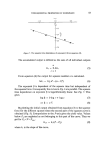
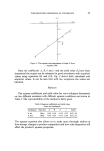
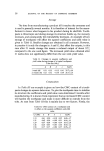
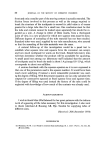
TUBE-SQUEEZING PROPERTIES OF TOOTHPASTE 55 Lo• ! -0'5 0'5 I i - -0'3 A• -O'5 -•*' Figure 9. The squeeze time dependence of slope k t from equation (10). Once the coefficients A, B, b and c and the yield value P0 have been determined the output can be estimated in good accordance with empirical values using equations (8) and (12). Fig. 3 shows both calculated and empirical values. It can be seen that with two exceptions the values are identical. RESULTS The squeeze coefficients and yield value for one toothpaste determined on two different occasions with different squeeze conditions are shown in Table I. The reproducibility of the method is fairly good. Table I. Squeeze coefficients and yield value from one toothpaste Toothpaste Tube size A B b c Po(N) A 1st 160 g 0.42 0.34 -0.12 0.37 18.7-•2.3 A 2nd 160 g 0.43 0.33 -0.13 0.39 19.3-•2.7 The squeeze equation also allows us to make more thorough studies on how storage, changes in product composition and how tube dimensions will affect the product's squeeze properties.
Purchased for the exclusive use of nofirst nolast (unknown)
From: SCC Media Library & Resource Center (library.scconline.org)